TL;DR
Deloitte interviews test whether you can select relevant evidence, explain your reasoning, and answer the question actually asked — and the process varies by vacancy, so confirm the country, practice, career level, and stage with your recruiter before building a prep plan. The nine questions above span behavioral, case, technical, and motivation territory, but the same discipline applies across all of them: name a decision, show your specific contribution, state the limitation, and never borrow a result you can’t defend. Case answers should clarify the objective and profit measure before structuring, and technical answers should explain the model before applying it rather than treating every arrangement as identical. Build reusable evidence cards instead of isolated scripts — each containing the question it answers, essential context, your decision, your actions, the verified outcome, and a limitation you’re ready to discuss — then run a seven-day drill ending with a timed rehearsal that includes an unexpected follow-up.
You've reached the final interview. Your qualifications match the role, you've researched the practice, and you can explain every line of your resume. Yet when the interviewer asks about a difficult project, your answer becomes a list of responsibilities rather than a clear account of a decision, an action, and a result.
That's the difference between knowing your experience and making it useful to an interviewer. The interview is a performance, not a checklist, but performance doesn't mean adopting an artificial corporate voice. It means selecting relevant evidence, explaining your reasoning, and answering the question asked.
Deloitte interview questions require that flexibility. Deloitte Australia's experienced-hire guidance describes behavioral questions alongside role-specific interviews, selected practical assessments, and potential senior-leader conversations, with the process varying by vacancy. Your preparation should therefore cover both what you've done and how you'd approach an unfamiliar problem.
Prepare the claim, recall the evidence, state your action, quantify the outcome when you can verify it, and anticipate the follow-up.
Build answers that can adapt to behavioral, case, finance, cybersecurity, product, engineering, and motivation questions. A debugging story might demonstrate analytical thinking, collaboration, or accountability, depending on which decision you emphasize.
The model responses below are illustrative wording, not documented candidate outcomes. Replace their details with your own verified experience, and never borrow a result you can't defend. Confirm the country, practice, career level, and interview stage with your recruiter, then match your preparation to the actual job description rather than treating any question list as a universal answer key.
What Are the Most Common Deloitte Interview Questions?
Deloitte’s process varies by vacancy. Deloitte Australia’s experienced-hire guidance describes behavioral questions alongside role-specific interviews, selected practical assessments, and potential senior-leader conversations — so your preparation has to cover both what you’ve done and how you’d approach an unfamiliar problem.
The nine questions that appear most consistently:
- Tell me about yourself / walk me through your resume — Present, past, future. Explain your direction, not your employment history.
- Why Deloitte? Why this practice? — Separate the work you want from the employer. Start with the vacancy, name a relevant practice detail, connect it to your evidence.
- A time you worked on a difficult team — Pick a disagreement with a real delivery consequence. Show how you preserved shared responsibility rather than taking everything over.
- Handling ambiguity or incomplete information — Name the decision, the missing information, and the cost of getting it wrong, then explain which uncertainty you investigated first and why.
- A time you disagreed with a manager or client — Check the evidence before challenging the decision, and be ready to explain what you’d have done if they hadn’t agreed.
- A time you used data to solve a problem — Start with the decision, not the tool. Separate findings from outcomes and name what the data couldn’t establish.
- A business case on declining profitability — Clarify the profit measure, period, and scope before announcing any framework. Deloitte’s U.S. guidance emphasizes clarifying the issue, articulating assumptions, summarizing findings, and recommending action.
- A technical prompt (e.g., revenue recognition under ASC 606) — Explain the model, apply it cautiously, and identify where contract terms or judgment change the conclusion.
- A mistake you made and what you learned — Ownership, correction, and a changed working method — not “I became more careful.”
The governing rule: prepare the claim, recall the evidence, state your action, quantify the outcome only when you can verify it, and anticipate the follow-up.
1. Tell Me About Yourself (Walk Me Through Your Resume)
A resume walkthrough should explain your direction, not reproduce your employment history. Use present–past–future: what you do now, which experience prepared you, and why this role makes sense next. The interviewer should understand your relevance without having to assemble it from disconnected duties.

A Model Opening With a Clear Direction
“I'm a finance analyst working on reconciliations and month-end reporting. My strongest experience has been investigating discrepancies, documenting their causes, and helping colleagues resolve them before reporting deadlines. Earlier audit experience showed me that I enjoy understanding the controls behind the numbers, which is why I'm interested in this Audit and Assurance role.”
This works because it connects current responsibilities to a credible motivation. It doesn't claim that performing reconciliations automatically qualifies someone for every audit task. Add a verified outcome if you have one, but explain your contribution rather than attaching an impressive number to a vague activity.
For more guidance on selecting relevant background, use this approach to answering the classic interview opener.
- Adapt the emphasis: Consulting candidates can lead with problem framing; engineers can lead with systems built or maintained; product candidates can connect user problems to decisions.
- Prepare the follow-up: Be ready to explain your personal contribution, why you're changing direction, and which part of the advertised work interests you.
- Practice without scripting: Use Qcard's resume-grounded talking points as memory cues, then record practice runs to check pacing and duplicated information.
Cut background that doesn't help explain the next step. Your answer needs a coherent thread, not a complete biography.
2. Why Deloitte? Why This Practice?
A convincing motivation answer distinguishes the work you want from the employer you're applying to. Reputation alone doesn't explain why you'd enjoy the actual responsibilities. Start with the vacancy, identify a relevant practice detail, and connect it to evidence from your experience.
Deloitte Switzerland's graduate recruitment guidance places motivation alongside role fit, competencies, and potential case assessment. That supports preparing a reasoned connection between your background and the work, rather than treating “Why Deloitte?” as an isolated statement of enthusiasm.
Make the Connection Specific
“I'm interested in this technology-risk role because my capstone project examined cybersecurity controls in a healthcare setting. I enjoyed translating technical weaknesses into practical recommendations for people responsible for operations. The responsibilities in this vacancy would let me develop that judgment further while contributing the research and communication skills I've already practiced.”
The answer works because the candidate explains an interest through experience. It doesn't promise exposure to particular clients, industries, or assignments that the vacancy hasn't confirmed.
Use the practice name shown in your local job posting. Don't assume that service-line labels or responsibilities are identical across countries.
- Work reason: Identify a task you want to perform, such as control assessment, financial analysis, or product discovery.
- Growth reason: Explain the judgment or capability you want to develop, without making the employer sound like a training service.
- Follow-up drill: Answer “Why this practice rather than an adjacent one?” and “Which responsibility would challenge you most?”
Use Qcard's AI mock interview practice to rehearse those follow-ups, not just the opening response. Close with a focused team question, such as how the team balances technical analysis with stakeholder communication. That invites useful detail without pretending you already know how the team operates.
3. Tell Me About a Time You Worked on a Difficult Team
Choose a disagreement with a real delivery consequence. A story about vaguely different personalities won't show much unless you explain what you changed. STAR, meaning situation, task, action, and result, keeps the context short and your intervention visible.

“In a university dashboard project, a teammate repeatedly missed our agreed checkpoints. I spoke with them privately and learned that our task allocation didn't fit their availability. I proposed smaller deliverables with explicit handoffs, took responsibility for a blocked data-cleaning task, and checked progress against the revised plan. We completed the submission, and I learned to address coordination problems before assuming someone wasn't committed.”
Show Cooperation Without Becoming the Rescuer
The useful evidence is the private conversation, revised allocation, and clearer handoffs. Taking over everything might solve an immediate problem, but it doesn't demonstrate a sustainable approach to teamwork. Explain how you preserved shared responsibility.
A consulting version can emphasize stakeholder alignment. A cybersecurity version might concern disagreement between security and operations, while an engineering version might involve incompatible assumptions about an interface.
Describe what the colleague did and how it affected delivery. Don't diagnose their personality or speculate about their motives.
Likely follow-ups include whether the revised plan was fair, what you would have done if the teammate still missed deadlines, and how other team members reacted. Practice answering those questions without becoming defensive.
Use Qcard's memory cues to retain the situation, your intervention, and the outcome rather than a memorized speech. International candidates can use academic or community examples, provided they explain the setting clearly. Workplace status matters less than a specific account of listening, judgment, and action.
4. Describe a Time You Handled Ambiguity or Incomplete Information
“I found that physical inventory records didn't match the reporting system. Rather than changing entries immediately, I listed plausible causes and checked items with the greatest financial exposure first. I traced a discrepancy to the receiving process, documented what I could verify, and flagged the remaining uncertainty before recommending a correction.”
That illustrative answer shows progress without pretending the candidate knew everything. The important distinction is between an assumption used to investigate and a fact used to justify action.
Explain Why You Investigated That Unknown First
A strong response names the decision, the missing information, and the cost of getting it wrong. Then it explains which uncertainty you investigated first and why. “I asked more questions” is incomplete unless those questions changed the analysis.
Deloitte New Zealand's interview guidance describes case assessments involving situation analysis, numerical interpretation, and potentially interactive discussion. Practice making your reasoning understandable while the information is still incomplete.
- Consulting adaptation: Separate the client's stated request from the business objective you need to clarify.
- Cybersecurity adaptation: Prioritize uncertainty using potential impact, exposure, and the reversibility of the proposed response.
- Product or engineering adaptation: Distinguish requirements that block a decision from details you can test through a prototype or experiment.
Follow-up questions might challenge your initial priority or introduce evidence that contradicts your hypothesis. Respond by explaining what you'd update, not by defending the original assumption at all costs.
Use Qcard's interview preparation guide to organize practice around decision points. When rehearsing, ask a partner to withhold a relevant fact, then reveal it after your initial recommendation. Your task is to revise the answer transparently.
5. Tell Me About a Time You Disagreed With a Manager or Client
Disagreement answers need both judgment and restraint. You're showing that you can raise a concern without turning a professional discussion into a contest. Frame the issue around a shared objective, such as reliable reporting, safe delivery, or a defensible client recommendation.
A Model Answer Grounded in Evidence
“During a finance internship, I questioned whether late invoices should be excluded from an accrual. I checked the supporting documents against our policy and brought the calculation to my supervisor privately. I explained the discrepancy and asked whether we should reassess the treatment. After reviewing the evidence, we updated the accrual, and I documented the basis for the change.”
The answer works because the candidate checks the evidence before challenging the decision. It also distinguishes raising a concern from claiming authority they didn't have.
An answer in which the manager agrees can sound tidy. Prepare to explain what you'd have done if they hadn't, including the difference between a reasonable commercial disagreement and an unresolved ethical, control, or compliance concern.
- Finance adaptation: Explain the relevant policy, accounting judgment, or reporting consequence.
- Cybersecurity adaptation: Discuss residual risk and compensating controls rather than insisting that every risk must be eliminated.
- Product and engineering adaptation: Show how you compared delivery speed with user impact, maintainability, or reliability.
Likely follow-ups include why you chose that communication channel, whether you considered alternative interpretations, and when escalation would have been appropriate. Don't imply that accepting a senior person's decision automatically resolves a serious concern.
Rehearse with Qcard's Interview Coach to check whether your delivery stays measured. Replace charged language such as “They ignored the facts” with a specific description of the competing interpretation. Respectful disagreement can still be direct.
6. Describe a Time You Used Data to Solve a Problem
The strongest analytical story begins with a decision, not a software package. Excel, SQL, or Python matters when you explain what you investigated, how you checked the data, and why the findings supported a recommendation.

“Refund requests were increasing, so I investigated whether the pattern related to products, delivery routes, or processing errors. I cleaned inconsistent reason codes in Excel and compared refund patterns with shipment volumes. The analysis identified a concentration worth investigating with operations, so I recommended reviewing the delivery process before changing product policy.”
Separate Findings From Outcomes
This model avoids claiming that correlation proved causation. It also stops at the recommendation rather than inventing a later performance improvement. If your real project produced a measurable result, explain the baseline, measurement period, and other changes that could have influenced it.
Deloitte's UK professional-careers guidance lists role-dependent assessments that can include technical questions, finance and Excel tests, coding tests, and case studies. Match the depth of your explanation to the assessment you've been told to expect.
- Analysis: Explain how you handled missing values, duplicates, inconsistent categories, or an unsuitable comparison.
- Decision: State what the team did differently because of your work.
- Limitation: Identify what the data couldn't establish and what further evidence you needed.
For product roles, discuss metric definitions and user segments. Cybersecurity candidates can explain alert quality and investigation priorities; engineers can connect logs or performance measurements to a debugging decision.
Prepare follow-ups about sample selection, alternative explanations, and validation. Use Qcard's question bank to rehearse a second analytical example so you're not dependent on a single story.
7. Walk Me Through a Business Case About Declining Profitability
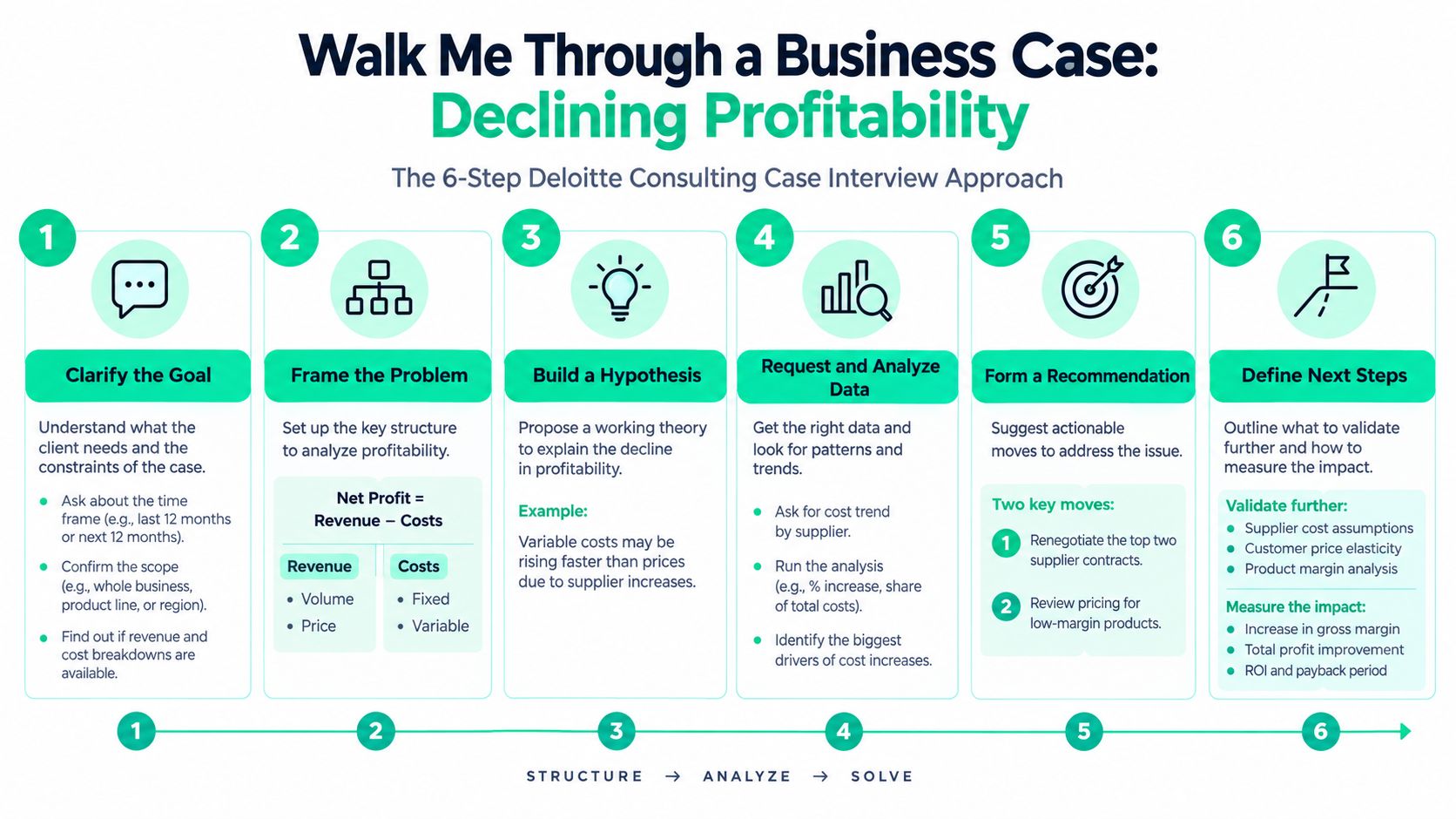
Don't announce a profitability framework before clarifying what “profit” means in the scenario. Ask about the objective, time period, business scope, and available financial breakdown. Then explain how your structure will help identify the cause.
Deloitte's U.S. case and scenario guidance emphasizes clarifying the issue, articulating assumptions, summarizing findings, and recommending action. The candidate's reasoning matters, not just the final answer.
Structure Before Calculating
“I'd first confirm the profitability measure and the period of decline. I'd separate revenue changes from cost changes, then examine price, volume, product mix, and relevant cost categories. Supplier increases are a possible hypothesis, but I'd compare their contribution with other drivers before recommending action.”
Use profit equals revenue minus costs as a starting relationship, while checking which profit measure the interviewer means. Don't confuse an operating-profit analysis with net profit if financing costs and taxes matter.
- Analyze: Request evidence that distinguishes competing explanations rather than collecting every available number.
- Recommend: If supplier costs are the main driver, compare renegotiation, alternative sourcing, and selective pricing changes.
- Implement: Explain ownership, risks, expected impact, and how the client would monitor progress.
The trade-off is specificity versus premature certainty. A conditional recommendation is useful when you state what evidence would confirm it; a confident guess isn't.
Deloitte's published case-preparation advice also addresses incomplete data, calculations, recommendations, and expected results. In Qcard mock practice, introduce a changed assumption after your analysis and rehearse updating the recommendation rather than restarting mechanically.
8. Explain Revenue Recognition Under ASC 606
Technical answers need more than an accurate recital. Explain the accounting model, apply it cautiously, and identify where contract terms or professional judgment affect the conclusion. Don't treat every software arrangement as identical.
Explain the Model, Then Apply It
“Under ASC 606, I'd identify the contract, identify the performance obligations, determine the transaction price, allocate that price to the obligations, and recognize revenue when or as each obligation is satisfied. For a software license bundled with support, I'd first assess whether the promises are distinct and examine the contract terms. I'd then consider the allocation and whether each obligation is satisfied at a point in time or over time.”
ASC 606 is the U.S. GAAP revenue-recognition standard, with IFRS 15 serving as its international counterpart. For an interview, demonstrate the sequence without suggesting that the standards or every application judgment are interchangeable.
The model answer works because it avoids automatically recognizing every license on delivery or assuming support always follows the same pattern. A simplified example can illustrate the approach, but the accounting conclusion depends on the arrangement.
- Judgment drill: Explain what additional information you'd need about variable consideration, distinct obligations, contract changes, or standalone selling prices.
- Audit adaptation: Connect the conclusion to evidence, timing, supporting documentation, and relevant controls.
- International adaptation: State which reporting framework applies before discussing the treatment.
A useful follow-up is: “What would change if the license and support weren't distinct?” Another is: “What evidence would you inspect before accepting management's conclusion?”
Use Qcard's technical question bank to practice a whiteboard explanation and a plain-English version. Before the interview, verify technical wording against current authoritative accounting guidance rather than relying solely on a remembered model response.
9. Describe a Mistake You Made and What You Learned
A credible mistake answer includes ownership, correction, and a change in working method. Avoid disguised strengths such as caring too much about quality. Choose a real error you can discuss without exposing confidential information or minimizing its consequences.
“In a class analysis, I used an incorrect currency conversion input, which affected the margin calculation. I identified the problem during review, told the team which conclusions needed checking, and rebuilt the affected table using a verified input. I then added source and date notes to my calculation sheet and introduced a separate check for inputs that drive the final recommendation.”
Show the Change, Not Just the Apology
The useful lesson isn't “I became more careful.” It's the source documentation and independent check. Explain whether that new method changed how you approached subsequent work, using only outcomes you can substantiate.
Own the error precisely. Don't take credit for discovering it if someone else found it, and don't hide your responsibility behind “we.”
For engineering, discuss a defect, its impact, and the regression test or review improvement that followed. Cybersecurity candidates might describe an incorrect prioritization decision and the revised validation process. Product candidates can explain a weak assumption and how they changed discovery or measurement.
Prepare for questions about who was affected, how quickly you communicated, and why existing checks failed. If the error reached a stakeholder, explain the correction process rather than rewriting the story as a near miss.
Use Qcard's practice interview questions to rehearse accountability follow-ups. Keep the answer concise enough that repeated apologies don't displace the evidence. A calm explanation of corrective action is more useful than trying to prove you felt sufficiently bad.
Build an Interview Evidence System
Prepare reusable evidence, not isolated scripts. Create a story bank covering conflict, ambiguity, professional skepticism, data-driven decisions, mistakes, and motivation. Each evidence card should contain the question it can answer, essential context, your decision, your actions, the verified outcome, and a limitation you're ready to discuss.
Create a separate case bank for issue trees, hypothesis testing, prioritization, and recommendations. Add a technical bank matched to the vacancy rather than collecting unrelated questions. For any confidential work, remove identifying details without changing the substance of your contribution.
Match Practice to the Assessment
Deloitte Australia's graduate-process information describes formats that can include digital interviews, job simulations, group cases, and presentations. Deloitte UK's early-careers assessment guidance distinguishes workplace-scenario exercises from numerical and verbal reasoning. A polished behavioral story won't substitute for practicing the format you'll face.
- Consulting and finance: Rehearse stakeholder framing and commercial recommendations, or connect technical standards to audit implications and supporting evidence.
- Cybersecurity and product: Explain risk-based priorities and control trade-offs, or clarify user needs, metrics, competing options, and outcomes.
- Engineering: Practice system design, debugging, testing, performance, and collaboration while retaining the business impact.
Where relevant, include whiteboard explanations, SQL or Python drills, and system-design follow-ups. Ask about assumptions, scalability, security, observability, and failure modes. For legal career switchers seeking profession-specific support, you can also find legal career coaching.
Practice Accessibly and Authentically
International candidates should translate jargon into direct English, explain unfamiliar acronyms, and choose culturally neutral descriptions of projects. Do not strip away meaningful context just to sound more corporate. Neurodivergent candidates can use written evidence cards, predictable STAR triggers, explicit transition phrases, and quiet timed rehearsals.
Deloitte-related neurodiversity guidance for recruiters discusses possible adjustments including advance topics and additional thinking time. Requirements vary by country, so ask your recruiter about the available process. A neutral request might be: “I perform best with a brief pause to organize my response. Could we discuss whether additional thinking time is available?”
Fluency isn't the same as competence. Memory cues should help you retrieve genuine evidence, not supply invented achievements. Use live assistance only where the employer permits it, especially during assessed technical work.
Finish With a Seven-Day Drill
- Day one: Build the story bank and verify every claim.
- Days two and three: Rehearse technical prompts and cases, including assumptions and recommendations.
- Days four and five: Conduct adaptive mock interviews with challenging follow-ups.
- Day six: Review practice transcripts for unsupported claims, unclear ownership, and rambling.
- Day seven: Complete a timed rehearsal that deliberately includes an unexpected follow-up.
Finish by tightening weak evidence, not polishing every sentence. You're ready when you can answer a changed question and explain the reasoning behind your response.
Key Takeaways
- Prepare evidence that flexes, not scripts that break — one debugging story can demonstrate analytical thinking, collaboration, or accountability depending on which decision you emphasize, which is why an evidence card (question it answers, context, decision, actions, verified outcome, limitation) outperforms a memorized response.
- Case answers lose points by framing before clarifying — announcing a profitability framework before confirming which profit measure, which period, and which business scope is the most common failure, while Deloitte’s own guidance emphasizes clarifying the issue, articulating assumptions, summarizing findings, and recommending action in that order.
- Separate findings from outcomes in every analytical story — a model that identifies a concentration worth investigating and stops at the recommendation is more credible than one claiming a later performance improvement, and if you do cite a measurable result, be ready to explain the baseline, measurement period, and other changes that could have influenced it.
- Technical answers need the model plus the judgment boundary — reciting the five-step ASC 606 sequence isn’t enough without identifying where contract terms determine the conclusion, and expect follow-ups like “What would change if the license and support weren’t distinct?” or “What evidence would you inspect before accepting management’s conclusion?”
- Mistake answers are won by the changed method, not the apology — “I added source and date notes and introduced a separate check for inputs that drive the final recommendation” is evidence; “I became more careful” is not, and you should own the error precisely rather than hiding responsibility behind “we” or taking credit for a discovery someone else made.
Qcard offers resume-grounded memory cues, AI-scored practice, and mock interviews with follow-ups to help you prepare for Deloitte interview questions without memorizing scripts. Visit Qcard to build your evidence bank, rehearse a role-specific interview, and review your pacing and answer length before the conversation.
Ready to ace your next interview?
Qcard's AI interview copilot helps you prepare with personalized practice and real-time support.
Try Qcard Free