Decision Making Under Uncertainty: A Practical Guide
TL;DR
Decision making under uncertainty means separating what you know from what you're assuming, choosing an action, and naming what would change your mind. First identify whether you're facing risk (probabilities are estimable) or ambiguity (they aren't) — Knight's 1921 distinction still explains why many strategic decisions resist stable odds. Then pick one model rather than narrating all of them: expected value for repeatable choices, expected utility when consequences are uneven, minimax when the downside is hard to reverse, Bayesian updating to show how evidence would revise your view, and value of information to decide whether research justifies delay. Run a five-step sequence — restate the decision, separate knowns from unknowns, sketch the downside, select one model, then decide with a falsifiable trigger and a review checkpoint. Watch for anchoring, availability bias, confirmation bias, and the planning fallacy, all of which intensify under time pressure; NIH research notes that anxiety increases avoidance of ambiguous options by making negative outcomes feel more likely and costly.
You're halfway through an interview answer when the interviewer asks for a metric you know you've seen before. The number won't come. Your thoughts speed up, the blank space feels dangerous, and you're tempted to guess rather than admit uncertainty. The problem isn't only memory. You're making a decision with incomplete information while someone evaluates your judgment in real time.
That same pressure appears when you're asked whether to launch a product before the data is conclusive, prioritize one customer segment over another, or explain how you'd respond to a sudden business risk. Decision making under uncertainty isn't an abstract management skill. It's the ability to separate what you know from what you're assuming, choose a sensible action, and explain what would change your mind.
What Is Decision Making Under Uncertainty?
Decision making under uncertainty is the ability to separate what you know from what you're assuming, choose a sensible action anyway, and explain what would change your mind. The goal isn't eliminating uncertainty — it's keeping uncertainty from turning into panic, bluffing, or an answer with no decision logic.
Start by identifying which kind you're facing. Frank Knight's 1921 framework distinguishes risk, where probabilities are known or estimable, from true uncertainty, where probabilities can't be reliably determined. If an interviewer gives you a market size and conversion rate and asks for revenue, the inputs are imperfect but the structure is familiar — that's risk. If they ask whether to pivot toward an emerging segment with little historical data, more research won't produce a trustworthy probability distribution — that's ambiguity.
Then match the model to the situation:
- Expected value — repeatable choices with comparable outcomes and usable probabilities
- Expected utility — when outcomes affect customers, safety, reputation, or strategy unevenly
- Minimax — one-shot or safety-sensitive decisions where you choose the option with the least damaging worst case
- Bayesian updating — when you want to show how your view will evolve as evidence arrives
- Value of information — when deciding whether additional research justifies the delay
Run this five-step sequence in roughly 60 to 90 seconds:
- Restate the decision — "You're asking whether we should scale the feature now or run a limited test first."
- Separate knowns from unknowns — name the facts, then the missing pieces, so assumptions don't get smuggled into your conclusion.
- Sketch probabilities and downside — use rough, honest language rather than false precision.
- Select one primary model — name the lens that fits and explain why; don't narrate every framework you know.
- Decide, define the failure trigger, and set the checkpoint — "I'd run a limited pilot. If activation stays weak or support volume rises materially, I'd stop and revisit."
The practical rule: when a fact is missing, don't replace it with confidence. Replace it with a visible assumption and a way to test it.
What It Feels Like to Decide Without Knowing
The interviewer asks, “What was the conversion rate after the redesign?”
You remember the project, the research, and the decision to simplify the onboarding flow. You can recall that the result was positive, but the exact metric sits just out of reach. Your mind searches through related numbers, finds several possibilities, and begins treating each one as plausible. Meanwhile, the silence grows.
That moment creates three competing impulses. You might bluff with a precise figure, retreat into a vague answer, or rush forward and explain the decision without addressing the missing evidence. None of these responses demonstrates clear judgment. They show that uncertainty has taken control of the answer.
A better response starts by naming the boundary of your knowledge: “I don't want to invent the exact percentage, but the direction was positive. I can explain the baseline, the decision, and how we measured the result.” You've preserved credibility while giving yourself a structure to work with.
The same pressure appears at work
Interview uncertainty resembles the decisions you'll face in the role itself. A product manager may need to prioritize a customer request before usage data is complete. A consultant may need to recommend a market entry strategy without a reliable historical comparison. A team lead may need to choose between a fast workaround and a slower fix when both carry costs.
Frank Knight's distinction helps explain why these situations feel different. In his 1921 framework, risk involves known probabilities, while true uncertainty involves situations where probabilities can't be reliably determined. That distinction remains influential because many strategic decisions don't offer stable odds, even when the decision maker has access to substantial information. Knight's framework and its influence on decision theory explain why people rely on scenarios, heuristics, and choices when the future can't be assigned dependable probabilities.
Practical rule: When a fact is missing, don't replace it with confidence. Replace it with a visible assumption and a way to test it.
Your aim isn't to eliminate uncertainty. It's to keep uncertainty from turning into panic, bluffing, or an answer with no decision logic.
Risk and Ambiguity The Two Flavors of Uncertainty
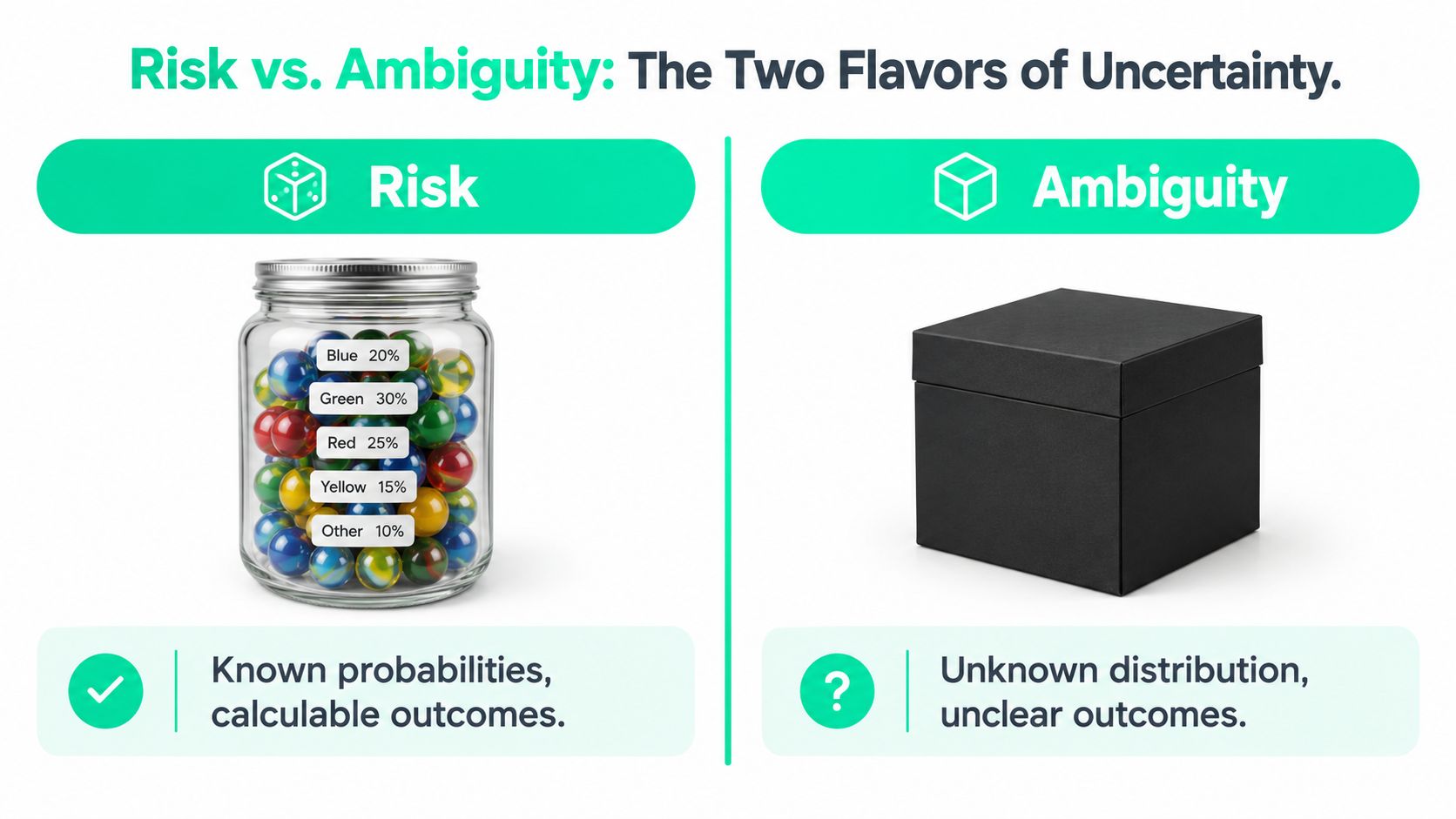
Not every uncertain decision needs the same response. The first question is whether you're facing risk, where probabilities are known or estimable, or ambiguity, where the possible outcomes or their probabilities are unclear.
Suppose an interviewer gives you a market size, a conversion rate, and a price, then asks you to estimate revenue. The inputs may be imperfect, but the structure is familiar. You can make assumptions, calculate scenarios, and show how the result changes when an assumption moves.
Now suppose the interviewer asks whether a company should pivot toward an emerging customer segment with little historical data. You may not know how large the segment will become, how competitors will respond, or whether the company has the capabilities to serve it. That's ambiguity. More research might help, but research alone won't create a trustworthy probability distribution.
Match the lens to the situation
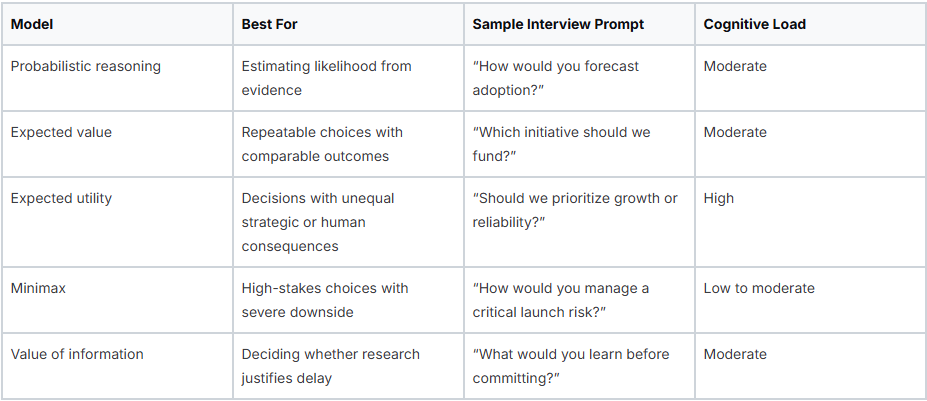
For risky decisions, expected value is useful. You estimate each outcome, assign a probability, and compare the weighted results. In an interview, you might say, “If the pilot has a reasonable chance of producing a meaningful improvement and the cost of testing is limited, I'd run it before scaling.”
Expected utility adds preferences and consequences. Two choices can have similar expected outcomes but very different effects on customers, safety, reputation, or your organization's strategic position. Utility makes those values explicit rather than pretending every outcome has the same importance.
Minimax takes a more defensive view. You choose the option whose worst plausible outcome is least damaging. That can fit a one-shot decision, a safety-sensitive launch, or a situation where recovery would be difficult.
Bayesian updating treats a belief as provisional. You begin with a prior view, gather evidence, and revise it. In an interview, you might explain that an early customer pilot would update your view of demand before you commit major resources.
These models aren't rivals. Expected value suits repeatable choices with usable probabilities. Expected utility reflects what the outcomes mean. Minimax protects against severe downside. Bayesian updating helps you show how your decision will evolve as evidence arrives.
Core Models That Help You Choose Anyway
Strong candidates don't need to recite decision theory. They need to select a model quickly and make the reasoning visible. The following lenses help you decide what to emphasize.
Probabilistic reasoning
Start with the evidence available. Ask what has happened in comparable situations, which assumptions come from direct observation, and which ones are guesses. You don't need false precision. A range or directional judgment can be more credible than a fabricated exact figure.
For a prompt such as “Should we expand this feature to every user?”, you could separate evidence about current usage, likely operational cost, and potential harm if the feature performs poorly. Then explain which unknown would carry the most weight.
Expected value and expected utility
Expected value compares outcomes by weighting them with their likelihood. Expected utility goes further by accounting for the organization's priorities and the uneven cost of failure.
A feature that might generate growth but create serious trust problems shouldn't be evaluated only through average financial return. Your answer should show that you understand the organization may value reliability, user safety, or strategic learning differently from short-term gain.
Minimax and information value
Minimax earns its place when the downside is difficult to reverse. If a decision could expose customers to serious harm, damage a critical relationship, or consume scarce resources, start by asking how you'd limit the worst plausible result.
Value of information asks whether additional research is worth the delay. If one more interview with users could determine whether the problem is real, the information may justify waiting. If the decision is reversible and the test is cheap, acting and learning may be better than extending analysis.
The cognitive load differs across these models. A candidate who tries to calculate every lens aloud may produce a slower, less coherent answer. A simple structure, such as the VoiceType guide to logic, can help you practice identifying assumptions, evidence, and conclusions before you need to perform under pressure.
Decision cue: Choose the simplest model that exposes the tradeoff the interviewer is testing.
Biases and Heuristics That Shape Your Decisions
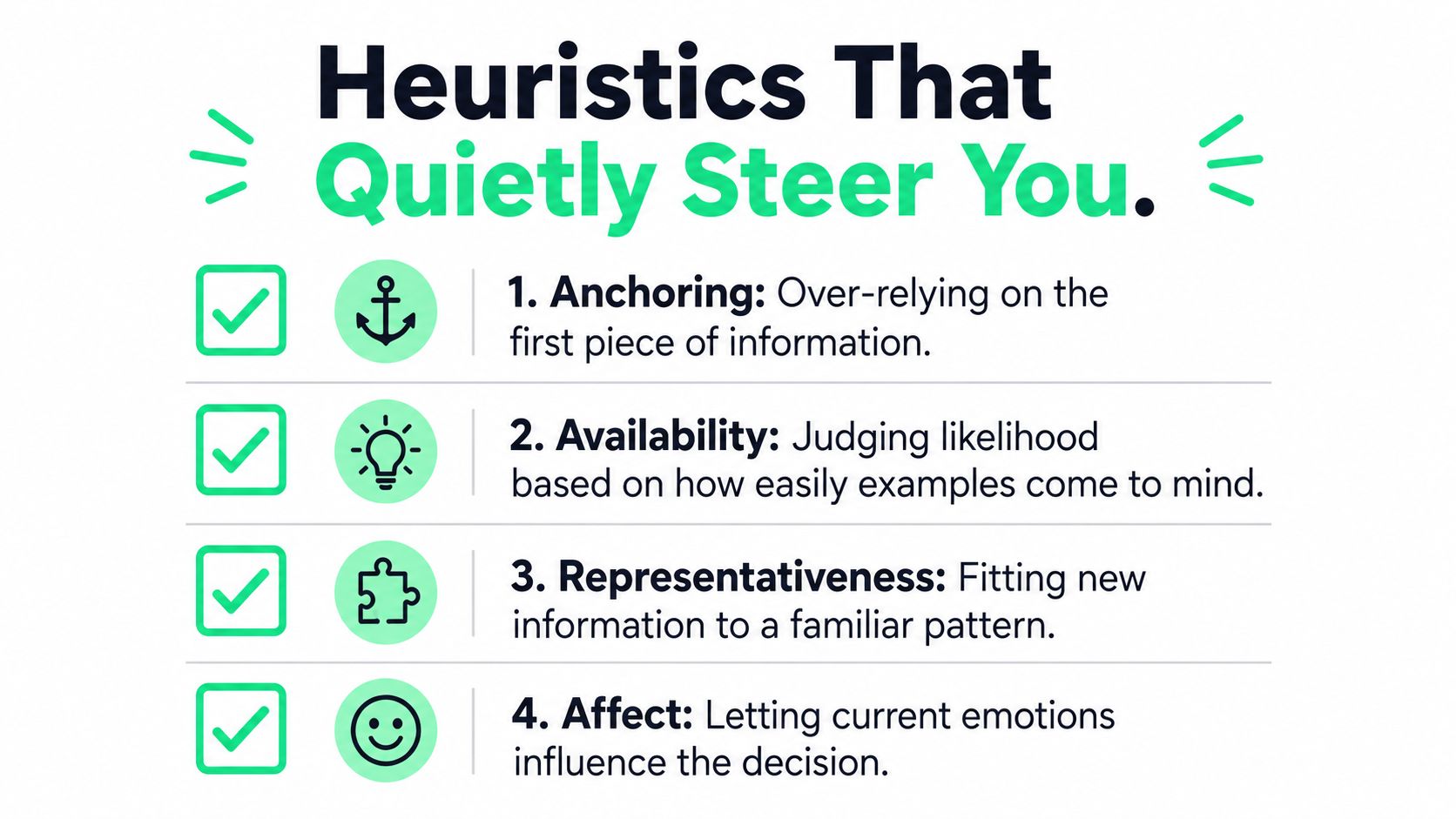
Under interview pressure, your mind may replace a difficult question with an easier one. Instead of examining the evidence for a recommendation, you may reach for the option that feels familiar. That shortcut saves time, yet it can reduce answer quality when the missing information matters.
Anchoring gives the first number or proposal too much influence. If an interviewer mentions a large potential market before asking how you would evaluate it, you may treat that figure as a credible starting point without checking its basis. Ask, “What evidence supports this figure?”
Availability bias makes vivid examples seem more probable. A dramatic product failure might make you reject a modest, reversible experiment. A famous growth story might make rapid expansion seem likely while hiding the unusual conditions behind it. Qcard can help by surfacing a prepared prompt that reminds you to ask what evidence is representative.
Confirmation bias directs attention toward information that supports your first conclusion. If you decide quickly that a product should launch, operational risks may receive less scrutiny. Deliberately ask, “What evidence would change my recommendation?” That question slows the answer slightly and improves its quality.
Planning fallacy leaves unnamed work outside an optimistic timeline. In an interview, a candidate may promise a quick launch while overlooking dependencies, quality checks, training, or stakeholder review. Name the hidden tasks before committing. A real-time recall tool such as Qcard can reduce ambiguity by prompting those checks while you are answering.
Anxiety changes the perceived choice
Risk and ambiguity can produce different reactions. A NIH review of decision making under uncertainty reports that people are generally risk averse when probabilities are available, while anxiety can increase avoidance of ambiguous options by directing attention toward possible losses and making negative outcomes feel more likely and costly.
In an interview, anxiety may make a balanced experiment sound reckless. Use a cue such as, “Am I avoiding this option because the downside is large, or because the outcome is hard to predict?” The question separates speed pressure from actual risk.
For an introduction to fast judgments, heuristics, and cognitive bias, Thinking Fast and Slow on smry offers a concise companion resource. You do not need to eliminate every bias. You need a brief pause, supported by a clear cue or Qcard prompt, that makes the hidden assumption visible.
A Step by Step Framework for Ambiguous Decisions
A reliable answer needs a sequence you can run while the interviewer is waiting. Use this five-step process as a mental outline for a response that takes roughly 60 to 90 seconds.
Start by restating the decision
Say what you believe you're being asked to choose. “You're asking whether we should scale the feature now or run a limited test first.” This gives the interviewer a chance to correct your interpretation and shows that you're solving the actual decision rather than reacting to keywords.
Separate knowns from unknowns
Name the facts you have, then identify the missing pieces. Known information might include the target user, current performance, available resources, and the cost of delay. Unknowns might include adoption, implementation risk, or a competitor's response.
Making uncertainty explicit reduces the chance that you'll smuggle assumptions into your conclusion.
Sketch probabilities and downside
Use rough language when exact probabilities aren't justified. You can say that adoption appears plausible but unproven, or that the downside is limited because the test is reversible. If the interviewer gives you enough information, describe a few plausible outcomes rather than presenting one forecast as fact.
The point isn't mathematical decoration. It's to show how your recommendation changes when the assumptions change.
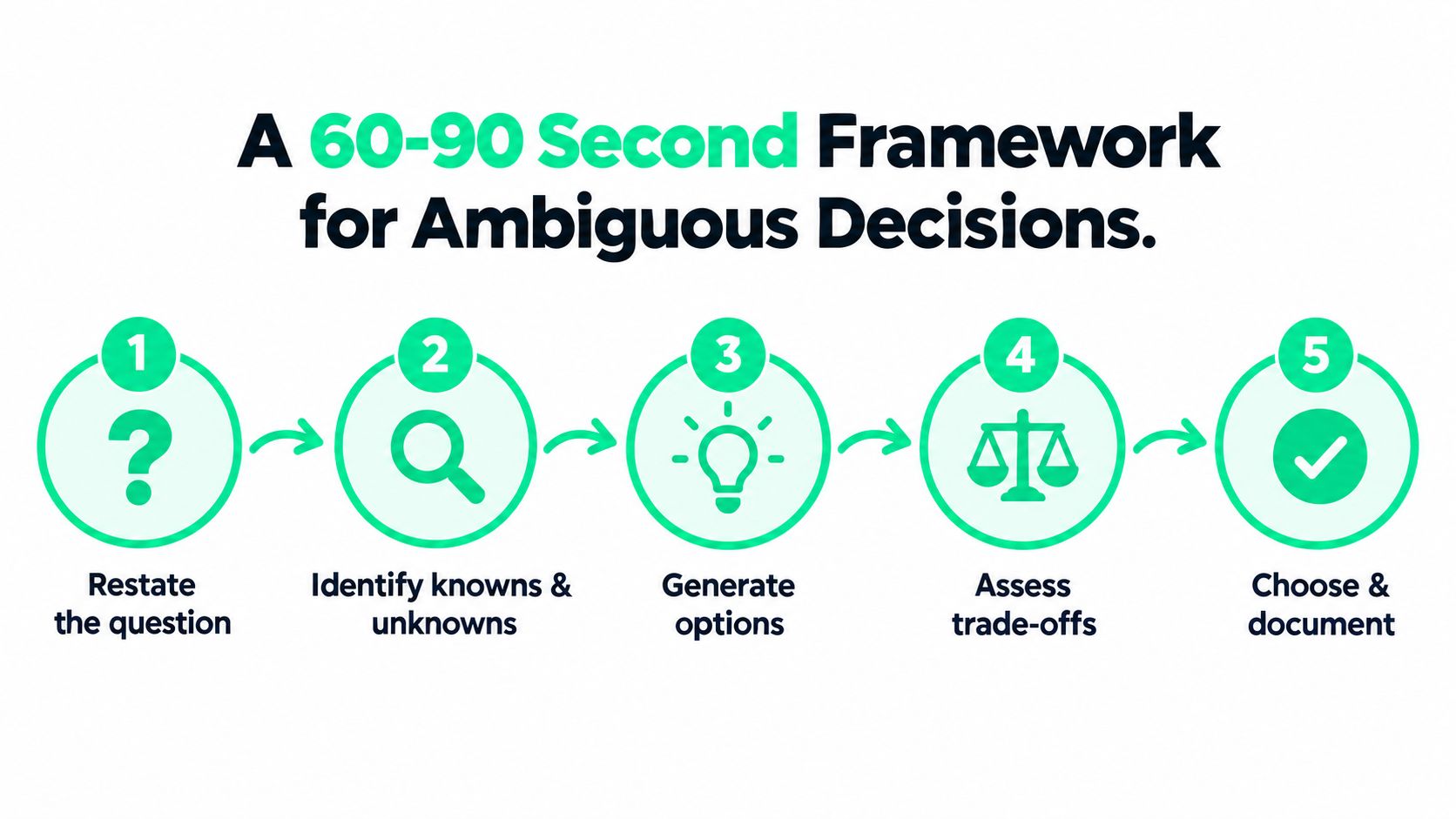
Select one primary model
Choose expected value for a repeatable decision with measurable outcomes. Choose minimax when a severe downside dominates. Choose expected utility when the tradeoff affects customers, reputation, or strategic priorities in different ways.
Don't narrate every framework you know. Name the lens that best fits and explain why.
Decide, define the failure trigger, and set the checkpoint
End with a recommendation. Then state what would prove it wrong and when you'd review the decision. For example: “I'd run a limited pilot first. If activation remains weak after the initial test or support volume rises materially, I'd stop and revisit the design. If the signal is positive, I'd expand in stages.”
This structure gives the interviewer a decision, a safeguard, and a learning plan. It also prevents the common mistake of treating uncertainty as a reason to wait indefinitely.
A structured answer can be cautious without sounding indecisive.
Real Interview Questions and Sample Answers
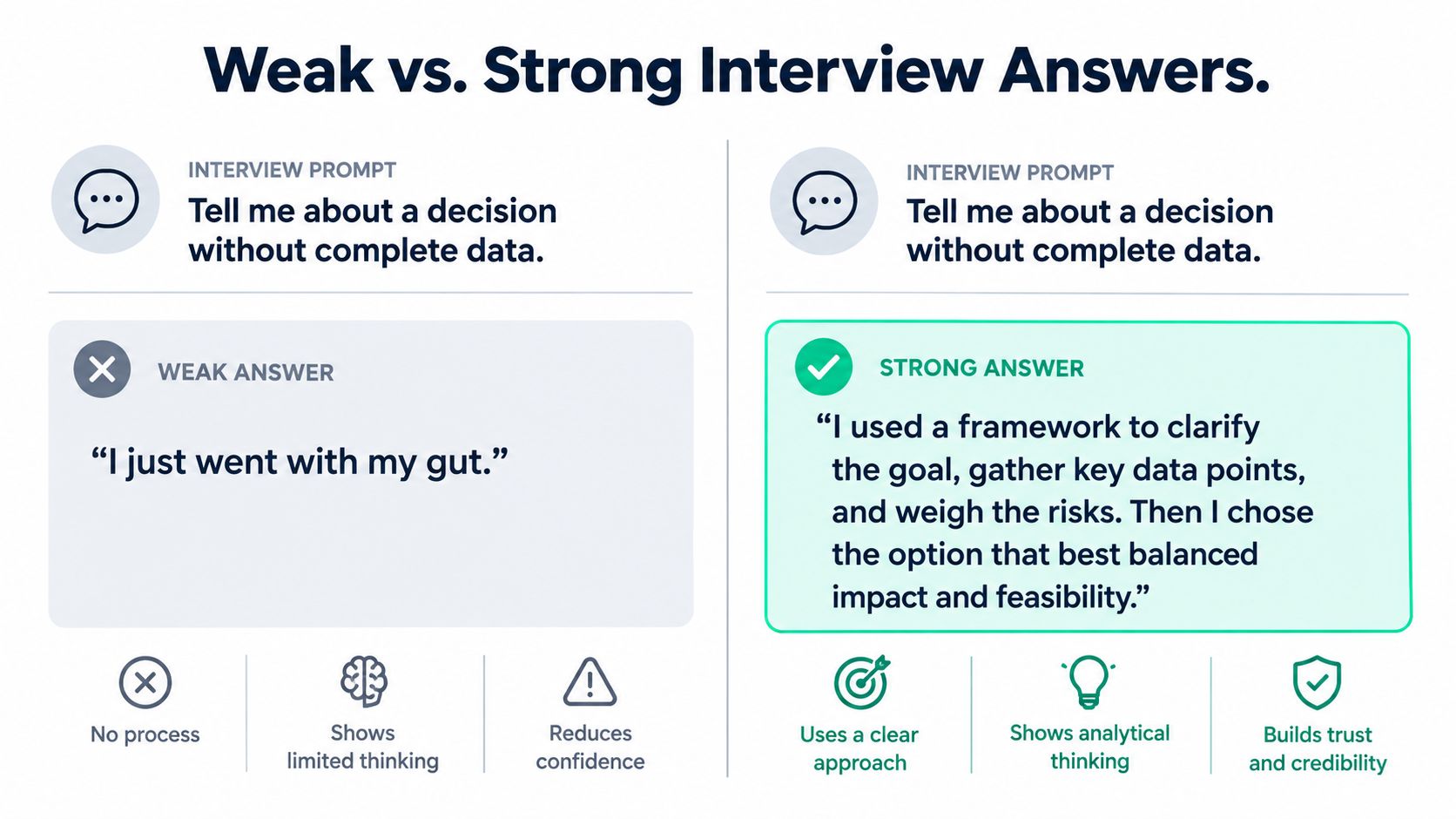
Theory becomes useful when it changes the words you say. Consider the prompt, “Tell me about a time you made a decision without complete information.”
A weak answer might be: “I didn't have all the data, so I trusted my gut and moved ahead. It worked out.”
The response jumps to action, provides no decision criteria, and offers no way to judge whether the choice was sensible. It also makes success sound accidental.
A stronger answer could sound like this:
“Our team had to choose whether to invest in improving onboarding or focus on a separate customer request. We knew onboarding complaints were recurring, but we didn't yet have a complete view of their effect on retention. I reviewed the available support themes, spoke with representative users, and compared the effort and reversibility of both options. I recommended a focused onboarding test because it addressed a repeated problem while limiting the cost of being wrong. I'd have changed course if the test failed to improve the chosen user behavior or created new support issues, and I scheduled a review after the initial measurement period.”
The strong version restates the decision, distinguishes knowns from unknowns, explains the evidence, selects a reversible action, and names a falsifiable trigger. It doesn't pretend the candidate possessed perfect information.
Estimation needs decomposition
Now consider, “How would you estimate the number of self-driving cars in San Francisco?”
A weak answer gives a single number immediately. That approach hides the assumptions and makes correction difficult.
A stronger answer begins: “I'd estimate this by defining the population, identifying the households or users able to access the technology, and applying an adoption assumption. I'd clarify whether we mean privately owned vehicles, commercial vehicles, or vehicles operating in the city.”
The candidate can then explain the knowns and unknowns, build a rough probability or adoption range, and recombine the parts. The conclusion should remain conditional: “My estimate depends most on the definition of self-driving and the adoption assumption. I'd test those assumptions first because they could change the result more than small changes in the population estimate.”
For additional drills, Qcard's practice interview questions can help you rehearse prompts where the interviewer evaluates structure, assumptions, and tradeoffs rather than one perfect answer.
Practicing With Real Time Recall Tools Like Qcard
Uncertainty doesn't only come from the problem. It also comes from trying to retrieve your own experience under pressure. A candidate may understand a project clearly but lose access to the metric, sequence, or lesson needed to explain it. Research on graphically displayed uncertainty found that limited working memory didn't significantly reduce basic information extraction, but it did reduce the ability to choose the optimal behavior from that information, especially when the display and task required more deliberation. The experiment on working memory and uncertainty information supports a practical interview lesson: reading information and acting well on it are different tasks.
Reduce the memory search
A cue card can hold the small prompts that tell a larger story.
- Metric anchor: The result you can state accurately.
- Decision context: The problem and constraint.
- Uncertainty cue: What you didn't know at the time.
- Model prompt: The tradeoff or framework you used.
- Follow-up probe: The question an interviewer might ask next.
This doesn't replace preparation. It reduces the simultaneous memory demands involved in recalling facts, organizing a narrative, monitoring your tone, and responding to a new question.
Qcard can surface resume-grounded talking points, prior metrics, role-specific frameworks, and likely follow-up prompts in real time. Its purpose is to bring forth knowledge you've already learned, not create a new accomplishment or encourage you to invent a number. Used carefully, that support leaves more attention for structure, presence, and honest qualification.
A recent review of deep-uncertainty decisions analyzed 37 infrastructure case studies and found that methods designed for a wide range of uncertain futures often overlooked the organizational and individual contexts where decisions occur. The structured review of decision making under deep uncertainty makes the same point relevant to interviews: a framework works better when it fits the person, setting, and decision, rather than operating as a purely technical formula.
You can explore Qcard's interview copilot as one way to practice retrieving structured, verified experience while answering under time pressure. The tool should support your reasoning, not substitute for it.
Your Week One Practice Plan
Choose three past projects. For each one, create a cue card containing the hard metric you can verify, the ambiguity you faced, the decision you made, the framework or model you applied, and the result. Rehearse each story aloud until you can deliver the core answer within 90 seconds, then practice adding detail only when the interviewer asks.
Spend five minutes each day applying the five-step framework to a recent decision. Restate the question, list knowns and unknowns, sketch the downside, choose a model, and define what would change your mind. During the weekend, create two additional cards, one comparing risk with ambiguity and one showing how Bayesian updating would change your view after new evidence.
The aim isn't perfect certainty. Each rehearsed story reduces the amount of searching your brain has to do under pressure, which gives you more room to think and speak naturally. For a broader preparation routine, use Qcard's interview prep guide and turn one real decision from this week into your first practice card.
Key Takeaways
- The first move is diagnosing the type of uncertainty, not reaching for a framework — risk with estimable probabilities calls for expected value and scenario work, while genuine ambiguity calls for reversible tests, downside limits, and explicit assumptions, and confusing the two produces either false precision or unnecessary paralysis.
- Naming the boundary of your knowledge preserves credibility better than bluffing — "I don't want to invent the exact percentage, but the direction was positive, and I can explain the baseline, the decision, and how we measured it" keeps you in control of the answer, while a fabricated figure or a vague retreat both signal that uncertainty is running the conversation.
- A decision isn't complete without a falsifiable trigger and a checkpoint — ending with "I'd run a limited pilot first; if activation remains weak or support volume rises materially, I'd stop and revisit the design" gives the listener a decision, a safeguard, and a learning plan, and prevents the common failure of treating uncertainty as a reason to wait indefinitely.
- Four biases reliably distort judgment under pressure, and each has a counter-question — anchoring ("what evidence supports this figure?"), availability bias ("is this example representative?"), confirmation bias ("what evidence would change my recommendation?"), and the planning fallacy ("what work is hidden outside this timeline?") — and a brief pause to surface the hidden assumption matters more than eliminating bias entirely.
- Retrieval failure is its own source of uncertainty, and cue cards reduce it — research on graphically displayed uncertainty found limited working memory didn't impair basic information extraction but did reduce the ability to choose optimal behavior from that information, which is why a card holding a metric anchor, decision context, uncertainty cue, model prompt, and likely follow-up leaves more attention available for structure and honest qualification.
Qcard offers resume-grounded memory cues, adaptive practice, and real-time interview support for candidates who need to explain decisions clearly without relying on scripts. Visit Qcard before your next interview, build cards from your verified experience, and rehearse the moments where uncertainty usually makes you lose your structure.
Ready to ace your next interview?
Qcard's AI interview copilot helps you prepare with personalized practice and real-time support.
Try Qcard Free