Case Interview Prep That Actually Builds Real Skills
TL;DR
Case interview prep works when it trains judgment under pressure, not framework memorization. Plan for roughly 60 to 80 hours, and prioritize review quality over case count, since 15 reviewed cases can beat 50 rushed ones. Use a four-week plan: diagnose your single weakest skill in week one, build foundations with focused daily drills in week two, and pressure-test with three timed mocks per week in weeks three and four. Weight your prep toward profitability (35–40% of cases) and market entry (20–25%). Replace named frameworks with custom issue trees built in the first 90 seconds, because a study of 379 candidates found 71.2% weak on MECE quality and 75.4% weak on quantitative analysis. Run short daily drills for math, cold-start structuring, exhibit interpretation, and a four-part synthesis. Score mocks on four categories (structure, quantitative work, exhibits, synthesis), retrain the weakest one, then retest. For neurodivergent and anxious candidates, use short timed blocks, a standardized opening routine, and one-line memory cues instead of scripts.
You've probably had this moment already. You open a practice case, read the prompt, and your brain goes oddly blank. You know what profitability means. You've seen market entry frameworks. You've done hard things before. But when someone says, “Take a minute and walk me through your approach,” your thoughts stop arriving in order.
That freeze doesn't mean you're bad at case interviews. It usually means your prep has focused on remembering frameworks instead of performing under pressure. Good case interview prep trains a different skill set: building a clear structure from incomplete information, speaking calmly while you think, and turning messy inputs into a recommendation that sounds human.
That matters even more if you're early in your career, switching industries, interviewing in a second language, or managing anxiety, ADHD, autism, or another neurodivergent profile. The fix isn't “do more cases.” The fix is to practice the right things in the right order.
How Do You Prepare for a Case Interview?
Effective case interview prep trains performance under pressure, not framework recall. Interviewers are scoring whether you can build a clear structure from incomplete information, speak calmly while you think, and turn messy inputs into a recommendation. That's why "do more cases" rarely works. One guide estimates 60 to 80 hours of prep for most candidates, and another argues 15 reviewed cases can beat 50 rushed ones.
Follow a four-week plan:
Week 1: Diagnose. Run two messy mock cases early (one profitability or market entry). Score yourself on structure, math, exhibits, brainstorming, and synthesis. Then write down one weakest skill only.
Week 2: Build foundations. Limit live cases. Run daily blocks for structuring an issue tree out loud, mental math (percentage changes, weighted averages, break-even), a one-to-two-minute synthesis, and reviewing your recording.
Weeks 3 and 4: Pressure-test. Aim for three timed live cases per week, solo drills on non-mock days, one deep review after every mock, and one rest half-day.
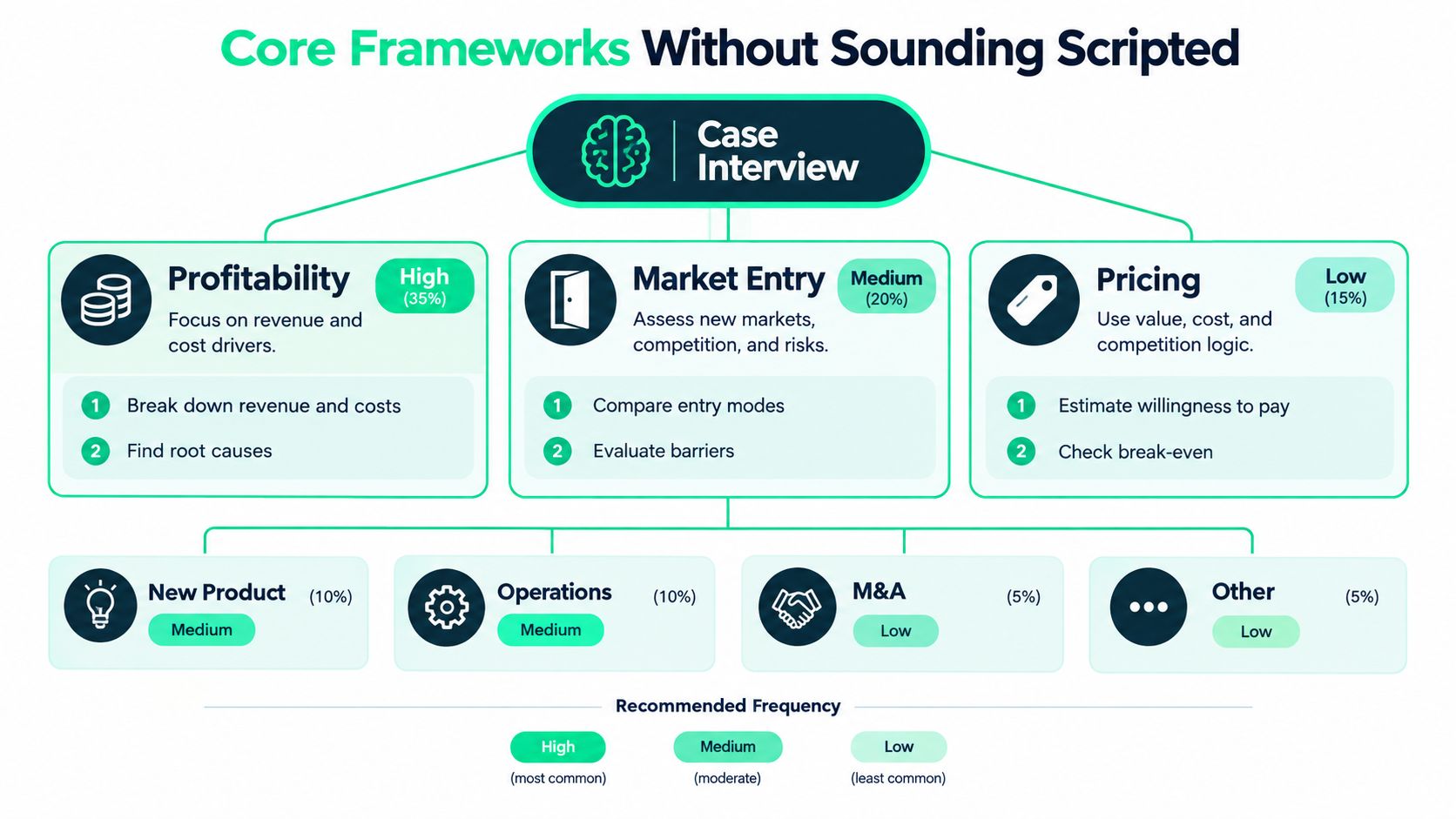
Prioritize the right case types. Profitability accounts for roughly 35–40% of cases and Market Entry 20–25%, followed by M&A and Growth Strategy at 10–15% each and Pricing around 10%. Spend the largest share of prep on the first two.
Build custom issue trees, don't announce frameworks. In the first 90 seconds, restate the problem, confirm the objective, and name three branches specific to the prompt: "I'd like to examine revenue, costs, and any business mix changes that may explain the drop." Then narrow based on data. This matters because in one study of 379 candidates, only 2 produced a framework rated above adequate, while 71.2% were weak on MECE quality and 75.4% weak on quantitative analysis.
Finish with a real recommendation, not a recap: recommendation, three reasons, one risk, one next step, all in under two minutes.
Why Case Interviews Feel Hard and What They Really Test
Your first hard case often feels unfair because it punishes two instincts that served you well in school. First, waiting until you've “figured it out” before speaking. Second, trying to give the perfect answer instead of a workable one.

What interviewers are actually listening for
Case interviews test whether you can stay organized while the information is incomplete. A practical method is to restate the prompt, confirm the objective, and build a custom structure instead of forcing a memorized framework, which aligns with Dartmouth's case interview guidelines.
A strong opening in the first 90 seconds sounds like this:
“Let me make sure I have the problem right. Our client's profits are down, and the goal is to identify the root cause and recommend actions to improve them. I'd like to look at this in three parts: revenue drivers, cost drivers, and any external changes that might explain the shift. Then I'll prioritize the branch that seems most likely to matter.”
That answer isn't flashy. It's useful. It tells the interviewer you heard the question, you know the objective, and you can create order quickly.
Why anxiety makes this format feel harsher
Interview stress is widespread, not rare. One source reported that 93% of people experience anxiety related to job interviews, and a Harris Interactive survey of employed U.S. adults found that 92% were stressed by at least one aspect of the interview process. The same source also notes a pooled anxiety prevalence of 34.8% across 39,668 graduate students in 50 studies, with 19.1% mild, 15.1% moderate, and 10.3% severe anxiety, according to these interview preparation statistics.
That matters because case interviews reward calm recall under time pressure. If your working memory drops when you're stressed, framework memorization won't save you. You need routines that reduce cognitive load.
A widely cited U.S. interview-preparation survey found that 70% of respondents practice their answers out loud and 62% prepare anecdotes ahead of time. The same survey reported that 63% change their eating habits before interviews, with more than half eating healthier or lighter than usual on interview day, according to this interview prep survey summary. Candidates already know, intuitively, that live performance improves when the routine is familiar.
What good prep sounds like in real time
Candidates often think the winning move is “show business knowledge.” Usually it's simpler.
- Good opening: “I want to clarify the success metric before I structure this.”
- Good pivot: “Based on that data, my initial hypothesis looks less likely, so I'd shift to the cost branch.”
- Good synthesis: “My recommendation is to focus on one primary lever first, because that's where the evidence is strongest.”
Practical rule: The interviewer is not scoring whether you remembered a famous framework name. They're scoring whether your thinking is structured, adaptable, and easy to follow.
Your Calendarized Case Interview Prep Plan
Vague prep creates vague results. “Do more cases” sounds productive, but it leads candidates to accumulate exposure without fixing weaknesses. Better case interview prep starts with diagnosis, then drills, then mocks.
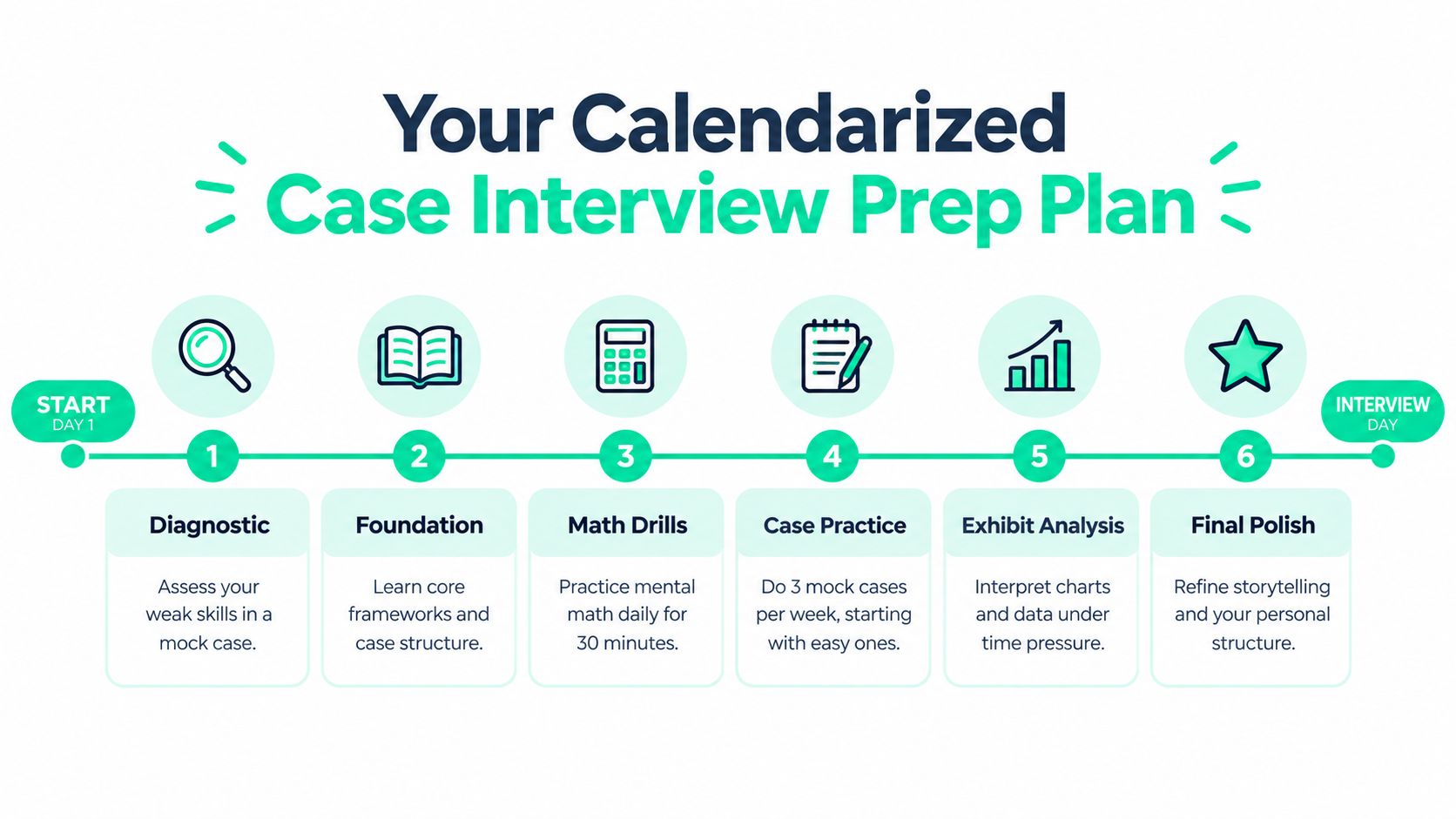
Independent prep guidance has become much more specific about volume and sequencing. One guide estimates 60 to 80 hours for most candidates, and another argues that 15 reviewed cases can beat 50 rushed ones. The same body of guidance emphasizes diagnostic practice, targeted drills, and feedback loops over generic case volume, as outlined in this case interview prep guide.
If you want one planning principle, use this: review quality beats case count.
A four-week version that works
Week 1 for diagnosis and baseline
Run two mock cases early, even if they're messy. One should be profitability or market entry. The other can be any common format.
Use them to answer five questions:
- Structure: Do you build a clean issue tree, or do you ramble?
- Math: Do you calculate accurately under time pressure?
- Exhibits: Do you read charts slowly or miss the punchline?
- Brainstorming: Do your ideas come in organized buckets?
- Synthesis: Can you land the plane in under two minutes?
Write down one weakest skill only. Don't pick three. Your first week is for finding the bottleneck.
If you want a reference point for building the rest of your schedule, this interview prep guide from Qcard includes a structured planning approach you can adapt to case work.
Week 2 for foundations and repetition
Learn the core case types and practice structuring from scratch. Keep live cases limited. This is the week to slow down enough to get mechanics right.
A solid weekday rhythm looks like this:
- One structuring block: Take a prompt and build an issue tree out loud.
- One math block: Mental math, percentage changes, weighted averages, break-even logic.
- One synthesis block: Summarize a recommendation in one to two minutes.
- One review block: Listen back to your recording and mark where your logic drifted.
Weeks 3 and 4 for pressure-testing
Start doing full timed mocks. Add exhibit-heavy cases and cases that force trade-offs, not just root-cause analysis.
A practical target during this phase:
- Three live cases per week
- Solo drills on non-mock days
- One deep review session after every mock
- One rest half-day each week
If you only have two weeks, compress the plan and keep the diagnosis step. If you have six weeks, don't spread the same effort thinner. Add more review cycles and more time on your weakest skill.
How to adapt this for different candidate profiles
Neurodivergent candidates usually benefit from more visible structure and fewer marathon sessions. I'd rather see four focused blocks than one long session that ends in overload.
Try these adjustments:
- For ADHD: use short timers, verbal checkpoints, and one-skill sessions.
- For autistic candidates: standardize your opening routine and note layout so the live case feels familiar.
- For anxious candidates: begin every session with a one-minute reset and an opening script you've practiced out loud.
- For international students: spend extra time on concise transitions, not just vocabulary.
The point of a calendar isn't discipline for its own sake. It's reducing decision fatigue so your effort goes into reasoning, not into figuring out what to practice next.
Core Frameworks Without Sounding Scripted
Frameworks help when they give you starting logic. They hurt when they become a script. The fastest way to sound junior in a case is to announce a framework and then force the prompt to fit it.
Start with the case types that actually matter
One framework guide lists seven major categories: Profitability, Market Sizing, M&A, Market Entry, Pricing, Operations, and Capacity, and recommends starting profitability cases with revenue-versus-cost splits, then isolating price, volume, fixed costs, and variable costs in this consulting framework overview.
Another source gives a practical prioritization rule: Profitability accounts for 35–40% of cases, Market Entry 20–25%, M&A 10–15%, Growth Strategy 10–15%, Pricing about 10%, and Market Sizing is often embedded rather than standalone, according to this case framework frequency breakdown.
That means most candidates should spend the largest share of prep on profitability and market entry. Not because other types don't matter, but because those two teach the broadest reusable skills.
Turn a prompt into a custom issue tree
A neutral case-interview guide recommends identifying the client's core question, choosing the closest starting logic, and converting it into a case-specific issue tree within the first 90 seconds. It also recommends practicing the “rule of three,” where you state three areas of focus out loud, as described in this framework guide.
Here's what that sounds like.
Example one for a profit decline case
Prompt: profits fell.
Don't say, “I'll use the profitability framework.”
Say this instead:
- Restate the problem: “Our client's profits are down and wants to know why.”
- Confirm the objective: “Should I focus on diagnosis only, or also on potential actions?”
- State your branches: “I'd like to examine revenue, costs, and any business mix changes that may explain the drop.”
Then go narrower. If revenue is flat and costs are up, split costs into fixed and variable. If revenue is down, split into price and volume.
A framework is useful when it helps you ask the next question. It becomes dead weight when you recite it instead of using it.
Example two for a market entry case
Prompt: should a client enter a new market?
A crisp opening is:
- Market attractiveness
- Right to win
- Execution risks
Then ask for data. Don't drown the interviewer in every strategy concept you know.
What most candidates still get wrong
The biggest gap in case interview prep isn't framework knowledge. It's real reasoning quality. Recent guidance notes that candidates often over-index on templates while firms care more about hypothesis-driven thinking, creativity, synthesis, and communication. One large candidate study reported that only 2 of 379 candidates produced a framework rated above adequate, while 71.2% were weak or very weak on MECE quality and 75.4% were weak or very weak on quantitative analysis, according to this analysis of candidate performance gaps.
That's why “Which framework should I memorize?” is usually the wrong question.
A better question is: how do I stop sounding scripted while keeping my thinking organized?
Daily Drills for Math Structuring and Storytelling
Improving faster usually comes from short drills rather than another full case. Full cases are valuable, but they're noisy. Drills let you isolate one skill and repeat it enough times to build fluency.
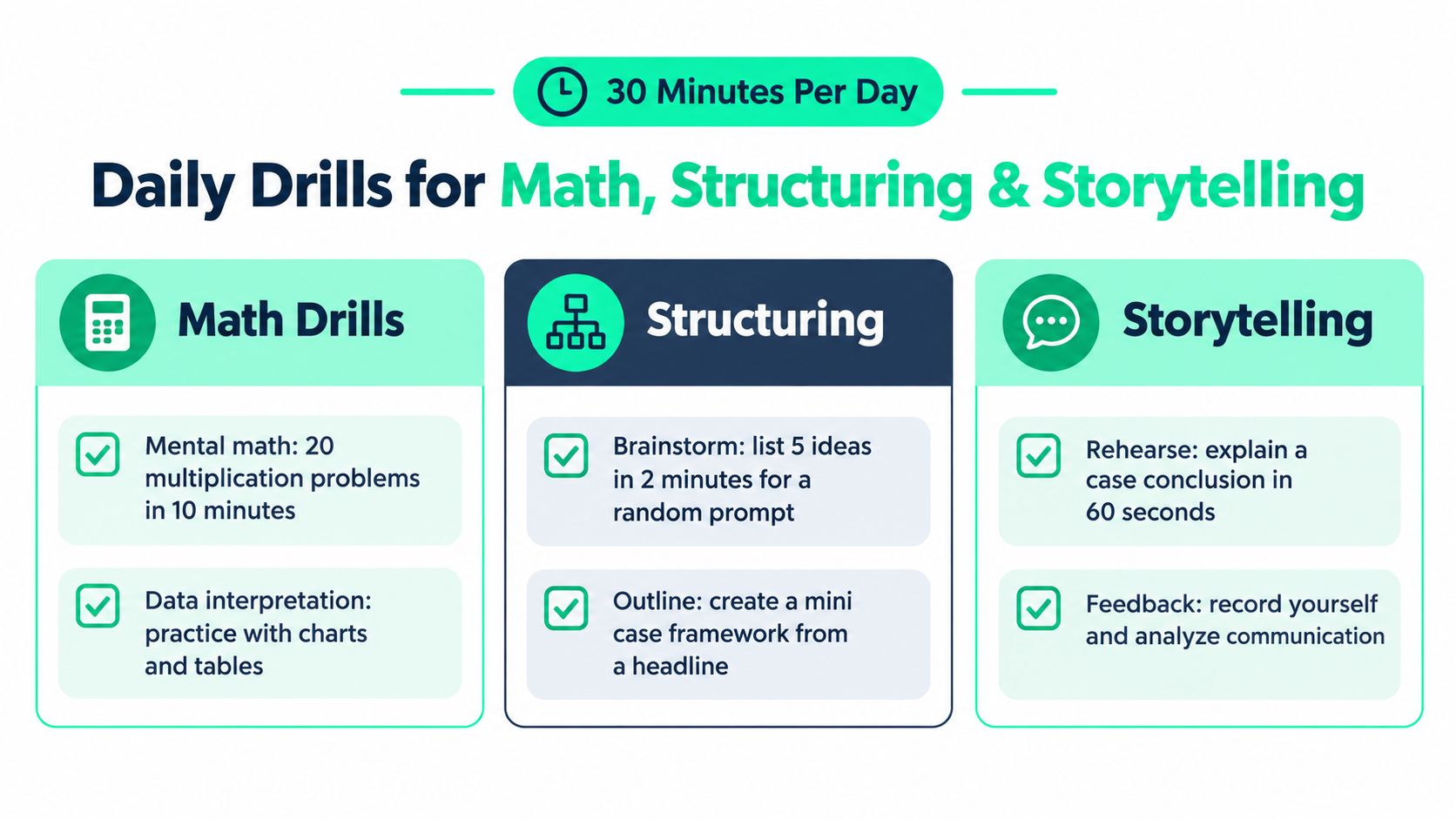
Independent guides recommend a mix of timed solo drills, live practice cases, mental-math repetitions, and concise verbal synthesis. They also recommend practicing structures from scratch for growth, M&A, market-entry, and profitability cases, speaking answers out loud, and keeping the final recommendation under two minutes in this consulting case interview guide.
A 30-minute drill block
You don't need a partner every day. You do need repetition.
Drill one for math under pressure
Set a timer and work through basic business math aloud. Aloud.
Use prompts like:
- Revenue changed because price rose while volume fell. What's the net direction?
- A product line has fixed costs and variable costs. What would you check before recommending a price cut?
- Which segment contributes more profit, and why?
The self-check is simple. Did you keep your numbers organized on paper, and did you explain what the answer meant?
Drill two for structuring from a cold start
Take one prompt and give yourself one minute to build a custom structure.
Examples:
- “A retailer's profits are down.”
- “A software company is considering entering a new geography.”
- “A manufacturer is considering an acquisition.”
For each prompt, force yourself to speak the structure before you write more detail. That trains visible thinking, which is what the interviewer hears.
If you want fresh prompts for solo reps, a bank of practice interview questions can help you generate more raw material for structuring and synthesis practice.
Drill three for exhibits and insights
Take any chart or slide and answer three questions:
- What changed?
- Why does it matter?
- What would I check next?
Many candidates can read a chart but not extract the implication. Don't just narrate bars moving up or down. Give the business meaning.
Drill four for final synthesis
This is the most undertrained skill in case interview prep.
Use a simple format:
- Recommendation
- Three reasons
- One risk
- One next step
Keep it short. If you can't say it clearly in under two minutes, your analysis probably isn't clear enough yet.
“I recommend the client delay entry for now. The market is attractive, but the company lacks a clear right to win, and the economics depend on assumptions we haven't validated. I'd confirm customer demand and acquisition cost before making the investment.”
That sounds senior because it prioritizes. It doesn't try to say everything.
Mock Interviews Feedback Loops and Anxiety Control
A mock interview only helps if it produces a specific adjustment. Too many candidates finish a case, say “that was rough,” then queue up another one and repeat the same mistake.
The better system is a loop: perform, review, isolate, retrain, retest.
Build a mock workflow that catches the real problem
Run mocks under light pressure. Time them. Speak as if it counts. Then score only four categories:
- Structure
- Quantitative work
- Exhibit interpretation
- Synthesis and communication
Don't grade yourself on “overall confidence.” That's too vague to improve. Instead ask, “Where did I become hard to follow?”
After the mock, pick the weakest skill first. Recent prep guidance has moved in this direction for good reason. Candidates improve faster when they identify whether the gap is structure, math, exhibits, brainstorming, or synthesis, then retrain that specific weakness before doing more volume. Self-review alone often misses blind spots, which is why recorded cases and scored feedback are increasingly useful, as noted earlier in the prep guidance section.
Why exposure matters for anxious candidates
Research summarized by Rehearsal Room's interview practice findings shows that repeated, structured exposure to speaking situations produces large, statistically significant reductions in public speaking anxiety, and that coaching focused on relevant interview content raises structured-interview scores.
That practical takeaway is straightforward. Don't make your prep passive. Reading frameworks feels safe, but speaking under a timer is what retrains the stress response.
A simple anxiety-control loop looks like this:
- Run one timed answer aloud
- Review the recording for pacing and clarity
- Repeat the same prompt once with one correction
- Stop before fatigue turns the drill sloppy
Neurodiversity-friendly routines that actually help
These are the accommodations I've seen work well without making answers robotic:
- Memory cues: keep one-line prompts on paper such as objective, branch, hypothesis, next step.
- Pacing prompts: write “slow first sentence” at the top of your page.
- Filler-word tracking: count only one filler word category at a time, such as “um” or “like.”
- Resume-grounded examples: keep a short list of projects, outcomes, and decisions you can pull into fit questions without inventing polished stories on the spot.
One tool option in this category is Qcard's mock interview AI, which supports mock practice and follow-up questioning. That kind of setup can be useful if you want repeatable speaking reps and recorded review, especially when finding a live partner is difficult.
Use supports that reduce brain fog. Don't use scripts that replace thinking.
The difference matters. A cue should remind you of your own experience or structure. It shouldn't feed you lines to imitate.
Common Pitfalls and How to Finish Strong
Weak case performances are usually predictable. The candidate solves the wrong problem, force-fits a framework, gets loose with MECE logic, or treats the numbers as decoration instead of evidence.
The fix is rarely more content. It's better habits.
What to stop doing
- Stop announcing frameworks. Interviewers want logic, not textbook labels.
- Stop overexplaining early. Give the top-line structure first.
- Stop hiding from math. If the case gives numbers, use them to test your hypothesis.
- Stop treating the conclusion as a recap. A conclusion is a recommendation, not a transcript.
If you get stuck, don't spiral. Pause and restate what you know, what you still need, and where you'll look next. Recovery is part of the assessment.
A stronger way to finish the case
Your final minute should sound decisive, not overloaded.
Try this checklist before interview day:
- Opening routine locked: You can restate the prompt and confirm the objective cleanly.
- Issue trees customized: You can build a case-specific structure instead of reciting one.
- Math legible: Your paper, assumptions, and calculations stay organized.
- Synthesis concise: Your recommendation fits in a short verbal summary.
- Fit stories authentic: Your examples are tied to real decisions and outcomes from your own background.
- Calm cues ready: You know how to slow your first sentence, pause between branches, and reset after a mistake.
For early-career and neurodivergent candidates, this last point matters a lot. You do not need to sound like the loudest person in the room. You need to sound organized, thoughtful, and real.
Case interview prep works when it trains judgment under pressure. Not performance theater. Not framework cosplay. If your practice makes you more structured, more evidence-based, and easier to follow, you're on the right track.
Key Takeaways
- Review quality beats case volume, which is why the first week should be diagnostic rather than a race to log cases. Two early mocks scored across structure, math, exhibits, brainstorming, and synthesis reveal your one real bottleneck, and one guide argues that 15 reviewed cases can outperform 50 rushed ones.
- Frameworks are starting logic, not scripts, and announcing one makes you sound junior. In one study of 379 candidates, only 2 produced a framework rated above adequate, 71.2% were weak on MECE quality, and 75.4% were weak on quantitative analysis. Build a case-specific issue tree in the first 90 seconds instead: restate, confirm the objective, name three tailored branches.
- Put your prep hours where the cases are. Profitability accounts for roughly 35–40% of cases and Market Entry 20–25%. Those two formats teach the broadest reusable skills, so they deserve the largest share of practice time before M&A, growth strategy, and pricing.
- Synthesis is the most undertrained skill, and it's the one interviewers remember. A strong close fits in under two minutes using recommendation, three reasons, one risk, and one next step. If you can't say it that clearly, your analysis probably isn't clear enough yet.
- A mock only helps if it produces a specific fix. Score four categories (structure, quantitative work, exhibits, synthesis), retrain the weakest one, then retest. For ADHD, autistic, anxious, and international candidates, short timed blocks, a standardized opening routine, one-line memory cues like "objective, branch, hypothesis, next step," and practiced transitions reduce cognitive load without turning answers into scripts.
If you want extra support, Qcard gives candidates a prep toolkit that fits this style of practice, including mock interviews, AI-scored practice, recording and review, and resume-grounded talking points designed to reduce brain fog without turning your answers into scripts. It's a practical option if you want more structure between live mocks and a cleaner feedback loop before interview day.
Ready to ace your next interview?
Qcard's AI interview copilot helps you prepare with personalized practice and real-time support.
Try Qcard Free