TL;DR
Career change interview questions test whether your move is coherent, prepared, and low-risk — not whether your background matches perfectly. The eight questions cover motivation, transferable experience, gap-closing plans, handling inexperience, the value case against direct-experience candidates, learning agility, self-doubt, and your first 90 days. Ground every answer in verified resume achievements rather than adjectives: explain "the underlying work" that transfers, not that you're "organized" or "a fast learner." Build a skill map classifying each target competency as directly demonstrated, demonstrated in a different context, developing, or unfamiliar — that prevents you from claiming a perfect match. Name gaps directly and show what you've already started doing about them. Use a three-phase 90-day plan rather than promising transformation. Prepare follow-ups, not just headline answers, and keep every figure exact — credibility beats impressive-sounding precision. Practice from short cues like motivation, evidence, gap, contribution so the wording stays natural when the question changes shape.
You're in the interview, and the hiring manager has just noticed that your resume moves from operations into product, from teaching into customer success, or from finance into cybersecurity. They ask, “Why the change?” You know the answer, but the explanation feels difficult to compress. You don't want to sound bored with your previous career, unprepared for the new one, or unsure that you'll stay.
Strong career change interview questions and answers don't hide the transition. They connect verified achievements from your past to the work you want to do next. A useful answer can combine the STAR method, a skills map, an honest gap-closing plan, and a short memory cue instead of a memorized script. Indeed's guidance on career-change interviews recommends using STAR and focusing on transferable skills, while a practical answer can often fit into about 60 seconds when it includes your background, strongest achievement, and reason for moving into the role, as outlined by HireSprint's career-change interview guide.
The examples below are adaptable kits. For each question, connect the wording to your actual resume, measurable outcomes, target industry, communication preferences, and, where relevant, your work authorization context. Career transitions are common in a mobile labor market. The U.S. Department of Labor's Career Trajectories and Occupational Transitions dashboard tracks how workers move through jobs and occupations, so your task isn't to defend being different. It's to make the logic of your move easy to understand.
What Are the Most Common Career Change Interview Questions and Answers?
Strong career change answers don't hide the transition — they connect verified achievements from your past to the work you want to do next. Your job isn't to defend being different; it's to make the logic of your move easy to follow.
The eight questions career changers face most often, and what each one is really testing:
1. Why are you making this career change? Tests commitment. Follow the progression: past experience, motivating evidence, preparation, future fit. "I just needed a change" gives the interviewer nothing; a specific project that revealed your interest gives them everything.
2. What relevant experience do you have from your previous career? Tests transfer logic. Name "the underlying work" rather than vague traits — coordinating people, deadlines, and decisions transfers even when the software doesn't. Build a skill map before the interview and pick two or three strong parallels.
3. What's your plan for closing knowledge gaps? Tests responsibility. "I'm willing to learn" is intent. Identify three to five real gaps, show that you've already started on at least two, and explain your learning method with current state, action, application, and check.
4. How will you handle being the least experienced person on the team? Tests behavior, not attitude. Describe what you actually do when you don't know something: clarify the outcome, check documentation first, summarize your understanding, confirm risks before acting.
5. Why should we take a chance on you instead of someone with direct experience? Tests risk assessment. Name the trade-off calmly, then explain what lowers the risk — customer proximity, process discipline, cross-functional judgment, or change experience.
6. Tell me about a time you learned something completely new quickly. Tests your learning loop: identify the unknown, find a reliable source, test your understanding, apply it, adjust after feedback. Keep it to about 90 seconds.
7. How do you handle imposter syndrome or self-doubt? Tests self-management. Name the feeling briefly, then move to what you do — externalize the task, use feedback early, track evidence, use support intentionally.
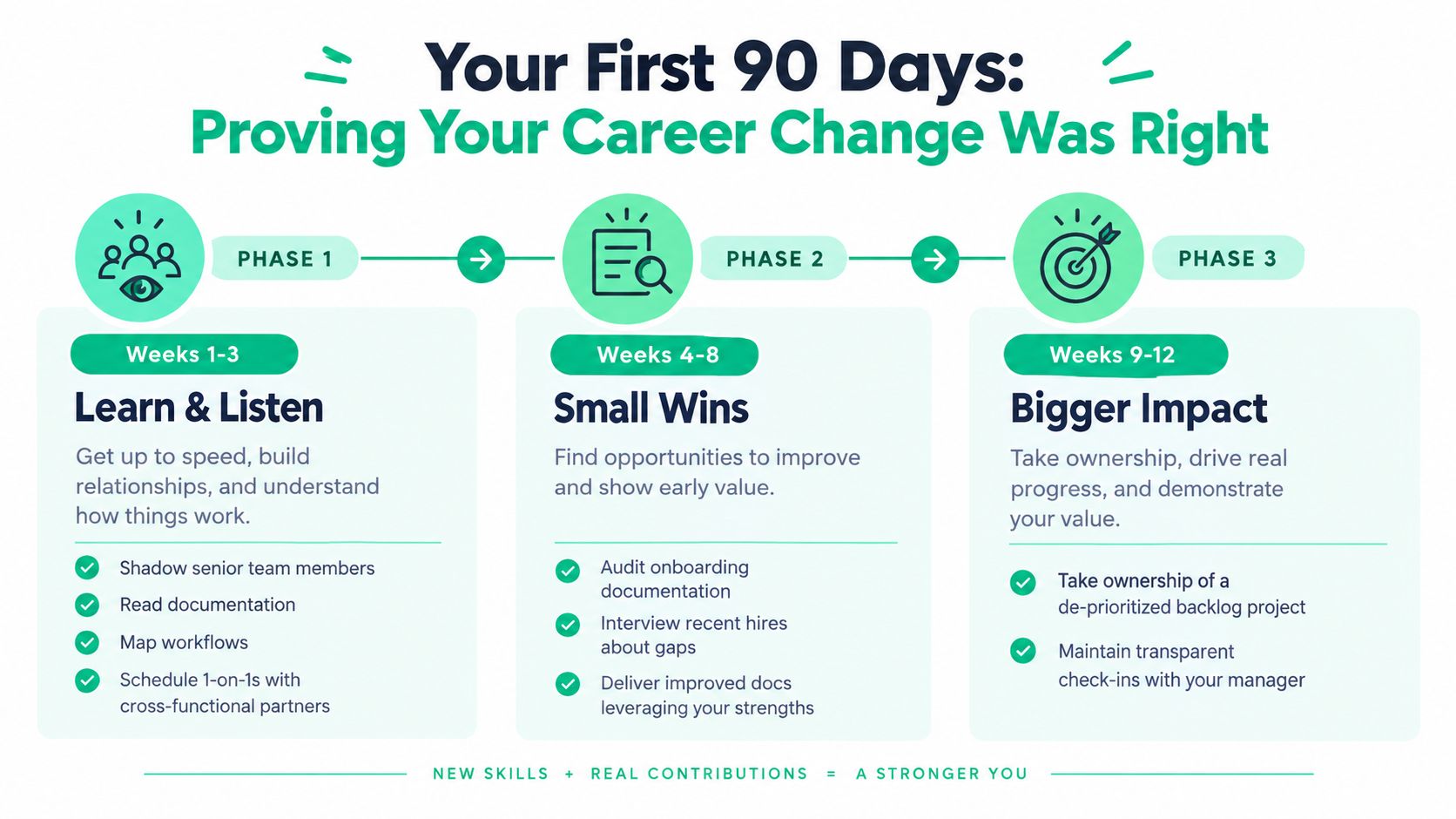
8. What would you do in your first 90 days? Tests realism. Use three phases: weeks 1–3 learn and align, weeks 4–8 contribute within scope, weeks 9–12 review and extend.
1. Why are you making this career change?
Hiring managers usually want more than a statement about personal interest. They're listening for a coherent reason, evidence that you've considered the demands of the new field, and signs that you're moving toward a durable goal rather than escaping an unpleasant situation.
A resume-grounded answer might sound like this:
“I've spent the past several years in customer operations, where I became most engaged when I analyzed recurring issues and worked with product teams to improve the customer experience. In my last role, I led a process change that reduced avoidable escalations and gave me a clearer interest in product operations. I've since completed relevant coursework and built a small project to practice product analysis. I'm now looking for a role where I can use my customer knowledge, process experience, and analytical work more directly.”
The answer works because it follows a simple progression: past experience, motivating evidence, preparation, and future fit. It doesn't dismiss customer operations. Instead, it explains how specific work within that career revealed a stronger direction.
What the interviewer is testing
The concern behind this question is commitment. An employer may wonder whether you understand the new field, whether the change reflects a considered decision, and whether you'll remain interested after the initial learning curve. Frame your answer around a specific project, repeated responsibility, or moment of discovery. “I just needed a change” gives the interviewer no useful evidence, while “I'm unhappy with my old industry” centers the answer on what you're leaving.
Use a short memory cue:
- Past: What did you do?
- Signal: What experience pointed you toward the new field?
- Proof: What have you done to prepare?
- Fit: Why does this role make sense now?
Likely follow-ups include “Why now?”, “What have you learned about this industry?”, and “What do you expect will be hardest?” Prepare one factual sentence for each. If you're an international professional, distinguish your career motivation from any work authorization matter, then answer the employer's question directly and accurately.
Practice cue: Record yourself answering without notes. If the response sounds like a complaint about your old career, replace criticism with a concrete example of the work you want to do more often.
2. What relevant experience do you have from your previous career?
You don't need to prove that your previous job was identical to the target role. You need to show how a skill produced a result in one setting and how the same skill can create value in another.
Suppose you're moving from event coordination into project management. A useful answer could be:
“My title was event coordinator, but much of my work involved project planning. I managed competing deadlines, aligned vendors and internal stakeholders, tracked risks, and adjusted plans when requirements changed. For example, I coordinated a multi-team launch by creating a shared timeline, clarifying ownership, and escalating dependencies early. The new part for me is the software and delivery framework used in this role, but the underlying work of coordinating people, deadlines, and decisions is familiar.”
The important phrase is “the underlying work.” It explains the transfer mechanism instead of listing vague traits such as communication or organization.
Build a skill map before the interview
Create a simple 2x2 grid. Place the target role's most important skills on one side and your strongest evidence on the other. You can then classify each skill as directly demonstrated, demonstrated in a different context, developing, or unfamiliar. This method helps you avoid claiming a perfect match.
Focus on two or three strong parallels:
- Stakeholder coordination: Name who had competing needs and how you reached alignment.
- Process improvement: Explain what was inefficient, what you changed, and what improved.
- Analysis or judgment: Show how you used information to choose an action.
Use the achievements already documented on your resume. Qcard's resume interview question tool can help turn those verified experiences into practice prompts, but the final answer should still reflect your real responsibilities and outcomes.
A hiring manager may ask, “How would that experience apply here?” Answer with a bridge: “In my previous role, I did X for Y audience using Z approach. In this role, the audience and tools differ, but the same decision-making pattern applies because…”
Adapt the answer to your audience
Mid-career candidates should explain how senior judgment, not just technical tasks, transfers. Neurodivergent candidates may prefer a structured answer with explicit categories rather than improvising a long comparison. International professionals should clarify terminology when job titles or processes differ across countries. End by acknowledging what you'll still need to learn. Realistic self-assessment makes the transfer story more credible.
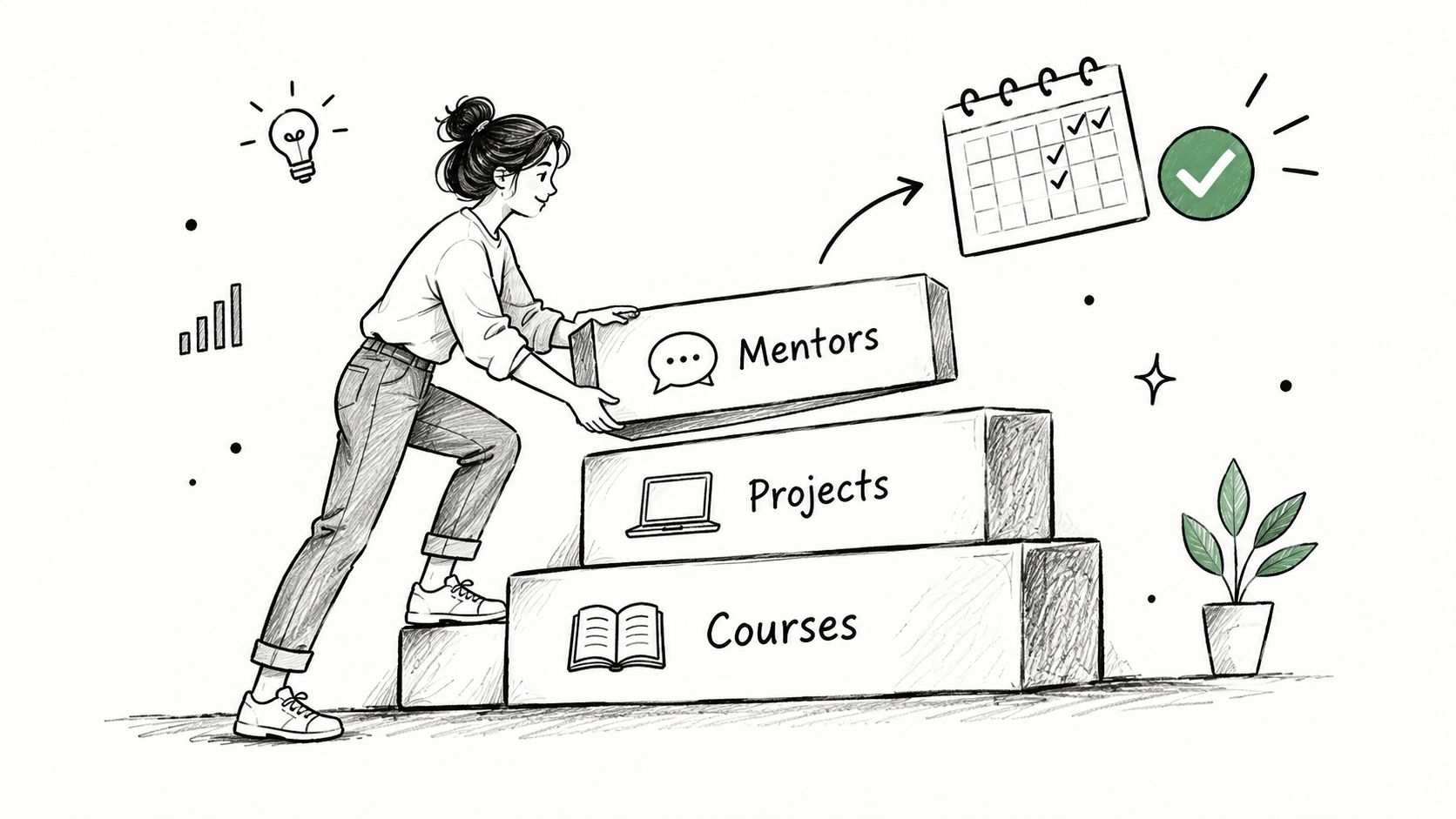
3. What's your plan for closing knowledge gaps in this new field?
A career changer who says, “I'm willing to learn,” has expressed intent. A stronger candidate identifies the gap, names the learning action, and explains how they'll know the learning is useful.
Consider a move from accounting into data analytics:
“My main gaps are the team's analytics stack, the field's reporting conventions, and experience presenting findings to product stakeholders. I've started addressing the first gap through hands-on practice with the tools listed in the job description, and I've used a personal project to work through data cleaning and visualization. For the stakeholder gap, I'm practicing concise recommendations rather than only presenting technical detail. In my previous role, I had to learn a new reporting process quickly after a system change, so I know I learn best by combining guided instruction with a real deliverable and feedback.”
That answer does three things. It admits what isn't known, shows that preparation has already begun, and offers a learning method grounded in previous behavior.
Separate gaps from risks
Not every unfamiliarity is equally serious. A tool gap may be closed through practice. A regulatory or domain gap may require formal training, supervision, or careful review. Before the interview, identify three to five genuine gap areas through research on the role, company, and industry. Then choose at least two that you've already started addressing.
For each gap, prepare:
- Current state: What you haven't done yet.
- Action: The course, project, mentor conversation, or guided practice you're using.
- Application: Where the new knowledge will appear in your work.
- Check: How you'll request feedback or assess accuracy.
A follow-up may ask, “What if you don't have time to learn everything?” Explain how you'll prioritize the skills tied to immediate responsibilities, ask experienced teammates for context, and avoid making unsupported decisions.
Make your learning style practical
Don't describe yourself only as a fast learner. Explain whether you learn through documentation, paired work, deliberate practice, or teaching the concept to someone else. For a neurodivergent candidate, it's reasonable to describe the structures that support accurate work, such as written priorities or clear feedback. For an international student, connect coursework or prior experience to the employer's tools without overstating equivalence.
The goal isn't to pretend the gap doesn't exist. It's to show that you can manage it responsibly.
4. How will you handle being the least experienced person on the team?
Being new to an industry doesn't require you to act either timid or omniscient. The strongest response shows that you can learn visibly, contribute within your competence, and use other people's expertise without becoming dependent on constant reassurance.
A candidate moving from teaching into learning and development might say:
“I'm comfortable being new when I have a clear way to learn and contribute. In teaching, I joined a team using an instructional platform I hadn't worked with before. I asked experienced colleagues to show me their workflows, reviewed the documentation, tested the platform with a small lesson, and requested feedback before expanding its use. I'll take the same approach here. I'll ask focused questions, keep notes on decisions, and look for early contributions in areas such as documentation, communication, and user support while I build deeper technical knowledge.”
Show the behavior, not just the attitude
“People say I'm humble” isn't evidence. Describe what you do when you don't know something. Interviewers may follow up with “What kinds of questions would you ask?” or “How would you know when to work independently?” Prepare examples such as clarifying the desired outcome, checking existing documentation first, summarizing your understanding, and confirming risks before acting.
Behavioral interviews often ask candidates what they did to adapt and what happened afterward. The University of Virginia's behavioral interview question guide uses questions that probe the action taken during change and the outcome or lesson that followed. Structure your example accordingly.
Turn newness into a contribution
A fresh perspective can help when you use it carefully. You might notice confusing documentation, repeated customer questions, or a handoff that makes sense to insiders but not to newcomers. Don't promise to redesign everything before understanding the context. Say that you'll observe first, then share patterns with your manager.
For candidates with anxiety or sensory needs, confidence may come from preparation rather than spontaneous performance. You can practice pacing and answer length with Qcard's real-time Interview Coach, then use a short cue such as listen, clarify, test, report. International professionals should also ask about communication norms instead of assuming that one workplace style applies everywhere.
A credible answer admits the learning curve and shows how you'll tackle it.
5. Why should we take a chance on you instead of someone with direct experience?
This question asks you to make a value case without pretending that direct experience has no advantages. A weak answer says, “I'm more motivated.” A stronger answer identifies what you bring, proves it with resume evidence, and explains how you'll reduce the employer's risk.
Imagine a sales professional moving into customer success:
“A candidate with direct customer-success experience may need less orientation to the field's terminology. I bring a different advantage: I've managed complex client conversations, built repeatable follow-up processes, and worked across teams when a customer issue required a coordinated response. In my previous role, I learned a new market quickly enough to support a new segment and created documentation that helped colleagues handle common questions. I'd still need to learn your systems and success measures, but I can contribute immediately through customer communication, account organization, and cross-functional follow-through.”
Address the trade-off directly
The hiring concern is not whether you care. It's whether the time and support required to bring you up to speed will be justified. Name the trade-off calmly: “I won't bring the same domain history as someone already in this field.” Then explain what evidence lowers the risk.
Choose advantages that belong to your background:
- Customer proximity: You understand the users, buyers, or internal partners affected by decisions.
- Process discipline: You've created structure in ambiguous or high-volume work.
- Cross-functional judgment: You've translated needs between groups with different priorities.
- Change experience: You've entered unfamiliar contexts and produced a useful outcome.
Don't claim that experienced candidates lack these qualities. Instead, explain how your combination supports the target role.
“You're not asking the interviewer to ignore the gap. You're showing why the gap is manageable.”
Close on contribution
End with what you'll deliver, not only what you hope to learn. “My goal would be to become useful quickly in the responsibilities I already understand, while building the domain knowledge required for broader ownership.” That wording is confident without promising immediate expertise.
Mid-career candidates should emphasize judgment, ownership, and the ability to operate with stakeholders, rather than presenting themselves as beginners in every respect. International candidates should describe work authorization accurately and avoid allowing that logistical topic to replace the value discussion. Neurodivergent candidates can use a prepared three-part structure to avoid minimizing their strengths under pressure.
6. Tell me about a time you had to learn something completely new quickly.
A strong answer shows how you reduce uncertainty while producing useful work. Choose a resume-grounded example with unfamiliar subject matter, a clear responsibility, deliberate learning steps, and an outcome you can explain. The story can come from another industry if the learning process resembles what this role requires.
A communications specialist moving into cybersecurity might answer:
“In a previous communications role, our team had to support a security awareness initiative, and I did not understand the technical language well enough to explain it accurately. I needed to create clear employee materials without weakening the underlying guidance. I interviewed the security lead, built a glossary, checked examples with subject-matter experts, and tested the draft with colleagues who had different levels of technical knowledge. I was uncomfortable at first because I did not want to oversimplify a sensitive topic. The materials were approved for rollout, and the review process taught me to separate what I know, what I need to verify, and what the audience needs to do.”
Make the learning process visible
The hiring concern behind this question is risk. Can you learn unfamiliar material without guessing, slowing the team, or producing work that others must correct? Your answer should therefore show your learning loop: identify the unknown, find a reliable person or resource, test your understanding, apply it, and adjust after feedback. Indeed's career-change interview guidance also recommends grounding behavioral answers in specific examples.
Keep the story to about ninety seconds. Open with the unfamiliar problem, spend most of the time on the two or three actions that changed your understanding, then finish with the outcome and transferable lesson. If the interviewer interrupts, cut background detail first, not the verification step. That step demonstrates judgment, which matters as much as speed.
A clear approval, completed rollout, successful handoff, or documented lesson can serve as the result when the project had no metric. If your resume includes a number, use the exact figure and explain how it was measured. Do not create one to make the story sound stronger.
Build versions for likely follow-ups
Prepare a short version, a detailed version, and a version focused on handling uncertainty. An interviewer may ask what you learned first, which resource helped most, or what you would change. Qcard's mock interview tool can help you rehearse those follow-ups while keeping the answer tied to your resume.
Neurodivergent candidates can use discreet cue words such as “unknown,” “check,” and “apply” rather than memorizing a full script. International professionals should explain unfamiliar local terminology or workplace context. Mid-career candidates can choose a recent example that shows current adaptability, especially if earlier successes no longer reflect the tools or expectations of the target field.
7. How do you handle imposter syndrome or self-doubt in a new environment?
A career change can make capable people feel inexperienced again. You don't need to deny that feeling, but you should show that you know how to keep it from controlling your work.
A mid-career professional moving from nonprofit leadership into corporate operations could say:
“I sometimes feel self-doubt when I'm entering a field with unfamiliar language or systems. I treat that feeling as a signal to prepare, not as proof that I can't do the work. I break the problem into specific questions, verify my understanding with a trusted colleague, and keep track of completed work so I don't judge myself only by what I haven't learned yet. In a previous role, I had to lead a project outside my original expertise, and regular feedback helped me move from uncertainty to confident decision-making. I still respect the learning curve, but I don't let discomfort replace action.”
Balance vulnerability with self-management
The interviewer is looking for self-awareness and resilience. Avoid presenting self-doubt as a permanent personal flaw, and don't give an overly polished answer that sounds like you've never struggled. Name the feeling briefly, then move to what you do.
Useful strategies include:
- Externalize the task: Write down the decision, unknowns, and next action.
- Use feedback early: Ask for a review before a small mistake becomes a larger one.
- Track evidence: Keep a record of completed work, useful feedback, and skills gained.
- Use support intentionally: Identify a manager, mentor, peer, or subject-matter expert.
A neurodivergent candidate may explain that written instructions, predictable check-ins, or structured priorities help them produce their best work. That's different from apologizing for a communication preference. International students may also face uncertainty about unfamiliar workplace conventions, so asking direct questions can be a strength when it prevents assumptions.
Feeling unsure and being incapable are different conditions.
Practice an authentic delivery
This answer can sound artificial if you memorize therapeutic language. Use Qcard's Mini mode to rehearse a short memory cue such as notice, structure, ask, act, then speak naturally. If the role involves high-stakes decisions, explain how you balance confidence with verification. Employers generally need someone who can move forward responsibly, not someone who claims never to hesitate.
8. What would you do in your first 90 days to add value and prove your decision was right?
A useful 90-day answer balances learning with contribution. It shouldn't promise a dramatic transformation before you understand the team, systems, customers, and constraints. Instead, divide the period into phases and identify how you'll build trust while producing visible work.
A teacher moving into customer enablement could answer:
“In the first three weeks, I'd learn the product, customer journey, success measures, and team workflows. I'd meet the people I'll depend on, review existing enablement materials, and confirm priorities with my manager. From weeks four through eight, I'd take ownership of a defined deliverable, such as updating one onboarding resource or documenting recurring user questions, while requesting feedback at agreed checkpoints. From weeks nine through twelve, I'd use that feedback to improve the deliverable, report what I learned, and propose the next small improvement. I'd measure success through the standards already used by the team rather than inventing a separate definition.”
Use three phases
Your plan should reflect the actual job description and company research:
- Weeks 1 to 3, learn and align: Understand expectations, relationships, tools, terminology, and current priorities.
- Weeks 4 to 8, contribute within scope: Take on a defined project that uses an existing strength, such as documentation, process improvement, stakeholder communication, or customer research.
- Weeks 9 to 12, review and extend: Share results, identify remaining gaps, and agree on the next level of ownership.
Avoid naming projects you couldn't realistically access. Say, “Based on the roadmap I reviewed, I'd want to understand whether…” rather than claiming certainty about internal priorities. Ask the interviewer how success is measured and what a new hire should accomplish early.
Build in feedback loops
A career changer can add value through disciplined observation and clear communication while developing domain expertise. Qcard's interview preparation guide can help you rehearse the plan and prepare for follow-ups about feasibility, priorities, and timing.
Use a cue such as learn, own, review. That keeps the answer concise without turning it into a rigid script. For neurodivergent candidates, a phase-based structure can reduce cognitive load. For international professionals, ask how onboarding, feedback, and decision-making typically work on the team. For mid-career candidates, show that you'll bring initiative without bypassing established processes.
Build Answers You Can Actually Deliver
Good career change interview questions and answers don't sound like speeches. They sound like clear explanations from someone who understands their own work history, knows what they're learning next, and can connect both to the employer's needs.
Start your rehearsal with one verified achievement that explains your motivation. Choose a project that shows why the new direction became meaningful, then describe the specific work that revealed your interest. Next, prepare two transferable-skill stories. One might show stakeholder management, process improvement, analysis, customer communication, or leadership. The other should demonstrate how you applied a familiar skill in an unfamiliar context.
Add one learning-agility example using STAR. Your story should include what you didn't know, how you learned it, how you checked your understanding, and what happened afterward. Then prepare one gap-closing plan tied to the target role. Name the gap directly, describe what you've already done, and explain how you'll continue learning without overpromising.
Finally, outline a realistic 90-day plan. Divide it into learning and relationship building, scoped contribution, and feedback-based expansion. Research the company enough to make the plan relevant, but don't pretend to know internal priorities that haven't been discussed. Ask the interviewer what success looks like and adjust your plan to the answer.
Adapt the language for your context. A mid-career candidate should not erase years of judgment and leadership just because the industry is new. An early-career switcher can draw from internships, academic projects, volunteering, part-time work, or independent projects, as long as the connection is honest. Neurodivergent candidates can use structured notes, explicit answer frameworks, or appropriate accommodations that support accurate communication. International students and professionals should prepare concise, factual responses about work authorization, location, and terminology when those topics arise.
Prepare follow-ups, not just headline answers. An interviewer may ask why now, what you'll miss, how you know the role fits, or what evidence supports your readiness. Keep your figures exact. If an achievement has no reliable metric, describe the outcome accurately rather than inventing a number. Credibility matters more than impressive-sounding precision.
Qcard is one optional way to rehearse this material. Its resume-locked approach can surface high-level talking points from verified experience, while its practice tools, mock interviews, recording studio, and Interview Coach can help you work on answer clarity, pacing, and follow-up handling. Use it as a memory-cue and practice tool, not as a substitute for understanding your own career story.
Before the interview, practice speaking from cues such as motivation, evidence, gap, contribution. That approach helps you stay natural when the wording changes. You're not trying to recite perfect career change interview questions and answers. You're showing how your past work supports a deliberate, prepared, and credible next step.
Key Takeaways
- The strongest career change answers follow a four-part logic — past experience, the signal that pointed you toward the new field, the preparation you've completed, and why this role fits now — which is why "I just needed a change" or "I'm unhappy with my old industry" both fail: one gives no evidence, the other centers the answer on what you're escaping.
- Naming "the underlying work" is what makes transfer credible — an event coordinator moving into project management should explain that coordinating people, deadlines, and decisions is familiar while the delivery framework is new, because that explains the transfer mechanism instead of listing vague traits like communication or organization.
- Admitting gaps makes you more hireable, not less — identifying three to five real gaps, showing you've already started on at least two, and explaining current state, action, application, and check demonstrates that you can manage unfamiliarity responsibly, while "I'm willing to learn" expresses only intent.
- The value case works when you name the trade-off calmly rather than dismissing it — saying "I won't bring the same domain history as someone already in this field," then showing the specific advantages that lower the employer's risk, is far more persuasive than claiming you're simply more motivated than experienced candidates.
- Every candidate profile needs a different emphasis — mid-career changers should show that judgment and ownership transfer rather than presenting themselves as beginners, early-career switchers can draw honestly from internships and projects, neurodivergent candidates benefit from explicit answer structures and cue words over improvised comparisons, and international professionals should keep work authorization factual and separate from the value discussion.
Use Qcard to turn your resume into grounded interview practice, concise memory cues, and follow-up preparation for a career change. Rehearse your motivation, transferable skills, learning plan, and 90-day answer so you can speak naturally without relying on a script.
Ready to ace your next interview?
Qcard's AI interview copilot helps you prepare with personalized practice and real-time support.
Try Qcard Free