Capital One Interview Questions: 8 Answers for 2026
TL;DR
Capital One interviews run on behavioral and case formats, with technology roles adding a 70-minute data-structures assessment and a Power Day covering coding, system design, behavioral, and case rounds. The preparation mistake that costs candidates most is answering every question the same way — each round needs its own structure: present-past-future for your opener, STAR for behavioral prompts, clarify-structure-calculate-recommend for cases, and clarify-narrate-code-test for technical questions. On the data-decision question, state the decision explicitly rather than saying you “analyzed the data and shared insights.” On fraud detection, clarify the use case before proposing any model and start with rules before escalating to gradient boosting. On coding, going silent is the most common failure. Build a practice routine around three questions matched to your target role, rehearse aloud with a timer, then run a mock with follow-up probes — because Capital One interviewers don’t stop at the first layer.
What do Capital One interviewers test when the question changes from a resume walk-through to a case prompt to a coding task? That's the gap most candidates miss. Capital One's own interview framework centers on behavioral interviews and case interviews, with behavioral questions commonly framed as “Tell me about a time when…” and case interviews built around hypothetical or real business problems, so the process is really checking how you communicate, how you reason, and how you defend decisions under pressure Capital One interview strategy. For technology roles, the company also documents a structured technical path, including a 70-minute data-structures-and-algorithms assessment and a Power Day that can include coding, system design, behavioral, and case-study interviews Capital One AI and ML interview guidance.
The easiest way to prepare for capital one interview questions is to match the answer to the round. A recruiter screen needs a clean, concise story. A hiring manager wants depth and fit. A case interview needs assumptions, math, and a recommendation. A coding round needs narration, edge cases, and a clear trade-off discussion. If you prepare every answer as if it were the same kind of question, you'll sound generic, even when your experience is strong.
What Are the Most Common Capital One Interview Questions?
Capital One’s interview framework centers on behavioral interviews and case interviews — behavioral prompts framed as “Tell me about a time when…” and cases built around hypothetical or real business problems. For technology roles, the path adds a 70-minute data-structures-and-algorithms assessment and a Power Day that can include coding, system design, behavioral, and case-study interviews.
The core insight: match the answer structure to the round. A recruiter screen needs a clean, concise story. A hiring manager wants depth and fit. A case needs assumptions, math, and a recommendation. A coding round needs narration, edge cases, and trade-off discussion. Preparing every answer the same way makes strong experience sound generic.
The eight questions to prepare:
- Tell me about yourself — Present, past, future. 60 to 90 seconds. Memorize the three beats, not a script.
- Why Capital One? — One reason tied to the company, one to your experience, one to the role. Slogans read as noise; naming a team, product area, or responsibility reads as focus.
- A time you used data to make a decision — The most important behavioral prompt here. State the decision explicitly, name one limitation, give the result, close with what you changed in your process.
- A time you failed — Three parts: name the mistake plainly, explain the correction, show the habit that followed. Don’t hide behind “we.”
- A disagreement with a teammate or manager — Challenge with evidence, then commit once the team decides. Describe the other person fairly.
- How would you detect fraudulent transactions? — Clarify the use case first (real-time blocking vs. review queue), build a baseline with rules before a model, then name the false-positive versus missed-fraud trade-off and monitoring for drift.
- Write a function to find duplicate transactions — Ask clarifying questions (empty input? hashable IDs? order preserved?), explain the approach before typing, then narrate while coding.
- Why are you changing careers? — What you liked in the old role, what you built to change direction, why the new role fits.
1. Tell Me About Yourself
What should Capital One hear in your opener? A clear story, not a life summary. Interviewers are checking whether you can organize your background, keep the answer relevant, and connect it to the role you want.
Use a present, past, future structure. Start with what you do now, move to the experience that explains how you got here, then finish with the role you are targeting. Keep the pace controlled. Sixty to ninety seconds is enough if every sentence earns its place.
Practical rule: do not memorize a script. Memorize the three beats, then adapt them to the round.
If you are switching fields, add one sentence that connects your old role to this one.
- Start in the present: state your current role, degree, or focus.
- Move to the proof: name one project, job, or internship that explains your direction.
- End with the fit: say the exact role you are applying for and why it fits your next step.
- Keep it specific: mention one measurable outcome if you have it, then stop.
A career switcher should avoid turning the answer into a detour. One bridge sentence is enough. If you came from another field, name the transferable skill that matters here, such as analysis, communication, or process improvement, then move on.
The best rehearsal method is simple. Read your resume, say the answer out loud, and check that every claim is easy to support. If the interviewer asks for more, you can expand. If not, you have shown that you can communicate cleanly. For a resume-grounded way to tighten that story, make your resume ATS-ready and keep your phrasing aligned with the job description. For more support, see these resume interview questions.
2. Why Do You Want to Work at Capital One?
This question is a filter for real research. “It's exciting” and “It's a great place to work” won't separate you from anyone else. Interviewers want to hear that you understand what makes the company different and that your own skills fit the way the work gets done.
Capital One's public interview guidance shows a company that wants candidates to think in terms of evidence, structure, and business judgment, not vague enthusiasm Capital One case interview tips. In practice, that means your answer should point to one or two concrete things and connect them to your background. If you're applying to analytics, mention data-driven decision-making. If you're applying to engineering, mention building systems that can support scale and reliability. If you're applying to product, mention the intersection of customer experience and business impact.

A strong answer sounds like this in structure, even if the details change:
- One reason tied to the company: maybe the data-first mindset or the way teams rebuild processes instead of patching them.
- One reason tied to your experience: maybe you've already worked on analytics, cloud, customer insight, or process improvement.
- One reason tied to the role: maybe you want a team where you can build, analyze, or improve customer-facing decisions directly.
The best answers don't praise the company in the abstract. They explain why the way Capital One works matches the way you work.
The depth should also shift by round. A recruiter call needs a concise answer. A hiring manager round should sound more informed and more role-specific. If you name a team, a product area, or a responsibility from the job description, the interviewer hears focus. If you repeat slogans, they hear noise.
3. Tell Me About a Time You Used Data to Make a Decision
This is one of the most important behavioral prompts in capital one interview questions because it maps directly to how the company talks about decision-making. Interviewers want to know whether you can start with a problem, pull the right data, check it, and then recommend a course of action without overcomplicating it.
Use STAR, but spend most of your time on Action and Result. Situation and Task should be short. The point is not to narrate every detail of the project. The point is to show how you think when the answer isn't obvious. That's especially important in analyst, data science, and product roles.

A good answer sounds like a decision, not a report. Say what question you were trying to answer, what data you used, what you checked, and what you changed because of it. If there was a trade-off, name it. That's where judgment shows up.
For example, a candidate might explain how they cleaned three years of records, removed duplicates, compared channels, and found that one outreach method performed better after controlling for donor size. That's stronger than saying “I analyzed the data and shared insights.” The interviewer wants to hear the choice you made and why that choice made sense.
- State the decision explicitly: “I recommended shifting calls to that donor segment.”
- Show one limitation: “The sample was smaller than ideal, so we treated it as directional.”
- Explain the result: “The team adopted the approach for the next cycle.”
- Close with learning: “I now check for duplicate records before comparing outcomes.”
Use the practice interview questions tool to rehearse the story until it sounds natural, not polished to the point of sounding scripted. That helps you keep the structure while still sounding like yourself.
4. Tell Me About a Time You Failed or Made a Mistake
How do you answer a failure question without sounding careless? Focus on ownership, recovery, and the habit you changed. Interviewers are listening for self-awareness and whether you can fix a problem without making excuses.
Pick a mistake that mattered, but that you could correct. A bad query, a missed detail in a project, a presentation error, or a process slip all work if you state it plainly. Own the error directly. Do not hide behind “we” if the mistake was yours. Do not stretch it into a fake strength story. Keep the error brief and spend more time on the recovery.
A clean answer has three parts. Name the mistake. Explain how you corrected it. Show what changed afterward. If you can point to a habit you still use, the lesson feels real.
A rehearseable structure sounds like this:
- Mistake: I double-counted records because I skipped a duplicate check.
- Fix: I caught it, told the team quickly, and rewrote the query.
- Prevention: I added a validation step I still use now.
That format works because it shows ownership without turning the answer into drama. It also shows you can recover fast when your work is wrong, which matters in roles where data quality, customer impact, and delivery timing affect the outcome.
Use a concrete example when you practice. If your answer makes you sound flawless, it feels scripted. If it makes you sound careless, choose a different story. The strongest answers show competence under pressure and a process that got better because of the mistake. To pressure-test the recovery story, run it through a mock interview with AI follow-ups and check whether your fix sounds concrete under probing.
5. Describe a Time You Disagreed With a Teammate or Manager
Conflict questions reveal how you handle pressure without damaging the working relationship. Capital One interviewers usually want to see that you can challenge an idea with evidence, then commit once the team decides. That balance matters in banking, analytics, and product work because people often need to move fast without skipping judgment.
Start with respect. Even if you disagreed strongly, describe the other person fairly. Then explain why you raised the issue, what evidence you used, and how you moved the conversation forward. The best answers show that you were direct without being difficult.
If you have a strong example, keep the issue practical. A launch without user testing. A decision to skip a validation step. A feature rollout with risk to support volume. Those examples work because they show real trade-offs, not personal friction for its own sake.
Say what you heard, say what you saw in the data, then say what you proposed.
That structure helps you stay calm. It also keeps the answer from becoming a story about who won. The interviewer is listening for collaboration, judgment, and follow-through. If the final decision went against you, say that you supported it anyway and stayed aligned with the team's plan.
A polished answer usually includes one of these moves:
- One-on-one conversation first: this shows maturity and avoids public escalation.
- Evidence from prior outcomes: this makes the disagreement concrete.
- A compromise proposal: this shows you're solving the problem, not defending your ego.
- Clear commitment after the decision: this proves you can move forward once the team chooses.
The strongest answers sound balanced. You didn't back down too quickly, and you didn't become rigid. You used facts, stayed respectful, and kept the work moving.
6. Walk Me Through How You Would Detect Fraudulent Transactions
This is the kind of case prompt where structure matters more than any one “right” answer. Interviewers are testing how you think through ambiguity, what assumptions you make, and whether you can connect analysis to business reality. A memorized fraud model won't help much if you can't explain why you chose it.
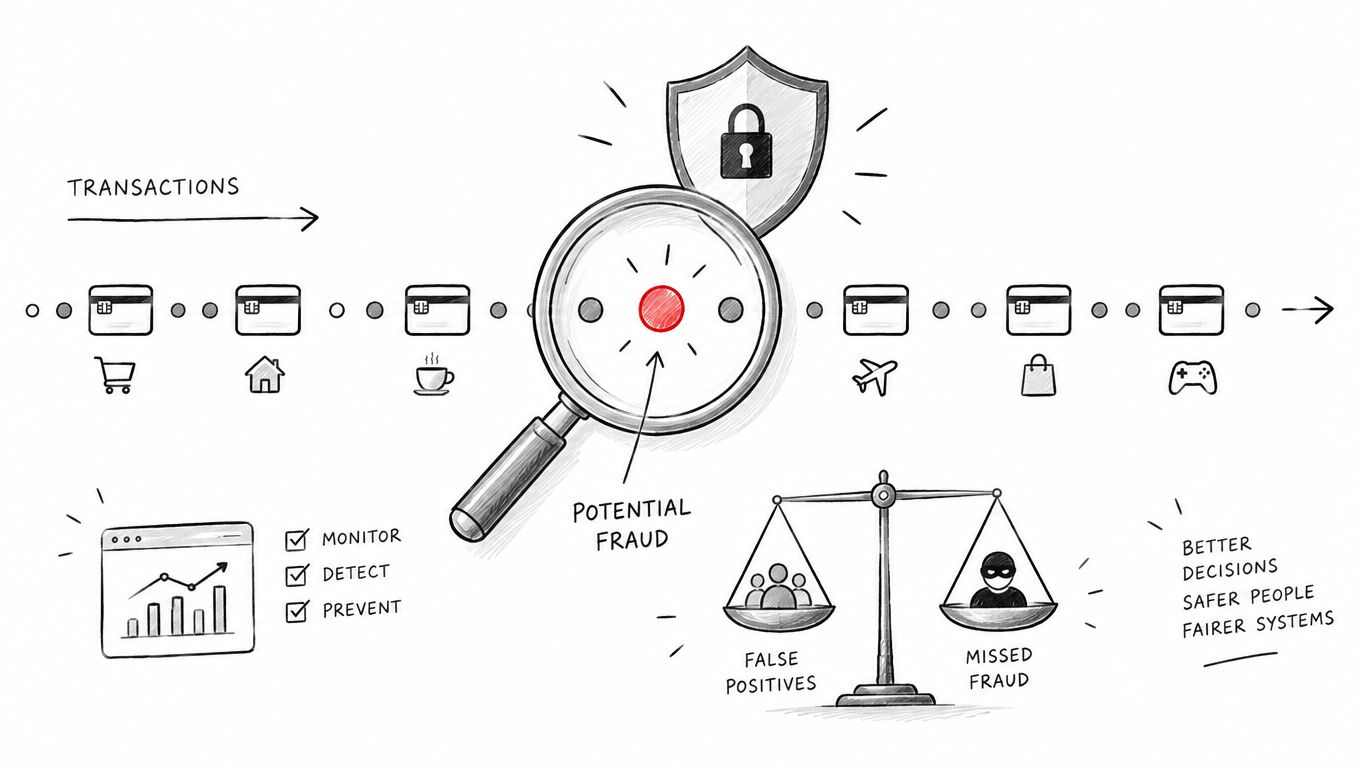
Begin by clarifying the goal. Are you blocking fraud in real time, or flagging it for human review? Are you optimizing for fewer missed fraud cases, fewer false positives, or a balance of both? That one question changes the whole answer.
Then move to data, baseline rules, and model choice. A strong answer might start with transaction amount, merchant category, location, time, device information, and the customer's normal behavior. From there, you can propose simple rules, then a supervised model such as logistic regression or gradient boosting if historical labels exist. You should also name the trade-off between false positives and missed fraud because that's a real customer and operations constraint.
A practical answer sounds like this:
I'd start simple, prove I understand the pattern, then improve the model only after I know what error I'm trying to reduce.
That's the right instinct for this kind of question. Interviewers want to hear that you can operate in stages, not jump straight to an advanced solution. They also want to hear that you'd monitor drift, since fraud patterns change.
A strong response usually includes three parts:
- Clarify the use case: real-time blocking or review queue.
- Build a baseline: rules first, then a model if the data supports it.
- Measure the outcome: precision, recall, and customer experience.
If you're nervous, keep the opening structured and short. Say your assumptions out loud. Then go deeper only when the interviewer asks. That's much better than diving into a complex model before you've defined the problem.
7. Write a Function to Find Duplicate Transactions
Coding rounds for Capital One often use practical, bank-like problems, so this kind of question is common. Interviewers aren't only checking whether your code works. They're listening for how you clarify the prompt, how you talk through trade-offs, and whether you handle edge cases before you code yourself into a corner.
Start by asking the basic questions. Can the input be empty? Are the IDs hashable? Does the output need to preserve order? Those clarifying questions save you from solving the wrong version of the problem. Then explain your approach before typing.
A simple solution in Python uses a set to track seen IDs and another set to collect duplicates:
def find_duplicate_transactions(transaction_ids):
    seen = set()
    duplicates = set()
    for tx_id in transaction_ids:
        if tx_id in seen:
            duplicates.add(tx_id)
        else:
            seen.add(tx_id)
    return list(duplicates)
This approach is clean because it checks each value once and keeps the logic easy to follow. If the interviewer asks about complexity, explain that set lookups are average O(1), so the loop runs in linear time with linear extra space. If memory is a constraint, say that you'd think about sorting or batching, depending on whether order has to be preserved.
The most common mistake here is going silent while coding. Don't. Narrate why you chose a set, what you're assuming, and how you'll test the result. After you code, walk through a tiny example line by line, because that's often where a bug shows up.
A good habit is to say:
- What I'm optimizing for: correctness first, then clarity.
- What could break it: empty input, repeated IDs, or a very large list.
- How I'd test it: a small example with one duplicate and one unique value.
That's the kind of answer that reads like an engineer who thinks before typing.
8. Why Are You Changing Careers?
Why does this change make sense now? Interviewers ask this to see whether your move is intentional, realistic, and backed by action. They want a clear reason, not a polished excuse.
Use a forward-looking answer. Explain what you learned in your last role, what drew you toward this one, and what you have already done to close the gap. Courses, side projects, certificates, and volunteer work all help because they show movement, not just interest.
A strong answer sounds like a bridge from one path to the next. If you are moving from a technical-adjacent field, reviewing sample answers for Node.js interviews shows how switchers frame prior experience for engineering roles. A hospitality manager, for example, can point to forecasting, staffing, and guest trends, then explain how a SQL project turned that experience into a data-focused path. That is much stronger than saying you only want a new job.
Keep the answer anchored to the role you want. A candidate for an analytics role should connect the transition to data work, decision support, or pattern finding. A candidate moving into product or operations should explain how the new role fits their interest in systems, customers, or process improvement.
A good answer usually covers three points:
- What you liked in the old role: forecasting, analysis, staffing, or process improvement.
- What you built to change direction: SQL practice, a portfolio project, or a coding certificate.
- Why the new role fits: a clearer path toward data, systems, or customer decisions.
The interviewer does not need a perfect story. They need a believable one.
Rehearse this as a 45-second answer, then test it with follow-ups like, “Why now?” and “What have you done to prepare?” If you can answer those cleanly, your career change sounds deliberate, not sudden.
Turn These Answers Into a Practice Routine
The fastest way to improve on capital one interview questions is to stop treating them as separate flashcards and start treating them as a system. Choose three questions that match your target role. If you're applying for analytics, pick a behavioral evidence question, a case question, and a technical or data question. If you're applying for engineering, pick a resume story, a coding prompt, and a behavioral conflict question.
Write each answer in the structure that fits it. Use present, past, future for the opening story. Use STAR for behavioral questions. Use clarify, structure, calculate, recommend for cases. Use clarify, narrate, code, test for technical questions. Then rehearse aloud with a timer until you can stay inside a tight range without sounding rushed. A strong answer in an interview should sound like a conversation, not a recital.
After that, run at least one mock interview with follow-up probes. The follow-up matters because Capital One interviewers do not stop at the first layer. They ask why you chose a model, why you made a decision, what you'd do differently, and what trade-off you accepted. If you can answer the first prompt but freeze on the second, your prep isn't finished yet.
Review your resume right after the mock. Every claim you make should map to a specific example you can defend. That is the cleanest way to avoid getting trapped by a detail you only half remember. It also helps you sound more credible when the conversation gets more technical or more specific.
Key Takeaways
- Match the structure to the round, because the same strong experience sounds generic when delivered in the wrong format — a recruiter screen rewards a tight 60-to-90-second story, a hiring manager round rewards depth and role specificity, a case rewards stated assumptions and a recommendation, and a coding round rewards narration and edge-case thinking.
- The data-decision question is the one most directly tied to how Capital One talks about decision-making, and it’s won by naming the choice — “I recommended shifting calls to that donor segment” with one stated limitation beats “I analyzed the data and shared insights,” because the interviewer is listening for judgment under uncertainty rather than a project summary.
- On case prompts like fraud detection, clarifying the goal changes the entire answer — real-time blocking and a human review queue optimize for different errors, so defining the use case before proposing rules, then a model, then precision and recall trade-offs demonstrates the staged thinking interviewers want far better than jumping to an advanced solution.
- Going silent during the coding round is the most common technical failure — narrating why you chose a set, what you’re assuming, what could break it (empty input, repeated IDs, a very large list), and how you’d test it signals an engineer who thinks before typing, while a correct silent solution gives the interviewer nothing to evaluate.
- Prepare the follow-up, not just the first answer — Capital One interviewers probe why you chose a model, why you made a decision, what you’d do differently, and what trade-off you accepted, so a mock interview with follow-up questions is what reveals whether your prep is finished, and every resume claim should map to an example you can defend under that second layer.
Qcard can help with that practice loop because it's built around resume-grounded talking points, mock interviews with follow-up questions, and live pacing support. For this topic, that matters because the challenge isn't memorizing answers, it's staying structured when the interviewer changes direction. If you want a tool that supports that kind of prep, visit Qcard and work your answers until they feel natural.
Ready to ace your next interview?
Qcard's AI interview copilot helps you prepare with personalized practice and real-time support.
Try Qcard Free