Bain Interview Questions: Complete Prep Guide 2026
TL;DR
Bain interviews test three distinct things and reward precision over polish. Case questions assess how you structure a problem and adapt when facts shift — clarify the objective before calculating, build an issue tree that fits the prompt rather than one you memorized, and say the calculation out loud before performing it. Fit questions need proof rather than drama, with the action section making your individual contribution unmistakable instead of hiding behind “we.” Scenario questions test judgment when you have no matching past example, so lead with objective, stakeholders, assumptions, trade-off, action, and verification. The most common failures are jumping into math before defining the problem, forcing a learned framework onto the facts, burying your personal role inside a team story, and cramming a STAR anecdote into a hypothetical. Because interviewers compare notes across rounds and candidates for a role get the same questions, consistency matters as much as polish. Use a 14-day plan: build stories, run case reps, clean behavioral delivery, then mock and tighten.
You've probably got the same problem most Bain candidates do. The interview isn't just “hard,” it's unpredictable in the wrong way, because you can't tell whether you're walking into a fit conversation, a case, a written exercise, or a mix of all three. The people who handle it well don't memorize a script, they learn to think like a Bain team member under pressure.
What Are the Three Types of Bain Interview Questions?
A Bain interview can feel like three different conversations, but the pattern is predictable once you see it. Each type tests something distinct, and the answer structure changes accordingly.
1. Case questions — how you think, not what you know. Bain describes the case as a structured conversation about a real business problem similar to the work its teams do. Your job is to define the problem, identify the analysis that matters, work the numbers, read exhibits accurately, generate client-viable options, and close with a recommendation that holds together. On a pricing case, you don’t open with a conclusion — you clarify what pricing problem is being solved, then examine demand, customer sensitivity, competitor response, and margin impact.
2. Fit questions — evidence, not drama. Bain customizes interviews to the role and keeps questions consistent across candidates for that role, which means your answers need to be sharp and steady. Use context, action, outcome, reflection — and make the action section specific. “I helped the team stay aligned” is weak; “I set the priorities, created the cadence, and resolved the conflict over ownership of the deliverable” gives the interviewer something to probe.
3. Scenario questions — judgment under uncertainty. These hypothetical prompts (re-engaging an unmotivated teammate, responding when a client rejects your recommendation) catch candidates who have no ready-made story. Start with the goal, not the backstory: state the objective, name the stakeholders, make your assumptions explicit, weigh the trade-off, choose an action, and say how you’d check whether it worked.
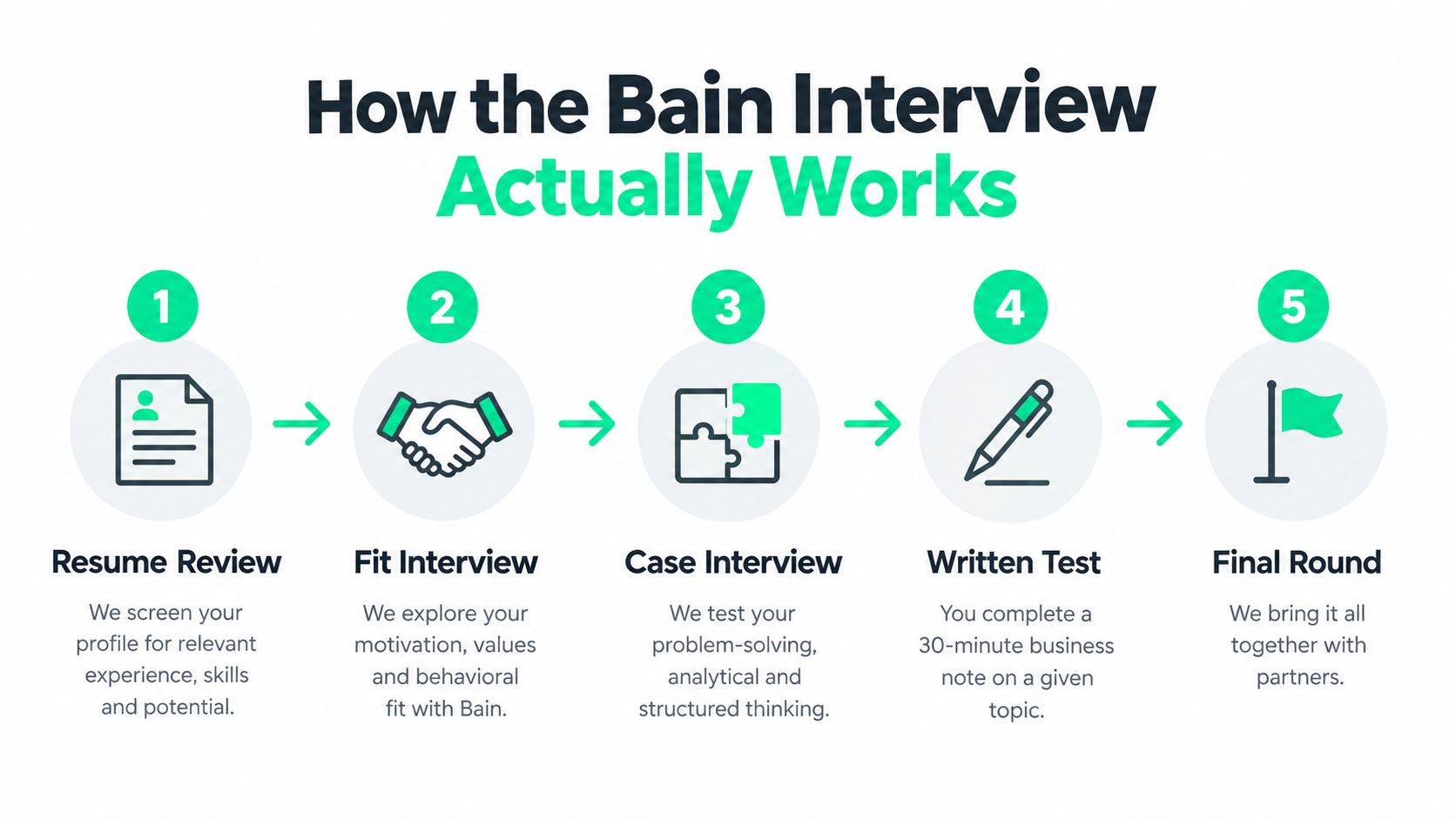
The process around them: application review and, where required, a digital assessment before live interviews. An initial round often includes two case interviews, with final rounds adding more cases or a partner discussion depending on office, role, and recruiting cycle. Since the structure varies, prepare for the hardest version of each likely round.
How Bain Interviews Are Structured
A Bain interview starts like a working session. The interviewer gives a prompt, then keeps pushing you to think aloud, explain trade-offs, and adjust when new information changes the picture. That format matches the way Bain describes its hiring process, with application review and, where required, a digital assessment before live interviews begin. The live rounds are built around case conversations and behavioral prompts, and Bain's case interview page frames the case as a structured discussion of a real business problem.
What the day usually feels like
Bain's process is usually described as multiple interview rounds. Case-prep.com's Bain format overview notes that an initial round often includes two case interviews, then final rounds can add more cases or a partner discussion, depending on the office, role, and recruiting cycle case-prep.com's Bain format overview. The structure changes enough that no one schedule covers every candidate. You have to be ready for office-specific instructions, recruiter guidance, and whatever direction the interviewer chooses.
The flow is straightforward. Screening comes first. Then the live conversation. Then the final round, where the standard shifts from “can this person reason clearly?” to “would we trust this person in front of a client?” Bain's evaluation starts before the interview itself, and comparing how other organizations handle screening, such as when you compare online job fair platforms, makes Bain's process easier to read.
Treat each stage as a test of how you would work inside the firm. The interviewer is watching how you handle ambiguity, how you structure a problem, how you use numbers, and how you respond when the conversation moves in a direction you did not expect. That is why preparation should start with the process, not with a pile of memorized answers. If you want a practical way to organize your stories before practice, the Qcard interview prep guide helps you map examples from your own background and keep them tied to your resume.
Practical rule: If you do not know which round you are preparing for, prepare for the hardest version of each likely round. Build short, crisp fit answers, and make your case habit one of clarifying, structuring, and synthesizing under pressure.
The Three Types of Bain Interview Questions
A Bain interview can feel like three different conversations, but the pattern is predictable once you see it. One question type checks how you solve a business problem. Another checks whether your record supports the story you tell about yourself. A third checks judgment when the interviewer changes the setup and expects a useful response on the spot.
Case questions test how you think, not just what you know
In a Bain case, the interviewer is not looking for a polished final answer first. Bain describes the case as a structured conversation about a real business problem similar to the work its teams do Bain case interview. Your task is to define the problem, identify the analysis that matters, work through the numbers, read exhibits accurately, generate options that would make sense in a client meeting, and end with a recommendation that holds together.
A pricing case shows the point well. You would not start with a conclusion. You would first clarify what pricing problem is being solved, then examine demand, customer sensitivity, competitor response, and margin impact before recommending a path. That is the kind of thinking Bain wants to see. The interviewer is watching for a clear structure that still adapts when the facts shift.
Fit questions pull from your real record
Fit questions expose a lot of candidates who can handle the numbers but struggle to sound credible about leadership, ownership, conflict, or resilience. Bain customizes the interview to the role and keeps the questions consistent for candidates in that role, which is one reason your answers need to be sharp and steady.
The best fit answers do not need drama. They need evidence. If you say you led a team, be specific about your role, the constraints you faced, and what changed because of your decisions. A vague claim sounds rehearsed. A concrete example sounds like someone who has actually done the work.
Qcard is useful here because it keeps your stories tied to your resume. That matters when you are choosing which example to use and how much detail to give. It helps you sort the strongest proof points before you start practicing out loud.
Scenario questions expose judgment under uncertainty
Scenario questions catch a lot of candidates because they ask what you would do before you have a ready-made story. Recent Bain fit guidance highlights these hypothetical prompts, including situations like re-engaging an unmotivated teammate or responding when a client rejects your recommendation Road to Offer on Bain fit interviews. That matters for early-career applicants and career switchers, since you will not always have a past example that fits neatly.
A strong scenario answer starts with the goal, not the backstory. State the objective, name the stakeholders, make your assumptions clear, weigh the trade-off, choose an action, and say how you would check whether it worked.
Seen this way, Bain questions are not a memory test. They are a rehearsal for how you would work inside the firm, under pressure, with incomplete information, and with a client expecting a clear recommendation.
Practical Frameworks for Answering Case and Fit Questions
The best Bain answers sound calm because they're built on a repeatable structure. Candidates often look for a clever framework, but the useful approach is usually simpler. The goal is to make your reasoning visible, not to sound complex. That's true in the case and in behavioral questions.
A clean case structure keeps you from rambling
Start by clarifying the objective and the constraints. If the prompt is “Should this company enter a new market?”, your first job is to make sure you know what success means. Revenue growth, profit, strategic positioning, and risk are not interchangeable, so you need to know which one matters most.
Then build a logical issue tree. A practical version for market entry can split into four branches, market attractiveness, competitive position, required investment, and expected profit. Once you have the branches, say what calculation or data you'd use before you do the math. That small habit signals control. It also helps the interviewer follow your thought process instead of guessing where you're headed.
Useful habit: Say the calculation out loud before you perform it. If you're estimating profit, name the inputs, the logic, and the decision implication first, then compute.
If the interviewer gives you new data, don't freeze. Adjust the tree. Bain cares about how you react when the case changes, because that's closer to client work than a memorized framework ever will be. You're not trying to protect your first idea. You're trying to reach the right one.
Fit answers need proof, not polish
For fit and behavioral questions, keep the story tight. A good structure is context, action, outcome, reflection. The “action” part is where candidates often undersell themselves. Don't hide behind “we.” Say what you did. If you were the person who rebuilt the timeline, negotiated the handoff, or caught the error, that's the detail the interviewer needs.
A practical example helps. If asked about leadership, a weak answer sounds like, “I helped the team stay aligned.” A stronger version sounds like, “I set the priorities, created the cadence, and resolved the conflict over ownership of the deliverable.” That answer tells the interviewer what happened and what your role was. It also gives them something to probe.
The same logic applies to “Why consulting?” and “Why Bain?” These aren't theater questions. They're consistency checks. Your answer should connect your experience, your motivation, and the kind of work Bain does. If those pieces don't line up, the interviewer notices fast.
Common Mistakes and How to Fix Them
Strong candidates usually do not fail because they cannot think. They fail because they answer the wrong version of the question. Bain interviews reward precision, and the easiest way to lose it is to rush.
The most common mistakes
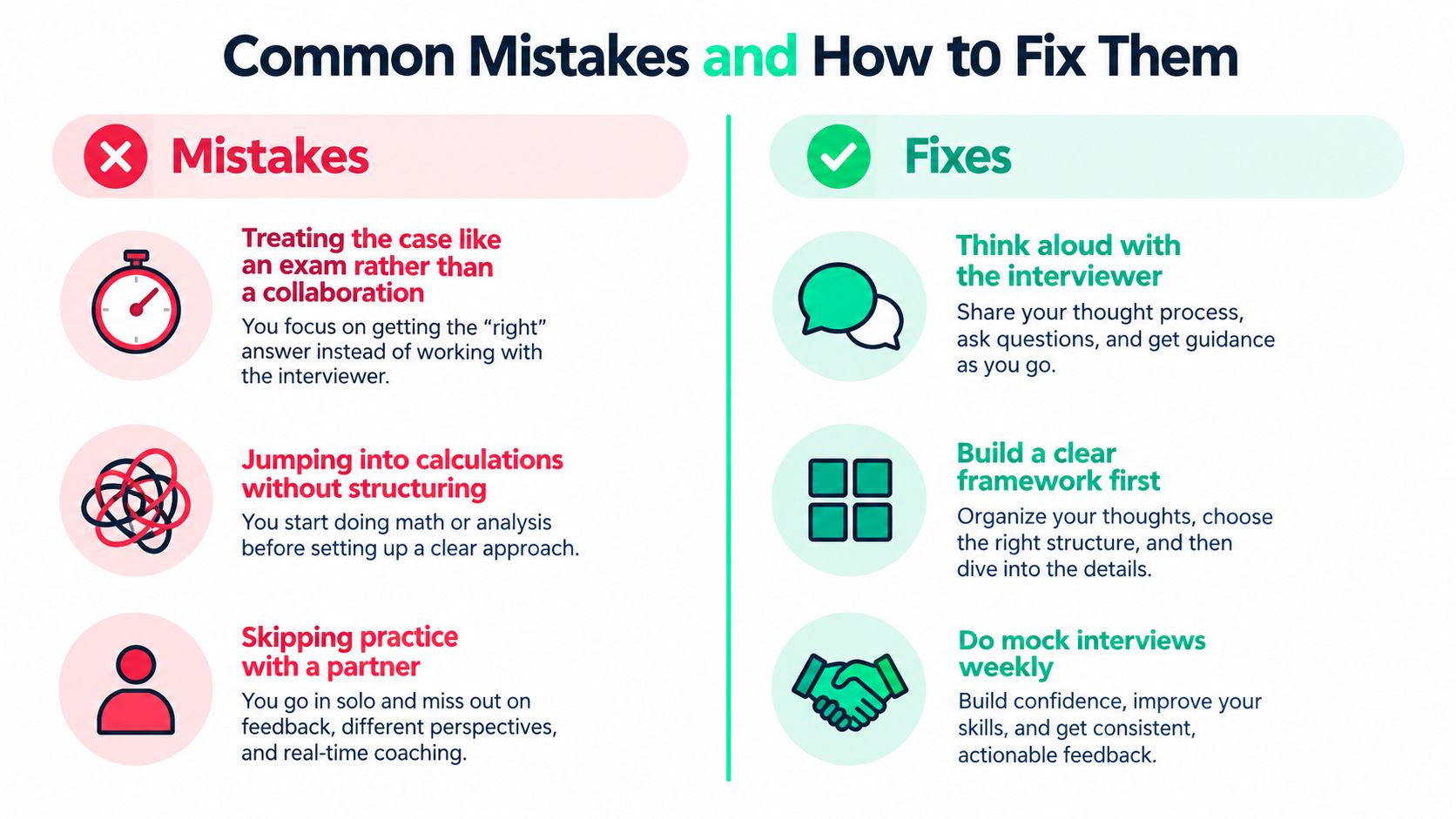
The first mistake is treating the case like an exam. If you jump into calculations before clarifying the objective, you may do accurate math on the wrong problem. The answer looks polished, but the decision value is weak. The second mistake is forcing a memorized framework onto the case facts. Interviewers can tell when you are reciting a structure you learned elsewhere instead of building one that fits the prompt.
The third mistake shows up in behavioral answers. Candidates often tell a long story and never make their individual contribution clear. The interviewer hears teamwork, but not leadership or ownership. The fourth mistake is trying to force every scenario question into a STAR story, even when you do not have a comparable past example. That calls for judgment, not a recycled anecdote.
What stronger answers look like
A better case response sounds interactive. You clarify the objective, state the issue tree, ask for data, and keep the interviewer in the loop. A better fit response isolates your personal choices and the observable result. A better scenario response names the stakeholders, states the assumption you would make, and shows how you would weigh trade-offs.
Interviewers also compare notes across rounds, so a reply that shifts from one interview to the next is harder to defend than one that is slightly rough but stable. Because candidates for the same role are asked the same questions, consistency in your own answers matters even more.
A simple self-check helps. Ask whether the answer shows a real decision, a real action, and a real result. If any one of those pieces is missing, the story probably needs more work.
Do not try to sound “consulting-ish.” Try to sound specific. The interviewer can usually tell the difference in the first minute.
A 14-Day Practice Plan for Bain Interview Prep
Two weeks is enough time to sharpen your performance if you stop practicing randomly. A clean plan gives every day a job. Without that, candidates tend to overwork the stories they like and ignore the questions that expose them.
Days 1 to 4 build the raw material
Start by reviewing the process and mapping your own experience. Read Bain's process pages again, then write down five to seven stories you can defend. Keep them tied to teamwork, leadership, ownership, conflict, resilience, and impact. If a story sounds impressive but you can't explain your exact role, cut it.
A useful way to stay organized is to group each story by what evidence it proves. One story might show leadership, another might show analytical judgment, and another might show resilience after a miss. The point is not to collect as many stories as possible. It's to make sure each one is doing a distinct job.
For a structured refresh on study habits, research study guide walkthrough is a good reminder that good prep starts with coverage, then moves to practice, then to review. The same logic applies here.
Days 5 to 7 are for case reps
Run cases with a focus on structure, not speed. Open each one by clarifying the objective. Then build the issue tree, say your assumptions out loud, and force yourself to explain the calculation before you do it. Do market sizing and profitability drills until the logic feels boring.
The goal isn't to become flashy. It's to become steady. If you can keep your head while a case shifts direction, you're already ahead of many candidates who know more theory but lose control once the interviewer changes the data.
Days 8 to 10 clean up behavioral delivery
Use these days to tighten your stories. Remove filler. Cut anything that sounds generic. Practice the forward-looking questions too, since they're often underprepared. If you're short on a natural example, answer with objective, stakeholder, assumption, trade-off, action, and learning rather than trying to manufacture a neat past story.
Days 11 to 14 are for mocks and cleanup
Do full mock interviews with feedback. Then review pacing, filler words, and the moments where you hesitated. Your last two days should be light but precise. Pick your final story set, rehearse the opening line for each one, and make sure you can transition smoothly from one question type to the next.
If you want a drill sequence to follow while you practice, the Qcard practice interview questions page is a practical place to keep your reps organized.
Using Qcard to Prepare for Each Stage of the Process
Bain interviews reward candidates who can stay close to their own experience while thinking on their feet. Qcard helps with that by surfacing resume-grounded talking points through its mock interview AI, which is useful when the pressure comes from recall, not raw knowledge.
Use it as a story-mapping layer first
Start by turning your resume into a small set of usable stories. The goal is not to script answers. It is to make sure the examples you want are easy to pull up when a recruiter or interviewer moves fast. That matters if your background is broad, if you freeze under pressure, or if you need help separating real leadership from simple participation.
It also helps keep your motivation answers aligned across rounds. If your reason for consulting shifts between the recruiter call and the case interview, that inconsistency can hurt you. A resume-anchored tool keeps the message steady without making you sound rehearsed.
Use it during mock interviews and follow-up practice
Once you move from story collection to live practice, Qcard's mock interviews with intelligent follow-ups and practice scoring give you the feedback loop solo rehearsal usually misses. The recording studio and checklists help with the cleanup pass, but the genuine value is repeated answers under pressure, because that mirrors how Bain interviews feel in the room.
That matters because Bain interviewers rarely accept a polished first pass at face value. They push, change the angle, and ask for more detail. A tool that keeps the practice tied to your own examples helps you spot weak reasoning, thin evidence, and answers that sound smooth but do not hold up under follow-up.
Its privacy setup also suits candidates who want practice without drifting into canned responses. Qcard uses no audio recording, encrypted sessions, and a strict zero-script policy, so the rehearsal stays tied to what you said, not to a memorized template.
The right interview tool does not give you a fake persona. It helps you recall the version of you that already has the evidence.
If you are working through a 14-day prep plan, Qcard fits naturally at each stage. Early on, it helps you map stories. Midway through, it helps you pressure-test them. Near the end, it helps you run full answers until your delivery sounds natural instead of memorized. For candidates who want the back-and-forth that makes Bain interviews feel real, the Qcard AI mock interview tool is the most direct place to practice.
Final Checklist Before You Walk Into the Room
Before interview day, check the process for your office and role so you know whether a digital assessment comes first and how many rounds to expect. Rehearse two or three strong behavioral stories that show leadership, impact, and teamwork, and keep your “Why consulting?” and “Why Bain?” answers concise and consistent. Review the mechanics of a case, especially objective-setting, assumptions, and recommendation logic.
Your last job is to remove surprises. Make sure your practice setup is ready, your notes are clean, and your stories are easy to access without sounding memorized. If you get a forward-looking question or a case twist you didn't expect, don't chase perfection. Slow down, state the objective, and reason through the choice.
The candidates who do well at Bain aren't the ones who know every answer. They're the ones who can think clearly, communicate cleanly, and adapt when the case changes.
Key Takeaways
- The three question types need three different structures — case questions reward clarifying the objective and building an issue tree that adapts to new data, fit questions reward specific personal action and observable results, and scenario questions reward naming the objective, stakeholders, assumptions, and trade-offs when no past example applies.
- Saying the calculation out loud before performing it is the habit that signals control — naming the inputs, the logic, and the decision implication first keeps the interviewer following your reasoning instead of guessing where you’re headed, and it prevents accurate math on the wrong problem.
- Forcing a memorized framework onto the facts is one of the fastest ways to lose credibility — interviewers can tell when you’re reciting a structure learned elsewhere, and Bain cares more about how you react when the case changes direction than about any framework you can recall.
- The “action” section is where candidates undersell themselves most — hiding behind “we” leaves the interviewer hearing teamwork but not leadership or ownership, so name what you decided, what you built, and what you resolved, because that’s the detail that gets probed.
- Consistency across rounds carries real weight since interviewers compare notes and candidates for the same role receive the same questions — an answer that shifts between the recruiter call and the case interview is harder to defend than one that’s slightly rough but stable, which is why “Why consulting?” and “Why Bain?” function as consistency checks rather than theater.
If you want a prep tool that keeps your answers tied to your own experience, Qcard helps you practice Bain-style interviews without drifting into scripts. It gives you resume-grounded talking points, mock interview follow-ups, and practice structure so you can walk in sounding like yourself, only sharper.
Ready to ace your next interview?
Qcard's AI interview copilot helps you prepare with personalized practice and real-time support.
Try Qcard Free