Areas of Improvement Interview: Real Examples That Work
TL;DR
Most candidates don't get rejected for admitting a weakness — they get rejected because the answer sounds fake, vague, defensive, or falls apart under nerves. Interviewers are scoring self-awareness, ownership, and forward motion. Use the four-move method: name the gap in behavioral language (not identity language), own it in one clean sentence, spend roughly 60% of the answer on what you changed, and close with a short forward tie-in to the role. Target 60 to 90 seconds. Pick a weakness that's honest, fixable, and not core to the job — naming something fundamental to the role can disqualify you immediately. Avoid perfectionism, "I work too hard," blame shifting, laundry lists, and any ending where the flaw is still winning. Adapt to your profile: early-career candidates should name a junior-level gap, career changers should answer the question rather than defend the pivot, neurodivergent candidates can describe work behavior and support systems without disclosing a diagnosis, and international candidates should focus on clarity rather than apologizing for an accent. Then rehearse with a 7-day plan: pick the weakness, draft, record, mock with follow-ups, build a backup version, stress-test, and deliver cold.
You're probably staring at this question because you know it's coming, and you don't want to blow it with some recycled answer about perfectionism. Smart instinct. Most candidates don't get rejected because they admitted a weakness. They get rejected because their answer sounds fake, vague, defensive, or impossible to say smoothly once nerves hit.
That's why a good areas of improvement interview answer has to do two jobs at once. It has to make sense on paper, and it has to come out of your mouth under pressure without turning into a ramble. That second part gets ignored in most advice. It matters even more if you're neurodivergent, interviewing in a second language, or making a career switch and already carrying extra mental load.
The fix is simple, but not easy. Pick a real weakness that won't disqualify you, build a short proof-based story around it, and rehearse it in a way that sounds like you, not like a memorized script.
How Do You Answer the "Areas of Improvement" Interview Question?
Interviewers aren't trying to catch you being flawed — they already assume you are, and so are the other candidates. What they're scoring is whether you can talk about a real limitation with judgment, ownership, and control. Specifically: self-awareness (can you name a real gap without hiding behind safe filler?), ownership (can you explain what you did about it without blaming your manager or workload?), and forward motion (is the weakness being managed, not just confessed?).
Use the four-move positive framing method:
Move 1 — Name the gap in behavioral language. Don't say "I'm bad at leadership" or "I'm not confident." Those are identity statements — too broad and too hard to fix. Say what actually happens at work: "I used to miss scope changes when several stakeholders were involved," or "I tended to over-focus on details, which slowed my delivery." Behavior beats personality every time.
Move 2 — Own it in one clean sentence. No dramatic apology, no speech about how hard you are on yourself. "That created avoidable confusion, so I had to tighten how I tracked changes." Calm ownership signals maturity.
Move 3 — Spend most of the answer on action. This is where candidates win or lose the question. MIT's STAR guidance suggests roughly 20% Situation, 10% Task, 60% Action, 10% Result. Don't linger on the weakness — get to what you changed: "I fixed that by using one source-of-truth document, confirming changes in writing after meetings, and ending check-ins with a recap of owners and revisions."
Move 4 — End with a forward tie-in. Make the improvement relevant to the role. Short and specific: "That matters here because clean handoffs and version control affect execution."
Target 60 to 90 seconds. Long enough to show judgment, short enough to stay sharp. And avoid the seven landmines: perfectionism, "I work too hard," "I'm too passionate," a confession that breaks role fit, blame shifting, a laundry list of five weaknesses, and any story that ends with the flaw still running the show.
Why Interviewers Really Ask About Your Areas of Improvement
Most candidates hear “What's an area of improvement for you?” and immediately think: trap.
That's the wrong frame. In a real areas of improvement interview, the interviewer usually isn't trying to catch you being flawed. They already assume you're flawed. So are the other candidates. What they're testing is whether you can talk about a real limitation with judgment, ownership, and control.
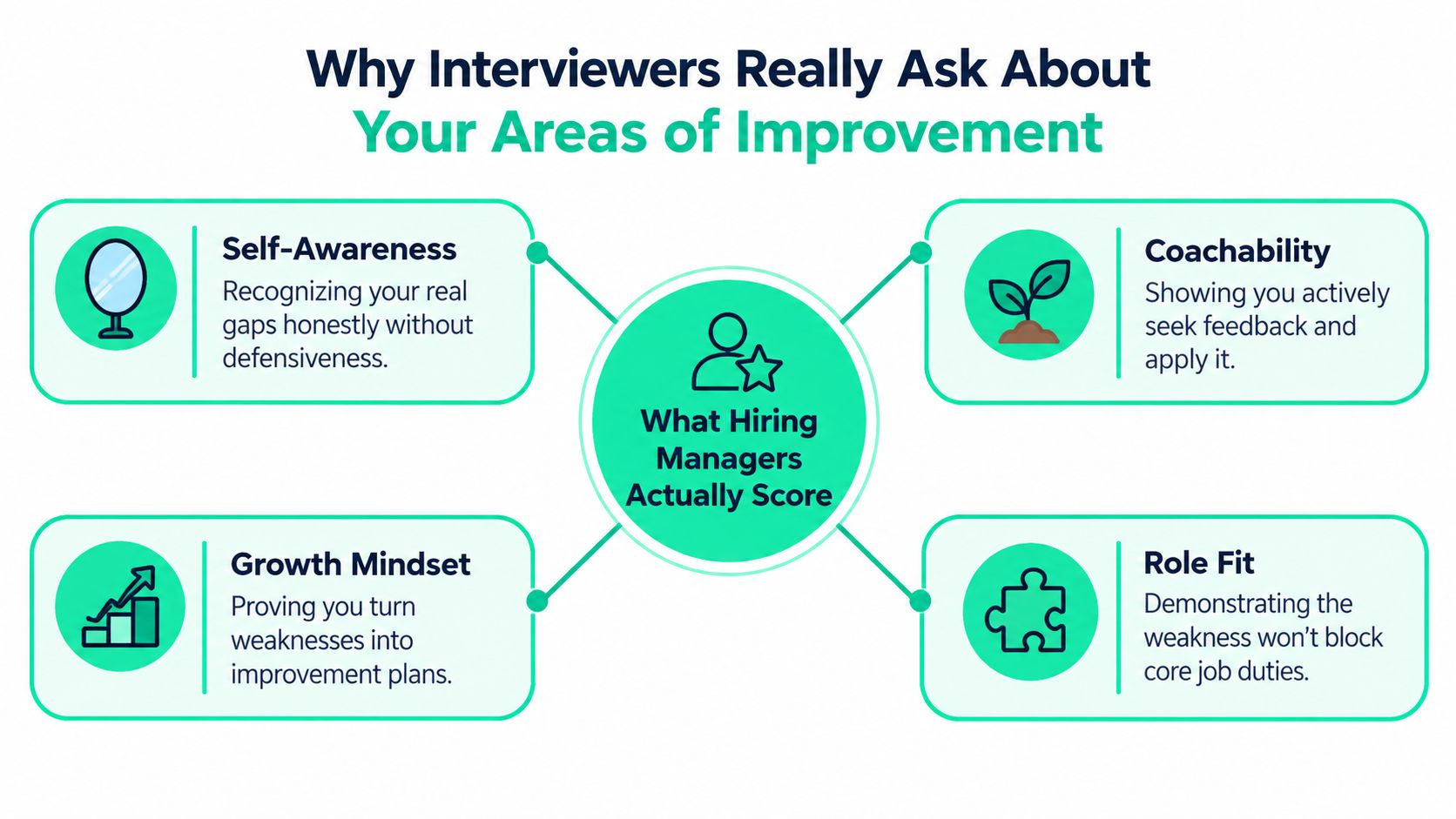
A strong answer tells them three things.
What they're actually scoring
- Self-awareness: Can you name a real gap without hiding behind fake-safe filler?
- Ownership: Can you explain what you did about it without blaming your manager, team, workload, or environment?
- Forward motion: Can you show that the weakness is being managed, not just confessed?
That's the test. Not whether you're perfect. Whether you're coachable and useful.
Structured interviewing guidance is very clear that consistency matters only when interviewers use fixed wording, order, defined response formats, and training to avoid drift. A written guide alone isn't enough because standardization depends on identical administration across interviewers, as outlined in CASRAI's guidance on structured interviews in research. That matters for you because “areas of improvement” often gets asked as a scored question, not casual small talk.
Practical rule: Treat this question like a structured storytelling prompt, not a confession.
Why candidates misread it
Candidates usually make one of two mistakes. They either give a polished non-answer like “I care too much,” or they overcorrect and dump a flaw that makes the interviewer think, “Why are you applying for this role at all?”
Recent career guidance has gotten more honest about this. One 2025 career article warns that naming a weakness that is fundamental to the job can get a candidate disqualified immediately, while newer advice also pushes candidates to use a real weakness plus evidence of improvement rather than generic filler, as summarized in this CNBC career piece.
That's the line you need to walk. Real, but not reckless.
Panels and hiring managers hear this differently
A startup founder often listens for adaptability. They want to know whether you learn fast, recover fast, and can operate without hand-holding.
A corporate panel often weighs evidence more heavily. They want signs that you've accepted feedback over time and changed behavior in a sustained way.
If you want a better prep framework for questions like this, use a structured practice flow instead of winging it with generic scripts. Qcard's interview prep guide is a good example of the kind of role-specific preparation that keeps your answer grounded.
The Positive Framing Method in Four Moves
Here's the formula I give candidates when their first draft sounds either too polished or too messy. It works because it gives your answer shape without making it robotic.
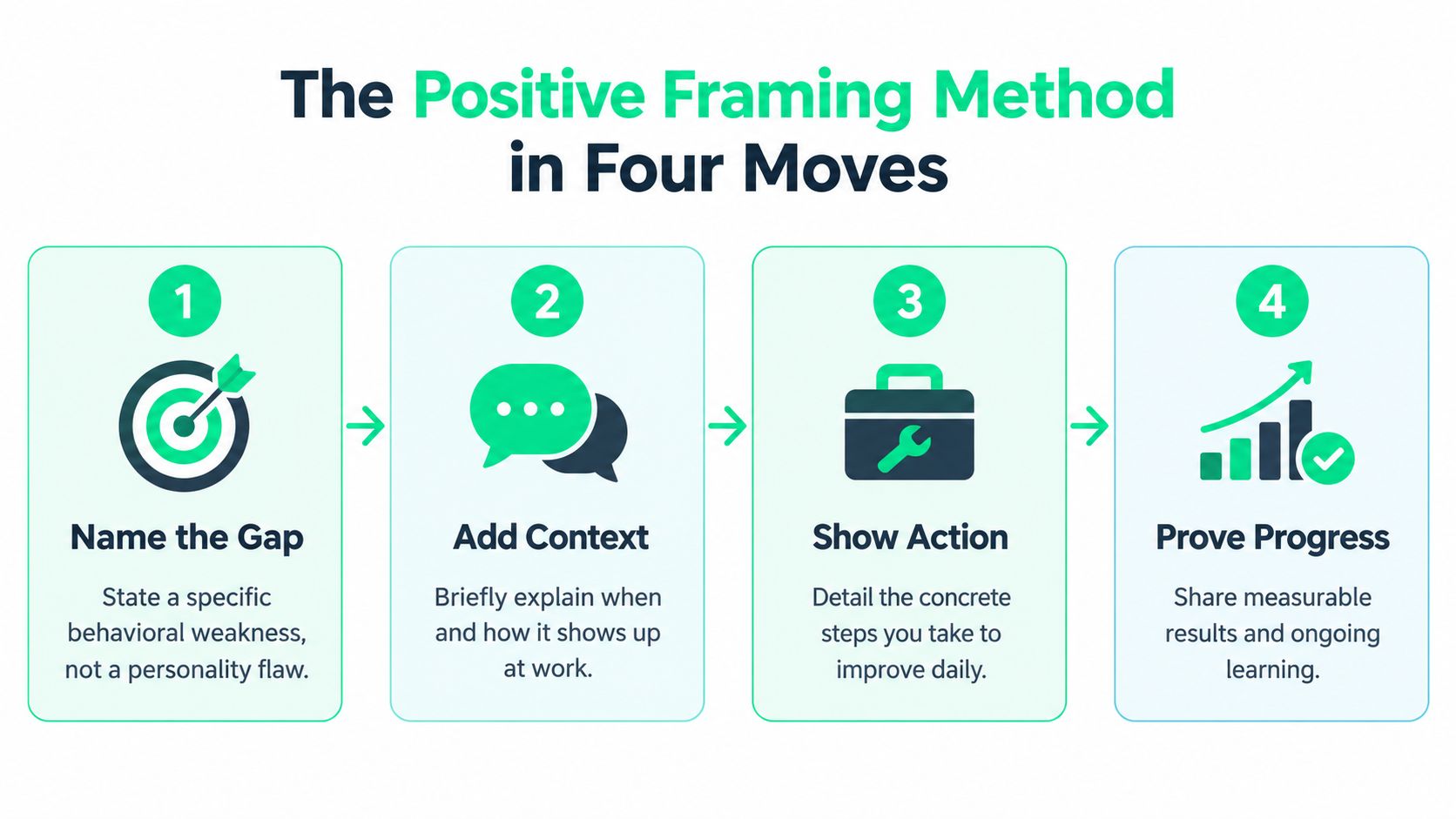
Move one, name the gap in behavioral language
Don't say, “I'm bad at leadership,” or “I'm not confident.” Those are identity statements. They're too broad and too hard to fix.
Say what happens at work.
Examples:
- Project communication gap: “I used to miss scope changes when several stakeholders were involved.”
- Execution gap: “I tended to over-focus on details, which slowed my delivery.”
- Speaking gap: “I used to over-explain when presenting to senior people.”
Behavior beats personality every time.
Move two, own it in one clean sentence
No dramatic apology. No speech about how hard you are on yourself. No attempt to make the interviewer comfort you.
Just own it.
Try lines like:
- Simple ownership: “That created avoidable confusion, so I had to tighten how I tracked changes.”
- Direct acknowledgment: “I realized it was affecting speed, not quality, and that was the part I needed to fix.”
That tone matters. Calm ownership signals maturity.
Move three, spend most of your answer on action
Candidates either win or lose the question here. MIT's STAR guidance suggests a practical split of roughly 20% Situation, 10% Task, 60% Action, and 10% Result so answers stay specific and evidence-driven, with the result section emphasizing quantifiable outcomes when you have them, as described in MIT's STAR method guide.
So don't linger on the weakness. Get to what you changed.
A stronger version sounds like this:
I used to miss scope changes on multi-stakeholder projects because I was tracking updates too informally. I noticed that if requests came through different channels, I'd sometimes act on an older version. I fixed that by using one source-of-truth document, confirming changes in writing after meetings, and ending check-ins with a quick recap of owners and revisions. That's made me much more reliable on cross-functional work, and it's a system I'd bring into this role.
Move four, end with a forward tie-in
Close by making the improvement relevant to the role you want. Short. Specific. Not salesy.
- For operations: “That matters in this role because clean handoffs and version control affect execution.”
- For client work: “It's helped me communicate more clearly when several people need different things at once.”
- For product or project roles: “Now I'm much better at keeping movement aligned as priorities shift.”
What to cut from your draft
Most weak answers have too much throat-clearing. Remove:
- Long disclaimers: “This might sound weird, but…”
- Therapy language: “I've always struggled with…”
- Resume padding: “As someone who's passionate about excellence…”
Use the frame, then strip it down until it sounds like a person talking.
Sample Answers for Early-Career, Career Changers, Neurodivergent, and International Candidates
Different candidates need different answers. That's not weakness. That's reality. A new grad shouldn't sound like a director. A career changer shouldn't pretend they have years of industry context. And if anxiety, sensory load, or language processing affects your delivery, your rehearsal method needs to reflect that.
Recent neurodiversity-focused guidance recommends advance detail about interview format, pacing, sensory conditions, and structured practice rather than script memorization, because uncertainty and cognitive load can raise anxiety. That's especially useful for this question, where candidates often freeze while trying to sound polished. See the practical guidance in this neuroinclusive interviewing resource.
Four answer models that actually sound credible
Candidate Profile Named Improvement Action Taken Forward Tie-In
Early-career
Hesitating to delegate in group projects
Started assigning owners and deadlines earlier
Shows readiness for team-based work
Career changer
Translating customer-facing experience into research-style analysis
Built a habit of documenting patterns and evidence before making recommendations
Connects transferable skills to the new field
Neurodivergent
Needing more structure when priorities shift quickly
Uses written task capture, meeting recaps, and priority checks
Shows a reliable workflow rather than a vague struggle
International candidate
Speaking too fast when nervous in English
Practiced pacing, pause points, and concise answer structure
Improves clarity in client or cross-functional communication
Use these as patterns, not scripts.
Early-career sample
If you're early-career, stop trying to sound “senior.” Name a junior-level gap and show that you're improving it.
One area I've worked on is delegation in group settings. Early on, I'd take on too much myself because I wanted to make sure everything got done well. I realized that slowed the team down, so I started assigning clear owners and deadlines earlier and checking in at set points instead of doing everything myself. That's helped me collaborate better, which matters in a role like this where the work moves through teams.
Career changer sample
Career changers often get too defensive. Don't explain your whole pivot. Answer the question.
I'm still improving how I translate fast, conversational sales instincts into a more research-driven style of problem solving. In sales, I was used to reacting quickly. In my transition work, I've trained myself to slow down, document patterns, and support recommendations with evidence before presenting them. That discipline has made my thinking sharper, and it's important for this role because the decisions need to be well-grounded.
Neurodivergent sample
You do not have to disclose a diagnosis. You can if you want to, but you don't need to. Focus on work behavior and support system.
One area I've improved is managing task-switching when several priorities change at once. I work best when expectations are clear, so I've built routines around written recaps, immediate note capture, and a quick priority check after meetings. That's helped me respond with less friction and more consistency. In this role, that means I can stay organized and deliver clearly even when the pace changes.
The goal isn't to sound effortless. The goal is to sound clear, honest, and in control of your method.
International candidate sample
If English isn't your first language, don't apologize for your accent. That's not the issue. Clarity is.
One area I've worked on is pacing my communication when I'm nervous. Early on, I sometimes spoke too quickly because I wanted to answer thoroughly, and that could make my points less clear. I've improved that by practicing timed answers out loud and building in pause points between ideas. That's made my communication more concise, which is important in a role where I'll need to explain work clearly across teams.
If you want more prompts to test and refine these examples, use a live bank of practice interview questions and answer them out loud, not in your head.
Delivering Your Answer in Real Time Without Losing Your Thread
Here's what usually happens. The interviewer asks the question. Your heartbeat jumps. You grab the first “safe” answer in your head. Halfway through, you realize you're rambling. Then you either keep digging or apologize and start over.
That spiral is predictable. You can interrupt it.
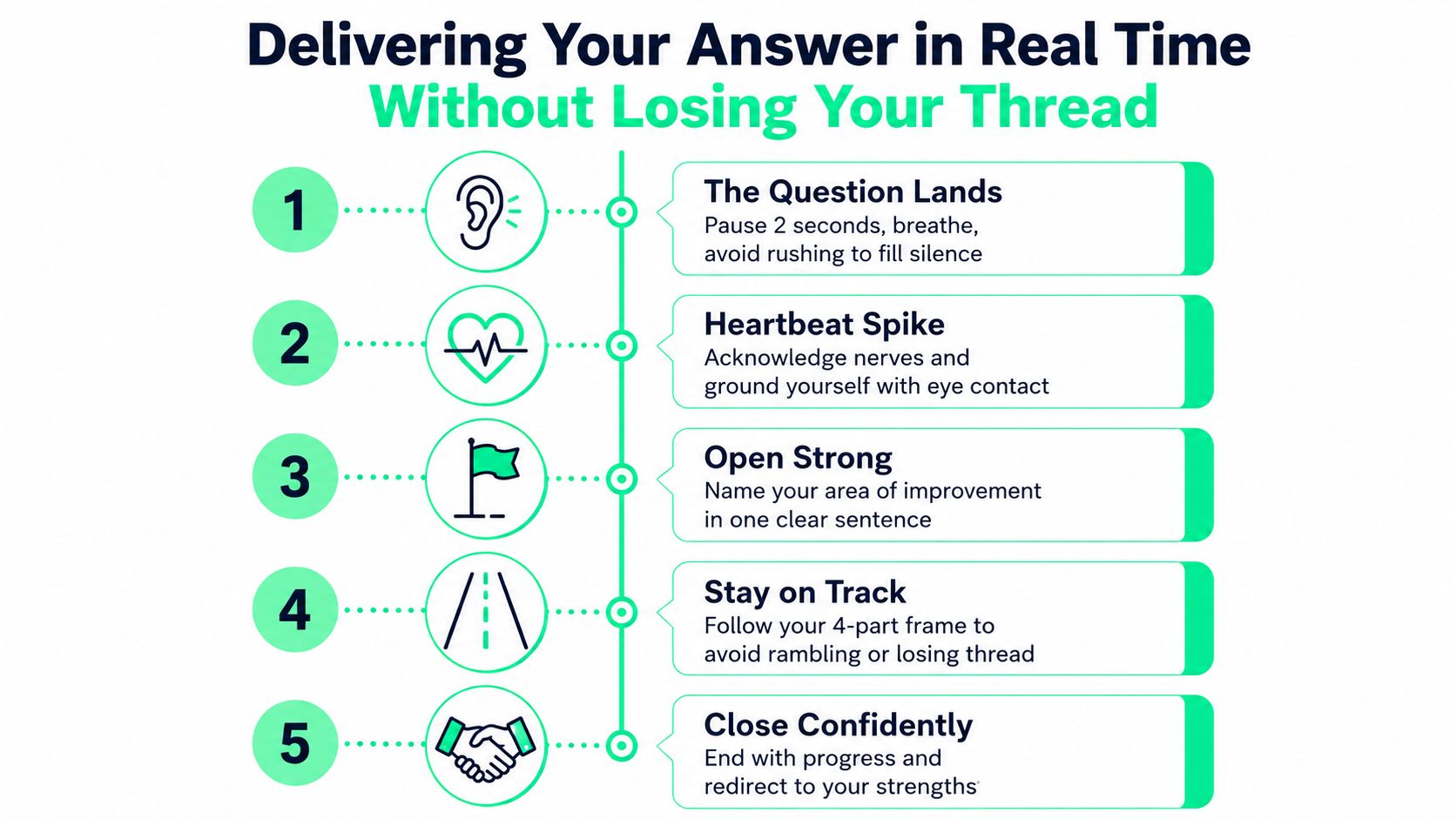
When the question lands
Take a two-second pause. Not ten seconds. Not a panicked instant reply. Two seconds gives your brain time to retrieve the frame.
Use a quiet breath cue before you start speaking. Inhale. Exhale. Then name the weakness in one sentence.
For most candidates, this answer should land in the 60 to 90 second range. Long enough to show judgment. Short enough to stay sharp.
When you feel yourself drifting
Use verbal checkpoints. These work because they let you restart without sounding lost.
Try:
- Reset phrase: “What that looked like in practice was…”
- Action bridge: “What I changed was…”
- Closing cue: “The result was that I became much more deliberate about…”
For video calls, keep your eye line near the camera when you open and close the answer. In the middle, it's fine to glance briefly at a note if you need a memory cue. For in-person interviews, use a physical anchor like a light wrist tap under the table or one keyword on a notepad such as “gap, fix, result.”
If you blank halfway through
Don't apologize. Redirect.
You can always say, “The short version is that I noticed X, changed Y, and now I handle it much better in team settings.”
That sentence alone can save a messy answer.
Candidates with high anxiety, ADHD, autism, or second-language processing often do better with cue-based rehearsal than full script memorization. Memorized scripts break the second you lose one word. A cue holds up under stress because it gives you structure, not a trap.
Weakness Answers That Quietly Cost You the Offer
Some answers don't explode your interview. They do something worse. They downgrade you from “strong maybe” to “too risky.”
That's why these clichés are dangerous. They make you sound either fake, unserious, or unaware of how hiring decisions get made.
The seven landmines
- Perfectionism: Interviewers have heard it too many times. It signals image management, not insight.
- I work too hard: Same problem. It reads like you're dodging the question.
- I'm too passionate: Fake flaw. Nobody buys it.
- A confession that breaks role fit: If the weakness is core to the job, you've just talked yourself out of contention.
- Blame shifting: “My old team had no structure” tells them you externalize problems.
- A laundry list: Five weaknesses means poor judgment.
- No growth ending: If the story ends with the flaw still running the show, they'll assume it will show up on the job.
Robert Half's practical guidance gets this right. A strong weakness answer should name a real, fixable limitation that doesn't disqualify you, then explain what changed and show evidence of improvement with a real example. Their example of over-focusing on details and fixing it with time-boxing or a review checklist is exactly the level of specificity you want in their interview weakness advice.
Cliché vs. Credible side-by-side answer swaps
Overused Answer What It Signals Stronger Rewrite
I'm a perfectionist
Rehearsed and evasive
I used to over-focus on details, which slowed delivery. I fixed that by time-boxing first drafts and using a final review checklist so I could move faster without losing quality.
I work too hard
Fake flaw
I used to say yes too quickly to extra requests, which hurt prioritization. I've gotten better about confirming timelines and tradeoffs before committing.
I'm too passionate
Low self-awareness
I used to over-explain ideas in meetings. I improved by preparing the headline first and limiting myself to the key recommendation and support.
I'm bad at public speaking for a client-facing job
Role risk
I used to get nervous leading larger internal updates, so I began practicing short structured briefings and asking for feedback on pace and clarity.
My manager didn't give clear direction
Blame shifting
I realized I needed stronger upward clarification, so I started confirming scope, owners, and deadlines in writing after meetings.
I have trouble with everything from time management to communication
Poor judgment
One area I've focused on is prioritization when multiple requests hit at once. I now rank by deadline, impact, and dependency before starting work.
I know this is still a weakness for me
Unresolved risk
This used to slow me down, but the system I built has made me much more consistent, especially on shared projects.
Two answers get rejected fast even when the rest of the interview is decent: the fake-strength answer and the dramatic over-share. One sounds slick. The other sounds unstable. Neither builds trust.
A Seven-Day Practice Plan With Mock Interviews and Feedback Loops
If you only think about your answer, it won't hold up in an interview. You need spoken reps. Out loud. Timed. Reviewed.
Behavioral interviewing matters because past-behavior answers are used as a real predictor of future performance. Structured behavioral interviewing is described as having predictive validity and as an effective selection tool for predicting sales success and improving salesperson retention in this behavioral interview research article. That's why rehearsal isn't cosmetic. It changes how your answer gets evaluated.
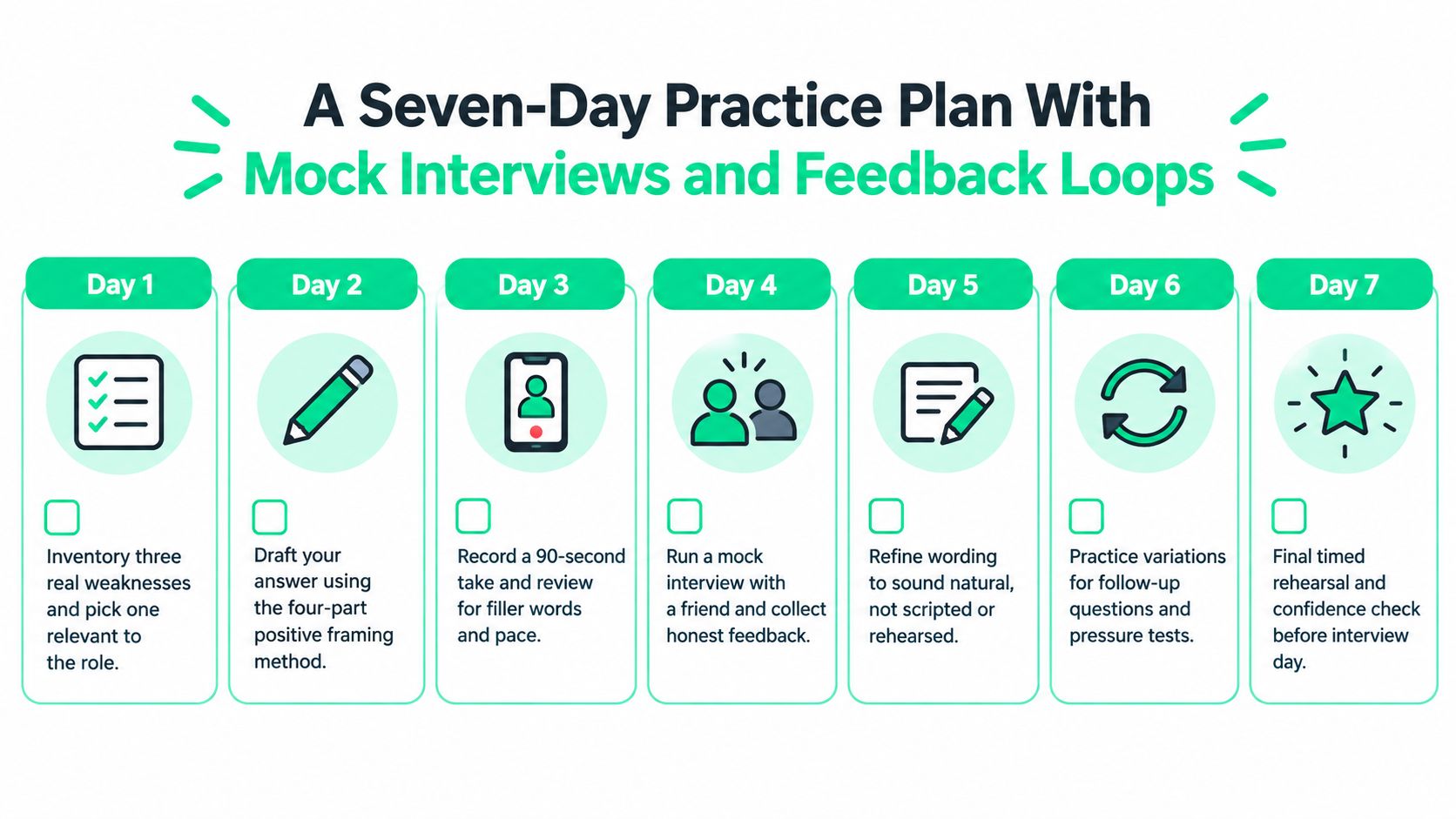
Day 1 to Day 3
Start with selection, then structure, then playback.
- Day 1, pick the right weakness
- Write down three real weaknesses. Cross out any that are fatal for the role. Keep the one that is honest, fixable, and job-relevant.
- Day 2, build the four-move answer
- Draft it in plain language. Gap, ownership, action, forward tie-in. No polishing yet.
- Day 3, record one take
- Record a 90-second answer on your phone. Play it back once for content and once for delivery. Listen for vagueness, filler words, and whether the action step gets enough time.
Day 4 to Day 5
These two days stop you from becoming too scripted.
- Day 4, run a mock with another person: Ask a friend, mentor, career center advisor, or peer to ask the question cold. Have them interrupt once with a follow-up like, “What specifically did you change?”
- Day 5, swap the weakness: Build a second version around another honest improvement area. This keeps you flexible if the interviewer rephrases the prompt.
A lot of basic interview mistakes come from poor preparation, rambling, and failing to ask questions. Monster also notes that being unprepared is the most common dealbreaker for hiring managers and recommends researching the company, role, and interviewer before the meeting. A useful prep move is to write a short summary of the company mission, recent news, and your top three relevant achievements, as outlined in Monster's interview mistakes guide.
Day 6 to Day 7
Now stress-test the answer.
Day 6
Run two back-to-back mock interviews and track:
- Clarity: Did the answer make sense on first listen?
- Specificity: Did you name a real behavior?
- Ownership: Did you take responsibility cleanly?
- Growth: Did you show a change in method?
- Length: Did you stay within the target window?
Use any combination of tools that gives you objective playback. A phone recording app works. A transcription app helps you catch repeated filler words. AI mock interview tools can flag pacing and answer length. One option is Qcard's mock interview AI, which is built to score practice answers and surface areas for improvement after the session.
Day 7
Simulate the interview. Dress normally for the role. Sit where you'll sit. Answer the question without notes. Then review short audio clips, not just your memory of how it felt.
If your answer only works when you can see the script, it isn't ready.
By the end of day seven, you should be able to deliver the answer cold. Not perfectly. Cleanly.
That's enough.
Key Takeaways
- Interviewers assume you have weaknesses — what they're actually scoring is self-awareness, ownership, and forward motion, which means the answer fails not because you admitted a gap but because it sounded fake ("I'm a perfectionist"), evasive ("I work too hard"), or unresolved (the flaw still running the show at the end of the story).
- Behavioral language beats identity language in every version of this answer — "I'm not confident" is too broad and too hard to fix, while "I used to over-explain when presenting to senior people" names something specific, observable, and correctable, which gives the interviewer evidence rather than a self-assessment.
- The Action section decides the answer — MIT's STAR guidance suggests roughly 60% of your time on what you changed, which means the practical discipline is to name the gap quickly and spend the answer on the system you built: one source-of-truth document, written confirmations after meetings, time-boxed first drafts, or a final review checklist.
- Picking the wrong weakness is the fastest way to lose the role — naming something fundamental to the job can disqualify you immediately, so the selection rule is honest, fixable, and job-adjacent rather than job-critical, and the cliché swaps matter here too: "I'm bad at public speaking" for a client-facing job becomes "I used to get nervous leading larger internal updates, so I began practicing short structured briefings."
- Cue-based rehearsal beats script memorization, especially under cognitive load — a memorized answer breaks the second you lose one word, while a cue like "gap, fix, result" holds up under stress, and verbal checkpoints ("What that looked like in practice was…", "What I changed was…") let you restart mid-answer without sounding lost, which matters most for candidates managing anxiety, ADHD, autism, or second-language processing.
Qcard helps you practice answers like this without turning you into a script reader. It gives you resume-grounded cues, mock interview feedback on pacing and structure, and support for staying clear under pressure, which is exactly what most candidates need for an areas of improvement interview. If you want a more structured way to rehearse before the thing, visit Qcard.
Ready to ace your next interview?
Qcard's AI interview copilot helps you prepare with personalized practice and real-time support.
Try Qcard Free