TL;DR
The Amazon Loop runs three to five interviews of roughly 45 to 60 minutes each, with each interviewer assessing different Leadership Principles or technical competencies and the signals combined afterward — a distributed evidence model, not a single-decision conversation. That means repeated questions about the same project are by design, and your preparation should produce a small portfolio of verified stories you can view from multiple angles rather than 25 memorized answers. Use STAR as an evidence chain: what you personally owned, the trade-off you rejected and why, measurable outcomes, and what you learned. In technical rounds, explain failure modes, monitoring, and business impact rather than presenting a clean diagram. Build a coverage map listing which stories prove which principles, keep backup examples ready for follow-ups, and run a four-week plan — weeks one and two for story mining and fact verification, weeks three and four for spoken rehearsal with interruptions. Keep the final days light and stop adding new stories.
You're staring at your calendar, and the day of the Amazon Loop feels too close. The interviews are stacked, the questions all seem to blur together, and every story you've prepared suddenly feels either too long, too vague, or not technical enough.
That anxiety makes sense. Amazon's final-stage process is not one conversation, it's a structured loop of multiple interviews, often three to four interviews lasting about 45 to 60 minutes each, with technical program manager roles described as five 55-minute interviews (Amazon's careers guidance, Amazon's interview loop). The good news is that the loop is built to assess evidence from different angles, not to trap you with trivia. If you stop memorizing endless question lists and start building an evidence portfolio, the whole process becomes more manageable.
What Should You Expect from Amazon Loop Interview Questions?
The Amazon Loop isn’t one conversation — it’s a structured series of interviews, commonly three to four sessions of roughly 45 to 60 minutes each, with technical program manager roles described as five 55-minute interviews. For SDE II candidates, Amazon’s process includes an online assessment, a systems design section, a work-style survey, and then four 55-minute loop interviews if you advance.
The design principle that changes how you prepare: Amazon uses a distributed evidence model. Each interviewer assesses a specific set of Leadership Principles or technical competencies, and your case gets built piece by piece rather than decided in one room. One strong conversation doesn’t cancel weak evidence elsewhere — and when two interviewers ask about the same project, that’s intentional, not a mistake.
So stop collecting questions and start building an evidence portfolio. Keep a small set of strong, verified stories and shift the angle to match each prompt. A project rescue can demonstrate Deliver Results in one round, Dive Deep in another, and Earn Trust in a third. The facts stay the same; the emphasis moves.
For behavioral rounds, Amazon’s own guidance recommends STAR with specifics and data. Treat it as an evidence chain rather than a script: state what you owned (not what the team broadly did), name the trade-off you rejected and why, use measurable evidence where you have it, and close with what you’d repeat or change. “I improved the process and the team was happier” fails; “I replaced three handoffs with a single template and cut cycle time from 10 minutes to 6” works.
For technical rounds, narrate the reasoning as you go. If you choose a cache, explain why the traffic pattern supports it, what happens when it goes stale, and how you’d monitor it. The rule: if you can’t explain how your design fails, you haven’t explained the design yet.
A Bar Raiser — a neutral participant who helps keep hiring standards consistent — also evaluates alignment with the Leadership Principles, which is why your evidence needs to hold up under a different lens than the hiring team’s.
Surviving the Amazon Loop Marathon
The Loop day usually starts calmly enough. You answer the first question, then hear a later interviewer revisit the same project from a different angle. That repetition can feel unnerving, but it is the design.
Amazon uses the loop to examine the same experience through different lenses, including behavioral judgment, role-specific depth, and long-term fit. For SDE II candidates, Amazon's own Amazon SDE II preparation guidance describes an online assessment, a systems design section, a work-style survey, and then four 55-minute loop interviews if you advance. One polished answer rarely carries the day. Interviewers are gathering separate signals.
Treat the day like a portfolio review
A portfolio mindset works because each story has a job. One example can show ownership, another can show how you handled incomplete data, and a third can show technical trade-offs. You are not trying to sound identical in every room. You are trying to prove the same capability with different evidence.
Practical rule: if two interviewers ask about the same project, do not repeat the same script. Shift the angle, one version can emphasize decision-making, another can emphasize metrics, and a third can focus on what you learned.
That shift also protects your energy. Instead of carrying 25 separate answers, you keep a small set of strong stories and adapt them as needed.
For practice, a short mock session can reveal where your stories feel too rigid or too thin. Tools like a mock interview workflow are useful when you want real-time practice without turning preparation into memorization.
This approach also helps neurodivergent and international candidates. If recall gets harder under stress, build cue cards with one line for the situation, one for your action, and one for the result. If English is not your first language, rehearse simple transitions you can rely on when a question changes shape. Clear structure beats a perfect script.
The goal on interview day is calm, specific evidence. When your examples are organized like a portfolio, you can respond to repeated questions without losing your footing.
How the Distributed Evaluation Model Works
A Loop interview can feel fragmented if you expect one person to decide everything. Amazon spreads the evaluation across interviewers, and each person looks at a specific set of Leadership Principles or technical competencies. The result is a distributed evidence model, where your case is built piece by piece rather than judged in one conversation.
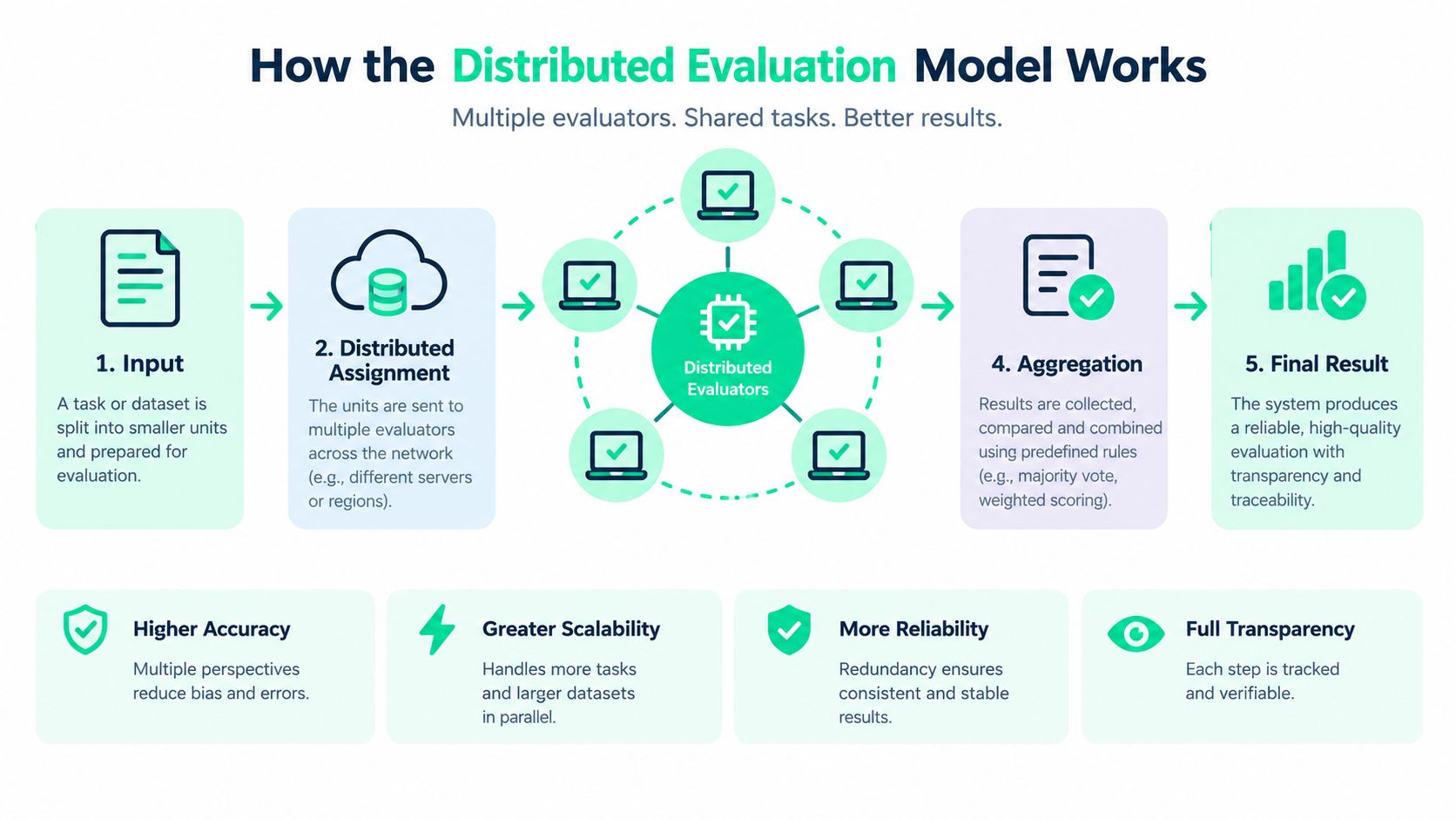
Amazon's hiring overview explains that loop interviewers assess different parts of your skills and experience, and the role's technical and behavioral signals are combined across the process (Amazon hiring overview). For technical roles, that usually means separate proof for coding depth, system design, and judgment. One strong conversation does not cancel weak evidence elsewhere, and repeated questions are often a sign that interviewers are checking the same trait from different angles.
Why the same story gets asked in different ways
If one interviewer asks about a hard technical choice and another asks about a disagreement with a stakeholder, both may be testing ownership or judgment. Your answer should stay anchored in the same facts, then shift the emphasis to match the question. That keeps you consistent without sounding memorized.
Amazon's Bar Raiser plays a part here too. AWS describes this role as a neutral participant who helps keep hiring standards steady and checks alignment with Amazon's Leadership Principles (AWS executive insights). The point is not whether the team enjoyed your answer. The point is whether your evidence still holds up when it is examined by someone looking for different signals.
Interview habit that helps: prepare one story with multiple entry points. A product launch can support Ownership in one round, Deliver Results in another, or Earn Trust in a third.
For many candidates, the missing piece is not more questions. It is a coverage map. List the experiences that prove each principle, note which stories can answer more than one kind of prompt, and keep backup examples ready for follow-up questions. That gives you structure without forcing every answer into one script.
Neurodivergent and international candidates often benefit from making the structure visible. Short cue cards can reduce working-memory load, especially when stress makes recall harder. If English is not your first language, rehearse a few simple transition phrases so you can move between the situation, your action, and the result without searching for wording on the spot.
ParakeetAI's question collection can help you see how broad the question pool is, but breadth alone is not the goal. Use it to build a small, flexible evidence set that you can adapt across interviewers and question styles.
Mastering Behavioral Questions and Leadership Principles
Amazon's behavioral questions are not warm-up questions. They are the core of the evaluation, because interviewers are expected to probe your concrete decisions, results, and learning. Amazon's interview guidance recommends the STAR method, Situation, Task, Action, Result, and explicitly pushes candidates to use specifics and data where possible (Amazon interview guide).
Build an evidence chain, not a script
The easiest way to understand STAR is to think of it as an evidence chain. Start with the situation, define the task, describe the exact action you personally took, and close with the result. The strength of the answer comes from the links between those parts, not from polished phrasing.
A weak answer sounds like this, “I improved the process and the team was happier.” That's too vague to evaluate. A stronger answer sounds like, “We had a delay because the release checklist was manual, I owned the review, I replaced three handoffs with a single template, and the team cut the cycle time from 10 minutes to 6 minutes.” The second version shows ownership, method, and outcome.
Adapt one story to several principles
The same story can support different principles if you change the angle. A project rescue might show Deliver Results in one round, Dive Deep in another, and Earn Trust in a third. What matters is that each answer is evidence-based, not generic.
- Start with your role: state what you owned, not what the team broadly did.
- Name the trade-off: say what you rejected and why you rejected it.
- Use measurable evidence: mention metrics, timelines, reliability, defect rates, or customer impact when you have them.
- Close with learning: explain what you'd repeat or change next time.
If you want extra practice prompts, a bank like Qcard's interview coach can help you rehearse the structure without turning your answers into scripts. The point isn't to memorize language. It's to make your best examples easy to retrieve under pressure.
Strong answer principle: Amazon cares less about “team success” in the abstract and more about what you personally did, what options you weighed, and what changed because of your decision.
That's why follow-up questions matter so much. The interviewer may ask what data you used, who disagreed, or what you'd do differently. If your answer is built as an evidence chain, those follow-ups are easier to handle because you already know the logic behind your story.
Navigating Technical and System Design Rounds
A correct answer in Amazon's technical rounds is more than code that runs. Interviewers are listening for how you reason about scale, reliability, and ownership, because those same habits show up in behavioral judgment too. In the loop, coding and system design are paired with work-style evaluation, so the goal is to show clear thinking, not to recite a polished script.

Explain the trade-off, not just the solution
In coding interviews, the interviewer wants to hear complexity, edge cases, and how you would test the result. In system design, the focus shifts to scalability, failure modes, bottlenecks, and how you would watch the system in production. The strongest answers connect each technical choice to a business effect.
A useful habit is to narrate the reasoning as you go. If you choose a cache, explain why the traffic pattern supports it, what happens when the cache goes stale, and how you would monitor it. If you choose a queue, say what it protects, what happens under backpressure, and how you would recover if retries start piling up.
Technical interview rule: if you cannot explain how your design fails, you have not explained the design yet.
That same habit helps with Amazon's behavioral lens. If you say, “I chose a simpler architecture because the first release needed stability and fast iteration,” you are showing technical judgment, ownership, and frugality at once. The same logic applies when you reject a more complex design and explain why it was the wrong fit.
Preparation works better when it is specific. Practice interview questions for technical rounds can help you rehearse coding and design prompts together, so your answers stay tied to real examples instead of drifting into generic talk. For mid-level and senior candidates, that matters because Amazon usually wants to hear how your design choices led to measurable outcomes, not just a clean diagram.
Interview Strategies for Neurodivergent and International Candidates
High-stakes interviewing can overload working memory fast. You're translating the question, filtering for the principle, recalling the right example, managing timing, and trying to sound natural at the same time. For neurodivergent candidates and international candidates, that load can make a good answer feel inaccessible even when the knowledge is there.
Reduce cognitive load before you walk in
The most useful preparation isn't more questions, it's better retrieval. Keep your evidence portfolio small and highly organized. For each story, write down the situation, your exact role, the metric or outcome, and one line on what you learned. That gives your brain a predictable path back to the story when stress starts to spike.
If English isn't your first language, practice short answer starts. A clean first sentence gives you control. Something like, “I'll answer with the situation, the decision I made, and the result,” buys you a second to settle in and organize your thoughts without sounding unnatural.
Use memory cues, not scripts
Some candidates do better with low-friction prompts than with full notes. That can mean a one-line cue card, a short checklist beside the screen, or a live coaching tool that surfaces your own verified talking points without writing the answer for you. One option is Qcard, which uses resume-grounded cues, pacing support, and real-time follow-up help to keep answers authentic rather than scripted.
Useful pacing strategy: pause for one breath before answering a hard question. That pause often sounds thoughtful, not slow.
The best interview answer is not always your fastest one. Neurodivergent candidates often benefit from reducing surprise, and international candidates often benefit from practicing idioms, cadence, and concise transitions before the live interview. If you know you ramble under stress, rehearse stopping points. If you know you blank on metrics, keep the numbers visible in a private prep sheet.
The bigger point is fairness. Interview performance should reflect your experience, not how well you can perform under artificial cognitive strain. When you support retrieval instead of memorization, you give your actual judgment a better chance to show up.
Building Your Four-Week Preparation Plan
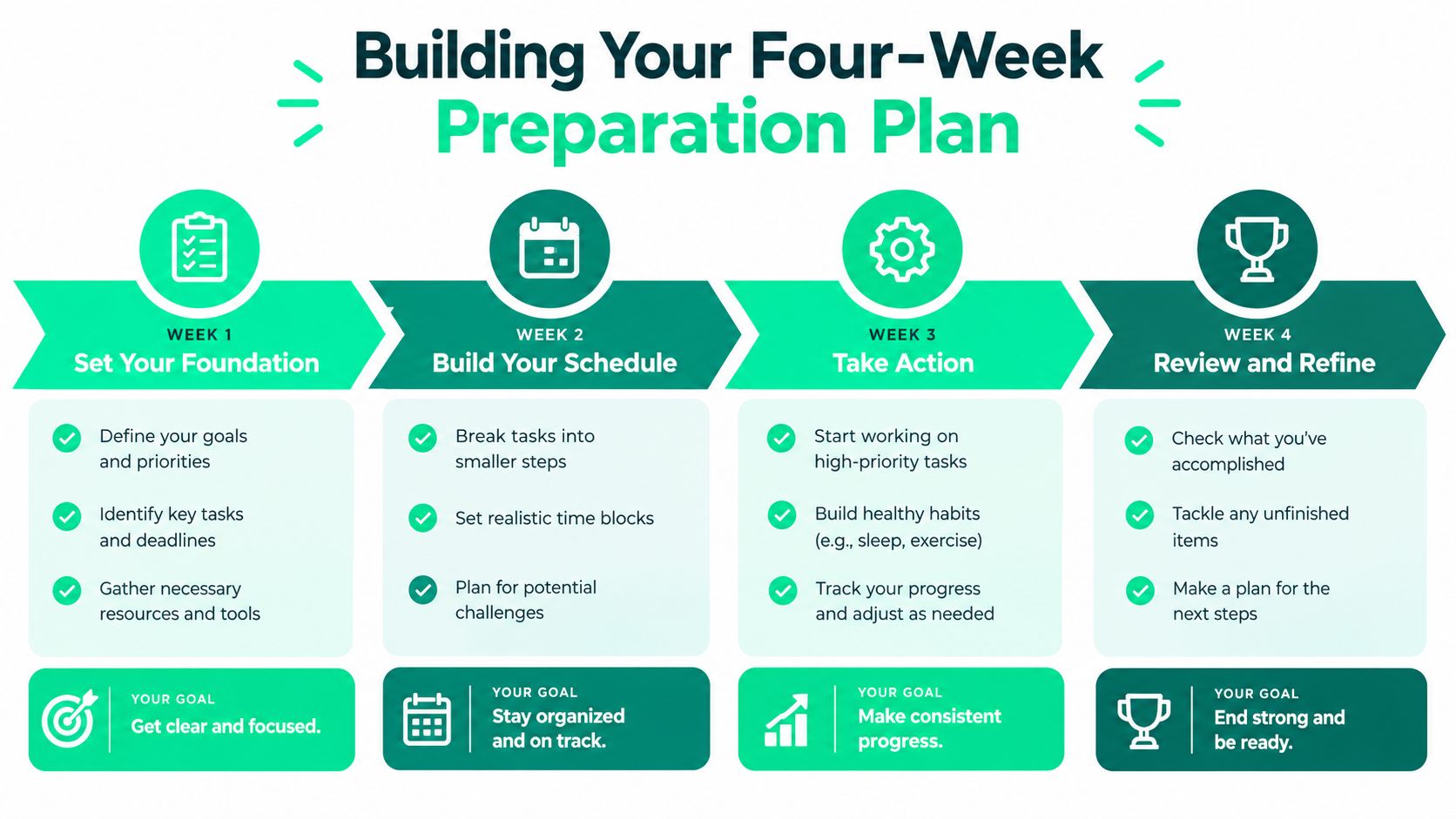
A Loop interview often feels like a set of moving targets. One interviewer asks for ownership, another probes trade-offs, and a third tests how you think under pressure. A four-week plan gives you a way to build an evidence portfolio, so each answer draws from verified stories instead of last-minute recall.
Week 1 and 2 focus on story mining
Start by listing your strongest examples across ownership, conflict, technical depth, customer focus, and results. Then verify the facts. Check project notes, performance reviews, launch docs, and any metrics you can defend. The goal is not to invent stronger stories. It is to make your real stories easier to recall and harder to distort under stress.
By the end of week 2, each story should fit on a short card. Include the situation, your role, the action, and the result. If a story only supports one Leadership Principle, keep it. If it can support several, even better. That flexibility matters in the Loop, where the same experience may be viewed through different interview lenses.
Week 3 and 4 focus on rehearsal
Shift from notes to spoken answers. Record yourself once, then listen for filler words, weak openings, and answers that stay in setup mode too long. Then do live practice with someone who can interrupt you the way an interviewer would.
- Run one behavioral session: answer one question, then take a tough follow-up.
- Run one technical session: explain a design out loud and defend your trade-offs.
- Run one mixed session: switch between behavioral and technical prompts so you practice context switching.
- Tighten your openings: the first 15 seconds should make your point obvious.
For neurodivergent candidates, repetition works best when it is predictable. For international candidates, practice short answer starts, simple transitions, and any idioms that feel awkward in speech. A clean first sentence can buy you time to settle in without sounding forced. A one-line cue card, a short checklist beside the screen, or a live coaching tool that surfaces your own verified points can also reduce load without turning your answer into a script.
The final few days should be light. Review your evidence portfolio, check your setup, and stop adding new stories. Use the time to arrive rested and ready to tell the truth clearly.
Final Takeaways for Interview Day Success
Amazon loop interview questions are easier to handle when you stop thinking in terms of scripts and start thinking in terms of evidence. The loop is built to compare signals across interviewers, so your job is to give each interviewer clear, defensible proof of how you work. That means real examples, personal ownership, and specific outcomes.
Keep your checklist simple on interview day. Test your camera and audio, keep water nearby, set your notes where you can glance at them without reading, and give yourself a few minutes of quiet before the first call. If a question lands hard, pause, breathe, and answer from the evidence portfolio you built.
What wins the day is not perfect polish. It's structured honesty under pressure.
Key Takeaways
- The Loop is a distributed evidence model, not a sequence of independent conversations — each interviewer gathers specific signals that get combined afterward, which means one polished answer can’t offset weak evidence elsewhere, and when a later interviewer revisits the same project it’s usually checking a different trait rather than catching an inconsistency.
- Prepare one story with multiple entry points instead of one answer per question — a product launch can support Ownership in one round, Deliver Results in another, and Earn Trust in a third as long as the facts stay constant and only the emphasis shifts, which keeps you consistent without sounding memorized across five interviews.
- Amazon’s behavioral evaluation cares about your personal decision, not team success in the abstract — state what you owned, name the option you rejected and why, attach a metric or timeline where you have one, and close with what you’d change, because follow-ups like “what data did you use?” or “who disagreed?” are easy to handle when the answer was built as an evidence chain.
- In technical rounds, the trade-off is the answer — explaining why a cache fits the traffic pattern, what happens when it goes stale, and how you’d monitor it demonstrates more than working code, and saying “I chose a simpler architecture because the first release needed stability and fast iteration” shows technical judgment, ownership, and frugality simultaneously.
- A four-week plan beats last-minute recall — weeks one and two for mining stories and verifying facts against project notes, reviews, and launch docs so your real examples are harder to distort under stress, then weeks three and four for spoken rehearsal including one behavioral session with a tough follow-up, one technical session defending trade-offs, and one mixed session that forces context switching.
If you want live support while you practice for Amazon, Qcard gives you resume-grounded memory cues, pacing help, and mock interview practice without scripting your answers. It fits this topic well because the core challenge in the Loop is turning your own experience into clear evidence under pressure. Visit Qcard and use it to rehearse the stories you'll want to tell.
Ready to ace your next interview?
Qcard's AI interview copilot helps you prepare with personalized practice and real-time support.
Try Qcard Free