10 Interview Questions About Character and STAR Answers
TL;DR
Character questions test judgment, accountability, reliability, humility, conflict resolution, initiative, and coachability — and they’re answered with decisions, not adjectives. The ten questions above each follow the same pattern: name the situation and the tension in a sentence or two, explain what you personally decided and did, then state the result and one honest reflection. The strongest versions show a real cost (integrity that was inconvenient), a system behind the behavior (a changelog, a checklist, a verification step), and a lasting change rather than a polite reaction. You don’t need ten separate stories — pick three strong experiences covering integrity, accountability, and teamwork, then map each to several competencies. Write them in STAR order without memorizing scripts, build short memory cues for each, and rehearse the follow-ups (“Who was affected?” “When did you realize?” “What would you do differently?”) since that’s where thin examples get exposed.
You hear, “Tell me about a time you made an ethical decision,” and your mind goes blank. You know you're dependable, honest, and collaborative, but intentions don't give an interviewer enough evidence. Strong answers about character show what you did when the convenient choice conflicted with accuracy, responsibility, fairness, or another person's needs.
The ten interview questions about character below focus on judgment, accountability, reliability, humility, conflict resolution, initiative, coachability, and teamwork. Each question includes a STAR breakdown, a sample answer built around a real decision, follow-up prompts an interviewer may use, and a memory cue to help you recall the story under pressure. This evidence-based approach is more useful than broad claims such as “I'm a team player.” It also aligns with how early-stage employers assess qualities such as ownership and judgment, including the approach described in how Underdog.io assesses early hires.
What Are the Most Common Interview Questions About Character?
Character questions ask for evidence, not adjectives. “I’m dependable and honest” tells an interviewer nothing — what counts is what you did when the convenient choice conflicted with accuracy, responsibility, fairness, or someone else’s needs.
The ten that appear most consistently:
- Tell me about a time you demonstrated integrity under pressure — Integrity becomes credible only when the right choice had a cost. Build the answer around the decision, not the trait.
- Describe a mistake you made and how you handled it — Keep the error to one or two sentences and spend the rest on when you recognized it, whom you told, and what you changed.
- Tell me about a time you gave difficult feedback — Describe the behavior, not the person. “The submission lacked tests” is evidence; “they were careless” is interpretation.
- Describe a time you kept a commitment when no one was checking — The evidence is the self-imposed standard plus the system behind it (a changelog, checklist, or log), not a claim about reliability.
- Tell me about a time you admitted you didn’t know something — The decision that matters is pausing rather than improvising, followed by how you closed the gap and verified it.
- Describe a conflict with a colleague and how you resolved it — A conflict story should show resolution, not victory, and represent the other person’s position fairly.
- Tell me about a time you stood up for what was right — Show judgment about seriousness, channel, and protecting the people affected — not dramatic language about courage.
- Describe a time you took ownership outside your job description — Initiative becomes overstepping without consultation; the strongest answers test a small solution with the people who’d use it.
- Tell me about a time you changed your approach after critical feedback — Include the uncomfortable first reaction. The proof of coachability is a changed method, not a polite response.
- Describe a time you helped a teammate succeed without getting credit — Keep attention on their progress and the line between teaching and taking over.
Every one of these works best in STAR order with a short memory cue attached — “outdated data, night before, rebuilt slide, source checklist, presented on time” recalls the sequence without forcing you to reproduce sentences.
1. Tell Me About a Time You Demonstrated Integrity Under Pressure
Interviewers want to know whether you act on your values when doing so costs time, status, convenience, or a relationship. Financial services interviews may ask about refusing to bend compliance rules to meet a deadline, while consulting firms often explore conflicts involving client data or confidentiality.
A useful version of the question is, “Tell me about a time you had to choose between what was easiest and what was right at work.” Build your answer around the decision, not the adjective. Explain the situation, the ethical tension, the action you took, and the result.
Practical rule: Integrity becomes credible when the right choice has a consequence.
Suppose you noticed a teammate reporting inflated test results in a class project. A strong answer could sound like this:
Situation: “Our group was preparing a report, and I noticed that several test results had been overstated.”
Task: “I needed to protect the accuracy of the submission without accusing my teammate unfairly.”
Action: “I raised the discrepancy privately, documented the correct figures, and asked our instructor to review them before submission.”
Result: “The project was delayed by two days, but the final report was accurate, and the instructor cited our transparency in the feedback.”
Expect follow-ups such as, “What options did you consider?”, “Who was affected by your decision?”, and “What would you do differently now?” Add the project name and outcome to your Qcard memory cues, then use Qcard's mock interview AI to rehearse the follow-ups until you can recall the sequence naturally.

2. Describe a Mistake You Made at Work or School and How You Handled It
A mistake answer should show ownership, repair, and lasting change. Interviewers usually care less about the error itself than about when you recognized it, whom you told, and what you changed afterward.
Try this phrasing: “Tell me about a mistake you made that affected others and what you did next.” Keep the mistake to one or two sentences, then spend most of the answer on your response.
In a group presentation, you might say:
Situation: “I used outdated market data in a presentation, and I discovered the problem the night before we presented.”
Task: “I had to correct the analysis without leaving my teammates unprepared.”
Action: “I emailed the team immediately, rebuilt the slide with current figures, and added a source-check step to our shared checklist.”
Result: “We presented on time, and our professor specifically noted the updated analysis.”
Interviewers may ask, “When did you realize something was wrong?”, “Who did you tell, and how?”, or “What process did you change?” Software and product teams often use blameless postmortems, so they may be listening for an ability to improve a system without shifting blame. Graduate programs and internships may focus on missed deadlines or errors in group work.
Avoid choosing a trivial typo unless the role makes that example relevant. Also avoid over-apologizing. A calm explanation of the error, recovery, and new habit sounds more reflective than an extended confession.

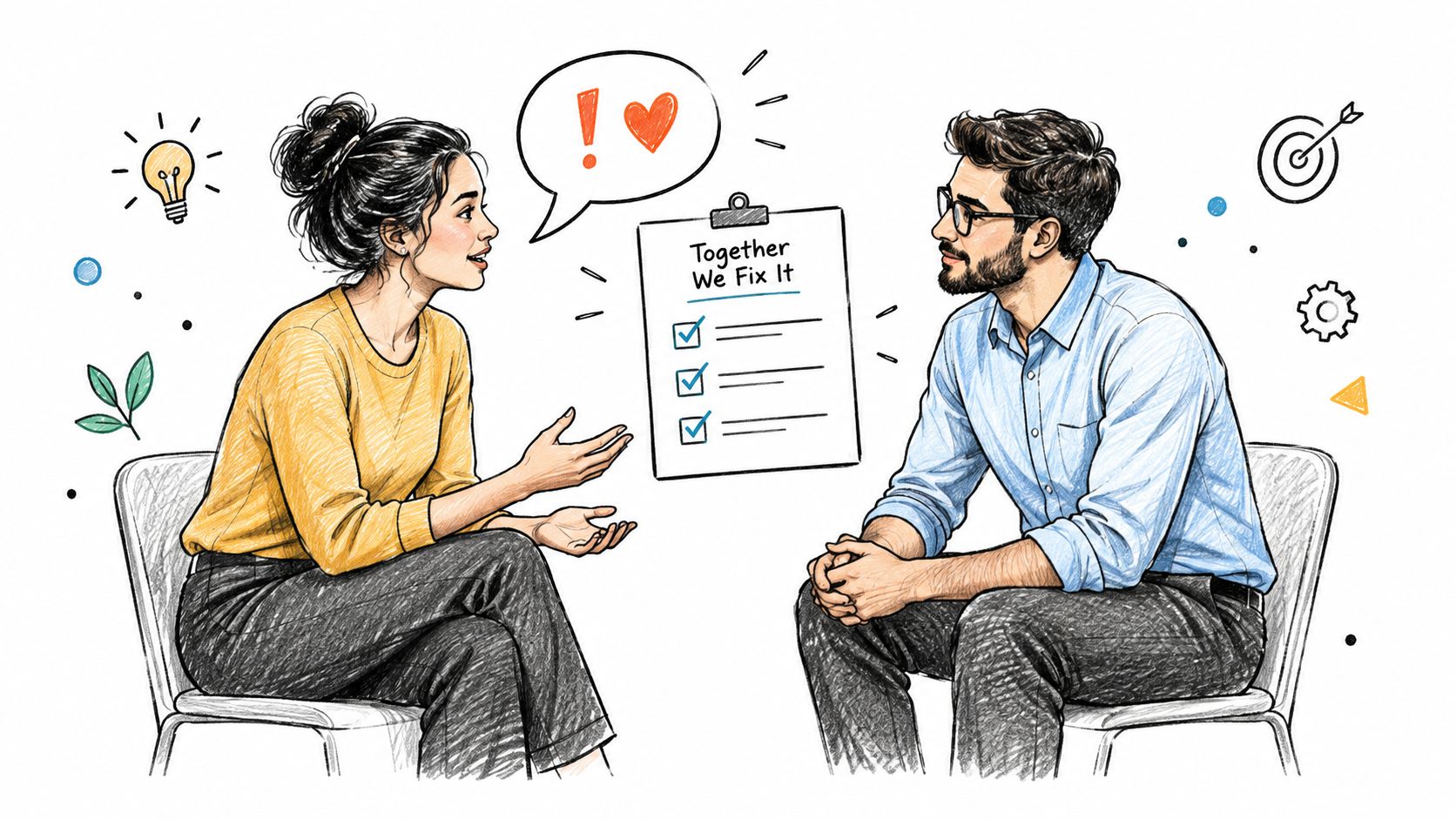
3. Tell Me About a Time You Gave Difficult Feedback to Someone
Difficult feedback tests whether you can be honest without being careless. Teams need people who can identify a problem, describe it accurately, and help another person improve without turning the conversation into a judgment about character.
Use a specific prompt such as, “Describe a situation where you had to tell a peer or manager something they didn't want to hear.” Before speaking, check your assumptions and gather examples of the behavior.
A strong answer might be:
Situation: “A teammate kept submitting code without tests, which was slowing our reviews.”
Task: “I needed to raise the issue without embarrassing them or assuming I knew why it was happening.”
Action: “I scheduled a one-on-one, described the pattern with specific examples, asked what was getting in the way, and agreed on a shared test checklist.”
Result: “Within two sprints, the review backlog dropped by half.”
Follow-up prompts may include, “How did you prepare for the conversation?”, “How did the person respond?”, and “What would you change about how you delivered the message?” Peer code reviews and sprint retrospectives create useful stories, as do group projects where you had to address missed work.
Describe the behavior, not the person. “The submission lacked tests” gives the interviewer evidence. “They were careless” only shows your interpretation.
“Good feedback protects the work and the relationship at the same time.”
Keep the story focused. Qcard's Interview Coach can help you stay under about two minutes so the behavior, decision, and result don't disappear inside a long explanation.
4. Describe a Time You Kept a Commitment When No One Was Checking
Reliability shows up in the standards you maintain without supervision. This question is especially relevant to remote-first companies, research roles, and laboratory work, where colleagues may not see each step of your process.
The interviewer might ask, “Tell me about a time you followed through on something nobody would have noticed if you skipped.” Choose a commitment beyond a routine assigned task, then explain how you tracked it.
Consider this example:
Situation: “While interning remotely, I decided to document every data pipeline change.”
Task: “No one required a detailed record, but future debugging depended on knowing what had changed.”
Action: “I maintained a changelog and reviewed it weekly to make sure each update was complete.”
Result: “When a bug appeared two months later, the team traced the relevant change in under an hour.”
The important evidence is the self-imposed standard and the system behind it. You might have used a calendar, checklist, project log, or version history. Stating only that you are very reliable gives an interviewer nothing to assess.
Follow-ups may include, “What made it difficult to maintain?”, “How did you track progress?”, and “What did the outcome mean for others?” Explain how your behavior helped another person work faster, avoid confusion, or make a safer decision.
A strong memory cue is remote internship, pipeline changelog, weekly review, bug trace. Those short prompts are easier to recall than a memorized paragraph and keep the answer tied to your actual experience.

5. Tell Me About a Time You Admitted You Didn't Know Something
Admitting a knowledge gap can demonstrate intellectual humility, provided you also show how you closed it. Interviewers don't expect you to know everything. They want to see whether you can identify uncertainty before it creates a bad decision.
Try answering, “Describe a time you were asked something you couldn't answer and what you did about it.” A client call offers a clear example:
Situation: “During a client call, I was asked about a regulatory requirement I hadn't reviewed.”
Task: “I needed to give the client an accurate answer without pretending to know the detail.”
Action: “I said I would confirm it within the hour, researched the rule, checked the interpretation, and sent a summary with sources.”
Result: “The client appreciated the accuracy and asked me to lead the next compliance review.”
The decision was to pause rather than improvise. That distinction matters in consulting, banking, engineering, cybersecurity, and any role where an unverified answer can affect other people.
Expect questions such as, “How did you decide what to admit?”, “What did you do to fill the gap?”, and “How did you follow up?” Mention the person, policy, documentation, or technical resource you consulted. Then explain how you verified the information before sharing it.
Practice a concise version with Qcard's interview question practice, especially if you tend to sound apologetic when discussing something you didn't know.
6. Describe a Conflict With a Colleague and How You Resolved It
Conflict answers often reveal more than the disagreement itself. Interviewers listen for whether you can represent another person's position fairly, separate the issue from the relationship, and move toward a shared outcome.
A useful phrasing is, “Tell me about a disagreement with a coworker or classmate and how it ended.” A university capstone can provide a credible example:
Situation: “A group member and I disagreed about research priorities for our capstone.”
Task: “We needed to choose a direction without allowing the disagreement to slow the project.”
Action: “I asked them to explain their reasoning, acknowledged the parts I hadn't considered, and proposed splitting the workload according to our strengths.”
Result: “We finished early, and they later asked me to co-lead our next project.”
That answer works because it doesn't turn the other person into a villain. It shows curiosity, a practical compromise, and a result that restored trust.
Interviewers may ask, “What did you learn about the other person's perspective?”, “What did you change in your approach?”, or “Would you handle it the same way again?” Be ready to name one adjustment. Perhaps you'd clarify decision criteria earlier, document ownership, or test both options before committing.
Remember this: A conflict story should show resolution, not victory.
Team-based interviews at product companies frequently explore cross-functional disagreement. Group projects are also useful for early-career candidates, but make the story specific. Name the decision, the competing priorities, and what you personally did.
7. Tell Me About a Time You Stood Up for What Was Right
Speaking up requires more than noticing a problem. You must decide whether the issue is serious, choose the right channel, and protect the people affected while the concern is reviewed.
The question may sound like, “Describe a time you spoke up about something you believed was wrong, even though it wasn't your responsibility to do so.” In a volunteer tutoring program, an answer could be:
Situation: “I noticed that new volunteers weren't receiving the background checks required by our policy.”
Task: “I needed to raise the gap responsibly without making an unsupported accusation.”
Action: “I brought the issue to the program coordinator with a checklist showing who was affected, proposed a verification step, and helped implement it.”
Result: “The program added the verification step within a week.”
This example demonstrates evidence, judgment, and a constructive solution. It doesn't rely on dramatic language about courage.
Healthcare and aviation professionals may encounter speaking-up protocols, while public-sector roles often explore policy compliance concerns. Follow-ups may include, “What made you decide to speak up?”, “How did you choose the audience?”, and “What happened afterward?”
Explain the channel you chose. A private conversation with a supervisor may be appropriate for a process gap, while an immediate safety risk may require escalation. Also describe how you avoided exposing people unnecessarily while the issue was investigated.
8. Describe a Time You Took Ownership of Something Outside Your Job Description
Initiative is valuable, but it can become overstepping if you act without understanding ownership or consequences. The strongest answers show that you noticed a problem, consulted relevant people, and improved the situation without taking control away from the right owner.
Use the prompt, “Tell me about a time you saw a problem that wasn't yours to fix and decided to act.” For example:
Situation: “Our department's shared folder had no naming system, so people struggled to find files.”
Task: “I wanted to improve retrieval without imposing a system that didn't fit the team's workflow.”
Action: “I drafted a simple naming convention, tested it with two colleagues, and presented it at our team meeting.”
Result: “Within a month, an informal survey showed that people spent less time searching for shared documents.”
The decision was not merely to “fix everything.” It was to test a small solution and involve the people who would use it.
Startups often ask about this because roles are less defined. Internship and graduate program interviews may also use process-improvement stories. Interviewers may ask, “How did you decide it was worth your time?”, “Who did you involve?”, and “How did you avoid overstepping?”
Name the practical result. If you have a credible metric, include it. If you don't, describe the observable change without inventing a number. Your memory cue might be shared folder, naming convention, two colleagues, team meeting, faster search.
9. Tell Me About a Time You Changed Your Approach After Receiving Critical Feedback
A good feedback story includes an uncomfortable first reaction, a decision to investigate, and a visible change in behavior. Don't pretend the criticism never bothered you. Show that you managed the reaction instead of allowing it to control your next step.
Try this phrasing: “Describe a time someone gave you feedback that was hard to hear and what you did with it.” A strong answer might be:
Situation: “My manager told me my weekly reports were too long for executives to read.”
Task: “I needed to preserve useful detail while making the reports easier to scan.”
Action: “My first instinct was to defend the detail, but I asked for two examples of what worked and what didn't. I restructured the report with a one-page summary and an appendix.”
Result: “My manager later used the format as a team template.”
The decision was to seek evidence instead of defending your original approach. Follow-ups may include, “What was your first reaction?”, “How did you verify the feedback was accurate?”, and “What changed afterward?”
Performance reviews, coding bootcamps, design critiques, and academic presentations can all provide examples. Focus on the behavior you changed, not only the praise you received later.
Use Qcard's AI Interview Coach to rehearse this answer with a calm tone. Your cue can be weekly reports, defensive reaction, asked for examples, summary plus appendix, team template.
The proof of coachability is a changed method, not a polite reaction.
10. Describe a Time You Helped a Teammate Succeed Without Getting Credit
This question explores whether you strengthen the team when recognition goes elsewhere. The answer shouldn't become a speech about generosity. Keep attention on the other person's progress, the support you chose, and the result.
A class project can provide a clear example:
Situation: “A classmate was struggling with statistical modeling before our final presentation.”
Task: “I wanted to help them understand the method rather than take over their analysis.”
Action: “I spent three evenings walking through the methods using their own dataset, then stepped back so they could present the work themselves.”
Result: “Their presentation earned top marks, and they credited the approach in their thank-you note.”
The distinction between teaching and taking over matters. Employers want colleagues who make others more capable, not people who absorb every difficult task without a word.
Mentorship programs at larger employers may ask about coaching, while open-source communities often value contributors who help newcomers get started. Interviewers may ask, “What motivated your support?”, “How did the person respond?”, and “What did you learn about your working style?”
Describe the other person's achievement in their words when possible. Then connect the experience to the team culture you want to contribute to in the new role. A concise memory cue is statistics, classmate's dataset, three evenings, stepped back, top marks.
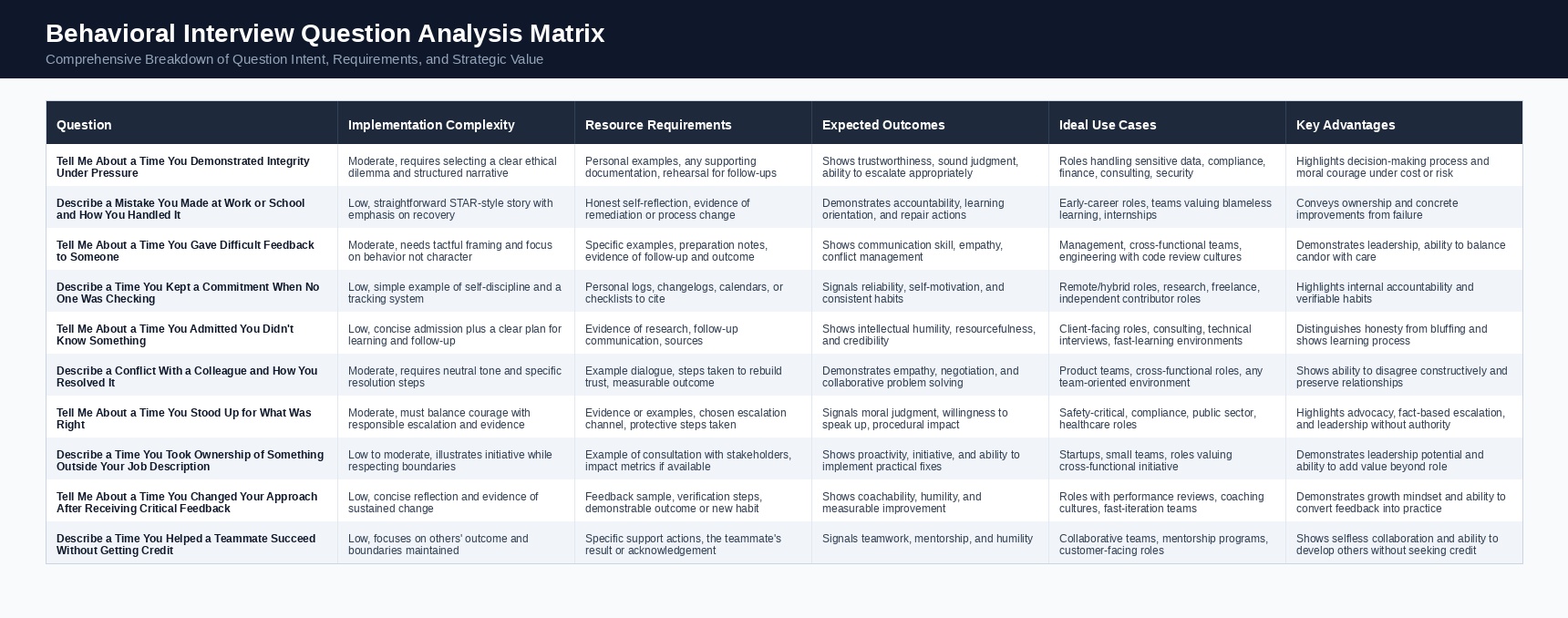
10 Character Interview Questions Comparison
Turn Your Character Stories Into a Reusable Story Bank
You don't need ten completely separate stories to prepare for interview questions about character. Choose three strong experiences from work, school, volunteering, internships, or community projects, then map each one to a different character competency.
Start with one story about integrity, one about accountability, and one about teamwork. Your integrity story might involve protecting accurate information or following a rule when doing so was inconvenient. Your accountability story could show how you handled a mistake and changed your process. Your teamwork story might involve conflict, feedback, coaching, or helping someone else succeed.
Write each story in STAR order, but don't memorize a script. Record the situation, the responsibility you carried, the decision you made, the actions you personally took, and the result. Then add the lesson or behavior you carried forward. Interviewers often ask what you'd do differently, so include one honest reflection rather than ending at the outcome.
Create short memory cues for every story. A cue might read: outdated data, night before, rebuilt slide, source checklist, presented on time. Those words can bring back the sequence without forcing you to reproduce exact sentences. They also reduce the risk of mixing details between similar examples.
Practice the follow-ups, not only the opening question. For an integrity story, prepare for “Who was affected?” and “What alternatives did you consider?” For a mistake story, prepare for “When did you realize it?” and “What changed afterward?” For a conflict story, prepare to explain the other person's perspective fairly.
Structured preparation is especially useful if you freeze under pressure, speak English as an additional language, or need more time to organize a response. It can also help neurodivergent candidates demonstrate character through concrete work evidence instead of relying on rapid recall, eye contact, or polished social performance. The goal isn't to sound rehearsed. It's to make your real experience accessible when the question arrives unexpectedly.
Save the story names, actions, outcomes, and follow-up cues in Qcard at qcardai.com. Keep the notes tied to your verified experience, then practice answering in your own words. Before the interview, review the three stories and identify which one best fits the role's priorities, whether that's compliance, client trust, resilience, collaboration, or judgment.
Finish by asking yourself one practical question: What did I do when the easy choice stopped being the responsible one? Your answer is usually the strongest material you have for character questions.
Key Takeaways
- Character answers need a decision with a consequence, not a claim about values — integrity stories only land when the right choice cost time, status, convenience, or a relationship, which is why “I raised the discrepancy privately, documented the correct figures, and asked the instructor to review them” works where “I always do the right thing” doesn’t.
- Describe behavior rather than character, especially in feedback and conflict stories — “the submission lacked tests” gives the interviewer evidence while “they were careless” only reveals your interpretation, and a conflict story that turns the other person into a villain signals less maturity than one showing curiosity and a practical compromise.
- The system behind the behavior is the proof — a changelog reviewed weekly, a source-check step added to a shared checklist, a naming convention tested with two colleagues — because stating you’re reliable or proactive gives an interviewer nothing to assess while naming the mechanism does.
- Coachability is demonstrated by a changed method, not a gracious reaction — include the uncomfortable first instinct (“I wanted to defend the detail”), then the decision to seek evidence (“I asked for two examples of what worked”), then the specific change that followed and whether it stuck.
- Three well-mapped stories beat ten memorized ones — one integrity story, one accountability story, one teamwork story can cover most character prompts, and short cue sequences (“statistics, classmate’s dataset, three evenings, stepped back, top marks”) prevent you from mixing details between similar examples under pressure, which matters most for candidates who freeze, speak English as an additional language, or need more time to organize a response.
Qcard helps you turn verified experience into concise memory cues for character-focused interview answers, with AI-scored practice and mock interviews that use intelligent follow-ups. Build a resume-grounded story bank and rehearse your STAR examples naturally by visiting Qcard.
Ready to ace your next interview?
Qcard's AI interview copilot helps you prepare with personalized practice and real-time support.
Try Qcard Free